The Life of David - Part 8
“More Assassinations”
Copied from the Sermon notes of Pastor Don Elmore
November 8, 2026
2 Samuel 3:13:
13) “And he [David] said, Well; I will make a league with thee [Abner]: but one thing I require of thee, that is, Thou shalt not see my face, except thou first bring Michal Saul’s daughter, when thou comest to see my face.”
To give a quick review from the end of Part Seven, Abner and Ishbosheth had a major disagreement over Abner’s sexual relations with Rizpah, one of king Saul’s concubines. Ishbosheth was the son of King Saul and Rizpah, Saul’s concubine, who had two sons by Saul, became famous later on in the story of David’s life. We will cover that story when we get to it in our bible exposition.
As a result of this bitter argument, Abner surprisingly said he would no longer be loyal to Ishbosheth and his kingdom but would go to David to merge the two kingdoms into one. In many places in the Near East, taking a former ruler’s wife or concubine was a symbolic claim to the throne. This possibly caused Ishbosheth to see Abner’s action as a treasonous power grab.
Abner denied or resented the charge, feeling deeply insulted after serving and protecting Saul’s house. Angered by Ishbosheth’s challenge, Abner swore to transfer the kingdom of Israel over to David effectively collapsing Saul’s remaining dynasty.
Possibly the key is to recognize that Abner, Saul’s uncle, was a powerful and older general who looked down on Ishbosheth, Saul’s son, who was a mere puppet to achieve Abner’s own goals. At some point Abner may have just lost his patience with “the puppet kid” acting like a fearful King. His disgust manifested itself in serving his own lust while insulting him.
This act of Abner seems then to have solidified his real desire with just switching sides in the war. Abner defected to David by showing that his offence was not in the ambition to steal the throne, but simply to offend for the pleasure of it and join the forces of a more respectable King.
When Abner requested a meeting with David, David agreed. But he requested one thing. Abner had to bring Michal, Saul’s daughter, who was his first wife, but who had been given to another, and if he did, they would discuss the merger.
2 Samuel 3:14-16:
14) “And David sent messengers to Ishbosheth Sauls’ son, saying, Deliver me my wife Michal, which I espoused to me for an hundred foreskins of the Philistines.
15) And Ishbosheth sent and took her from her husband, even from Phaltiel the son of Laish.
16) And her husband went with her along weeping behind her to Bahurim. Then said Abner unto him, Go, return. And he returned.”
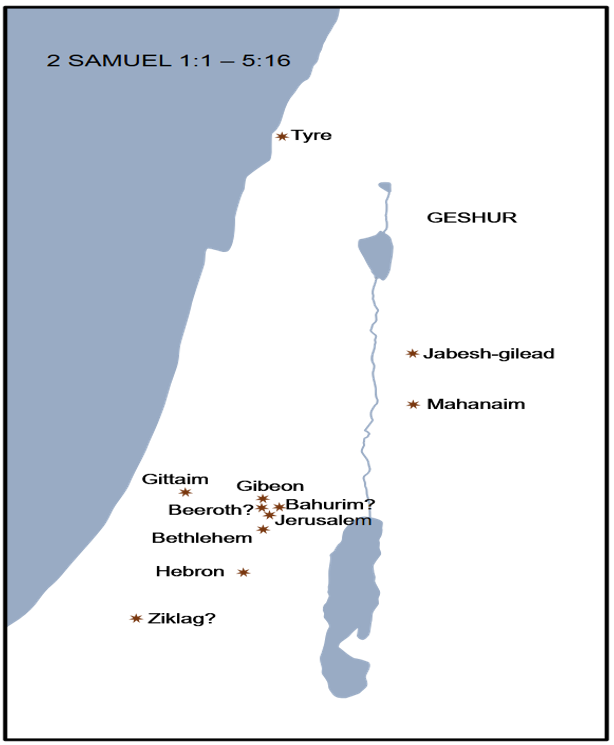
Where is Bahurim? It was very close to Hebron (30 miles southwest of Jerusalem) where Abner was going to have the meeting with David.
King Ishbosheth acted immediately at David’s request and took Michal from her present husband, Phaltiel, and sent her to David. Saul had taken his daughter, after driving David away from her (she was David’s first wife), and had given her to Phaltiel to be his wife.
What another strange, bizarre case. Michal was first offered to David by King Saul after he achieved military fame. Saul demanded 100 Philistine foreskins, hoping David would be killed in the attempt. David fulfilled the requirement with double the amount and married Michal.
When Saul later sent assassins to kill David, Michal defied her father, used a household idol to stage a fake sickbed, and lowered David out of a window to help him escape. While David was in hiding as a fugitive, Saul took Michal and gave her in marriage to another man named Paltiel the son of Laish. During this prolonged separation, David married other women, including Ahinoam of Jezreel and Abigail of Carmel and four others and had children by them (2 Samuel 3:1-5).
After Saul was killed in battle with the Philistines and David became king of Judah, David negotiated with Abner to unite the tribes of Israel. David made a strict condition: he would not meet with Abner unless Michal was returned to him.
Ishbosheth took Michal away from Paltiel, who followed her weeping along the road until Abner ordered him to turn back. David reclaimed her largely for political legitimacy to tie his reign to the house of Saul.
Who was Michal’s real husband? David or Paltiel? I think the answer to this case would even stump Judge Judy!
2 Samuel 3:17-19:
17) “And Abner had communication with the elders of Israel, saying, Ye sought for David in times past to be king over you:
18) Now then do it: for the LORD hath spoken of David, saying, By the hand of my servant David I [the LORD God of Israel] will save my people Israel out of the hand of the Philistines, and out of the hand of all their enemies.
19) And Abner also spake in the ears of Benjamin: and Abner went also to speak in the ears of David in Hebron all that seemed good to Israel, and that seemed good to the whole house of Benjamin.”
Abner knew that Michal had to be given back to David or the negotiations would not go on. David would not see Abner unless he got Michal back. All this seems cruel, and it was by our standards; but in those days one could demand his wife as his property as much as he could anything else which belonged to him; such was the civil law at that time.
But David had at least six wives at this time and he later added two more. David took additional unnamed wives and concubines, who bore him more children, though a total count for these extra women is never explicitly provided in Scripture. But this multiplying of wives was a violation of God’s law for it says that Israel’s king should not:
Deuteronomy 17:17a:
17a) “Neither shall he [the king of Israel] multiply wives to himself…”
David was guilty of breaking this law many times and he paid for it with much suffering from his offspring.
2 Samuel 3:20, 21:
20) “So Abner came to David to Hebron, and twenty men with him. And David made Abner and the men that were with him a feast.
21) And Abner said unto David, I will arise and go, and will gather all Israel unto my lord the king, that they may make a league with thee, and that thou mayest reign over all that thine heart desireth. And David sent Abner away; and he went in peace.”
Things are going very well. Abner, who was the head of the opposing force, was now seeking to unite the two kingdoms. All is well in Israel, finally. Well, I am sorry to tell you that it isn’t.
2 Samuel 3:22-25:
22) “And, behold, the servants of David and Joab came from pursuing a troop, and brought in a great spoil with them: but Abner was not with David in Hebron: for he [David] had sent him [Abner] away, and he was gone in peace.
23) When Joab and all the host that was with him were come, they [the men who were close to David] told Joab, saying Abner the son of Ner came to the king, and he hath sent him away, and he is gone in peace.
24) Then Joab came to the king and said, What hast thou done? Behold, Abner came unto thee; why is it that thou hast sent him away, and he is quite gone?
25) Thou knowest Abner the son of Ner, that he came to deceive thee, [David] and to know thy going out and thy coming in, and to know all that thou doest.”
It seems that many bands of men from all nations round about made raids on their neighboring countries taking all the spoil they could. David did this while he was living in Ziklag. Perhaps this troop had invaded Judah. Joab and his men pursuing and bring back the spoil they had taken from Judah and other places, for they brought back a great spoil.
Abner had been to see David, bringing Michal with him, and laying the groundwork for the uniting of the two kingdoms. Abner had been gone from David for some time when Joab came back from pursuing the troop. Upon hearing that Abner had been there and David had permitted him to depart in peace, Joab becomes incensed and protesting, accusing Abner of spying on Judah to make war.
2 Samuel 3:26, 27:
26) “And when Joab was come out from David, he sent messengers after Abner, which brought him again from the well of Sirah: but David knew it not.
27) And when Abner was returned to Hebron, Joab took him aside in the gate to speak with him quietly, and smote him there under the fifth rib, that he died, for the blood of Asahel his brother.”
David was not aware of Joab’s plot to kill Abner. Joab sent a message to Abner, probably in David’s name, to return to Hebron for more discussion. Joab took Abner into a private place and then surprised him when he smote him under his fifth rib, killing him. He did this for the murder of his brother that occurred several years in the past.
2 Samuel 3:28-30:
28) “And afterward when David heard it he said, I and my kingdom are guiltless before the LORD forever from the blood of Abner the son of Ner:
29) Let it rest on the head of Joab, and on all his father’s house; and let there not fail from the house of Joab one that hath an issue, or that is a leper, or that leaneth on a staff, or the falleth on the sword, or that lacketh bread.
30) So Joab, and Abishai his brother slew Abner, because he had slain their brother Asahel at Gibeon in the battle.”
The murder was one of the most unprovoked and wicked in history, but the influence of the murderers in the army of David was so great that the king dared not bring them to justice. Of course, Abishai and others were involved in the plot, and to deal with all of them would have probably caused a war between the two kingdoms once again. So, David merely committed the situation to God!
2 Samuel 3:31-39:
31) “And David said to Joab, and to all the people that were with him, Rend your clothes, and gird you with sackcloth, and mourn before Abner. And king David himself followed the bier.
32) And they buried Abner in Hebron: and the king lifted up his voice, and wept at the grave of Abner; and all the people wept.
33) And the king lamented over Abner, and said, Died Abner as a fool dieth?
34) Thy hands were not bound, nor thy feet put into fetters: as a man falleth before wicked men, so fellest thou. And all the people wept again over him.
35) And when all the people came to cause David to eat meat while it was yet day, David sware, saying, So do God to me, and more also, if I taste bread, or ought else, till the sun be down.
36) And all the people took notice of it, and it pleased them: as whatsoever the king did pleased all the people.
37) For all the people and all Israel understood that day that it was not of the king to slay Abner the son of Ner.
38) And the king said unto his servants, Know ye not that there is a prince and a great man fallen this day in Israel?
39) And I am this day weak, though anointed king; and these men the sons of Zeruiah be too hard for me: the LORD shall reward the doer of evil according to his wickedness.”
David told Joab and all the people with him to tear their clothes and mourn for Abner. David and the people wept at his grave in Hebron. David lamented over Abner and all the people wept again. Then David made a vow to not eat until sundown, and all the people accepted this because they knew that David was not guilty for the act of the murder of Abner. Who was it that said that real men don’t ever cry?
David had adverted another tough situation. What would happen next? What would king Ishbosheth do now? His top general was now dead.
2 Samuel 4:1-3:
1). “And when Saul’s son heard that Abner was dead in Hebron, his hands were feeble, and all the Israelites were troubled.
2) And Saul’s son had two men that were captains of bands: the name of the one was Baanah, and the name of the other Rechab, the sons of Rimmon a Beerothite, of the children of Benjamin: (for Beeroth also was reckoned to Benjamin.
3) And the Beerothites fled to Gittaim, and were sojourners there until this day.)”
After the news of Abner’s death spread to the land of Israel, all the Israelites (all the tribes except for Judah) were troubled. The next few verses tell us about Saul’s sons.
2 Samuel 4:4-7:
4) “And Johathan, Saul’s son had a son that was lame of his feet. He was five years old when the tidings came of Saul and Jonathan out of Jezreel and his nurse took him up, and fled: and it came to pass, as she made haste to flee, that he fell and became lame. And his name was Mephibosheth.
5) And the sons of Rimmon the Beerothite, Rechab and Baanah, went, and came about the heat of the day to the house of Ishbosheth, who lay on a bed at noon.
6) And they came thither into the midst of the house, as though they would have fetched wheat; and they smote him under the fifth rib: and Rechab and Baanah his brother escaped.
7) For when they came into the house, he lay on his bed in his bedchamber, and they smote him, and slew him, and beheaded him, and took his head, and gat them away though the plain all night.
Is this God’s nation? Mephibosheth, one of Saul’s sons became a cripple when they heard the news of Saul’s and Jonathan’s death. He would be twelve years old now. He was lame so he was hindered in doing any fighting for his father or for Ishbosheth’s throne.
Two Benjaminites, who were leaders of Ishbosheth’s bands, came into the house where Ishbosheth was laying on his bed, to act like they were gathering some wheat. It was customary to get wheat in the afternoon for grinding the next day, so they avoided suspicion of any wrongdoing. Ishbosheth was taking his daily nap after the noon meal when the men, pretending to go into the granary for wheat, gained access to his apartment and killed him. Putting his head in a wheat sack as though carrying out wheat, they escaped and traveled all night.
So, the most powerful man in the kingdom of eleven tribes of Israel, Abner, was assassinated. And the king of this kingdom, Ishbosheth, was also assassinated. What were the two men from Benjamin going to do with their king’s head?
2 Samuel 4:8:
8) “And they brought the head of Ishbosheth unto David to Hebron, and said to the king, Behold the head of Ishbosheth the son of Saul thine enemy, which sought thy life: and the LORD hath avenged my lord the king this day of Saul and of his seed.”
They brought the king of the eleven tribes’ head to David in Hebron. The only son left of Saul was his twelve-year-old son who was a cripple. Do you think that the assassins wanted a reward for killing David’s enemy?
2 Samuel 4:9-12:
9) “And David answered Rechab and Baanah his brother, the sons of Rimmon the Beerothite, and said unto them, As the LORD liveth, who hath redeemed my soul out of all adversity.
10) When one told me, saying, Behold, Saul is dead, thinking to have brought good tidings, I took hold of him, and slew him in Ziklag, who thought that I would have given him a reward for his tidings:
11) How much more, when wicked men have slain a righteous person in his own house upon his bed? shall I not therefore now require his blood of your hand, and take you away from the earth?
12) And David commanded his young men, and they slew them, and cut off their hands and their feet, and hanged them up over the pool in Hebron. But they took the head of Ishbosheth, and buried it in the sepulcher of Abner in Hebron.”
The two assassins were surprised at what David said. The king of Judah told them of what the Amalekite said, when he brought the crown and bracelet to David, that he had killed Saul. David had him executed. How much more should David do to the two men who slew Saul’s son while he was napping in his bed. He ordered their execution too.
The hands that assassinated Ishbosheth and the feet that carried his head were cut off and hung over the pool in Hebron. This was done, not only to punish the murderers, but to show David’s abhorrence of the crime. The head of Ishbosheth was buried in Abner’s tomb.
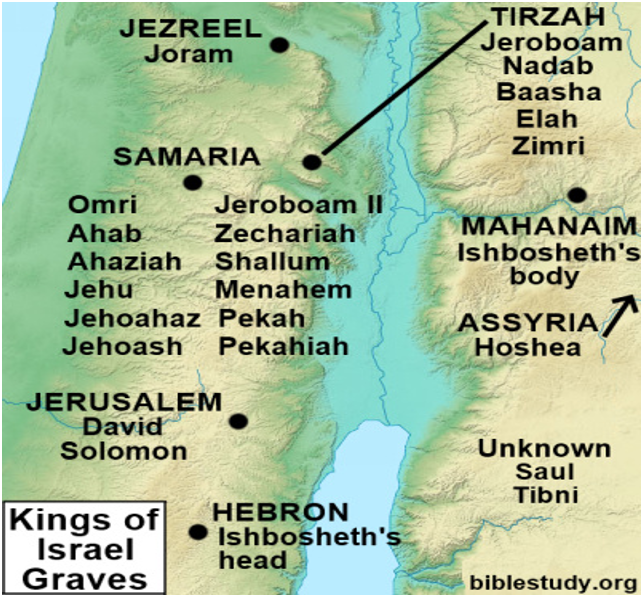
The top general and the king of the Israelites (11 tribes) both were assassinated. The general of the larger Israelite kingdom by the head general of the kingdom of Judah, Joab, and the king by two of his own people. The two men who assassinated Ishbosheth were executed. Notice how quickly the executions took place. How can capital punishment be a deterrent if it doesn’t take place until the murderer is executed between twenty to forty years? David ordered the executions right away.
2 Samuel 5:1-3:
1). “Then came all the tribes of Israel to David unto Hebron, and spake, saying, Behold, we are thy bone and thy flesh.
2) Also in time past, when Saul was king over us, thou wast he that leddest out and broughtest in Israel: and the LORD said to thee, Thou shalt feed my people Israel, and thou shalt be a captain over Israel.
3) So all the elders of Israel came to the king to Hebron; and king David made a league with them in Hebron before the LORD: and they [elders of Israel] anointed David king over Israel.”
After the assassination of their king, Saul’s son, and the execution of his murderers, the elders of all the other tribes of Israel came to David in Hebron and made a covenant with him, anointing David king over all of Israel. The kingdom was finally one nation after seven and a half years of being a divided kingdom with two different kings and government.
2 Samuel 5:4, 5:
4) “David was thirty years old when he began to reign, and he reigned forty years.
5) In Hebron he reigned over Judah seven years and six months: and in Jerusalem he reigned thirty and three years over all Israel and Judah.”
David was finally king over all Israel. It only took about fifteen years from the time he was anointed by Samuel to be king that he became the king of all Israel. His own people fought against this anointing for over a decade.
One of the first things that David decided to do was to move the capital from Hebron to Jerusalem to be more centrally located. Jerusalem was controlled by the Jebusites ever since Israel had conquered most of Canaan land.
2 Samuel 5:6-10:
6) “And the king and his men went to Jerusalem unto the Jebusites, the inhabitants of the land: which spake unto David, saying, Except thou take away the blind and the lame, thou shalt not come in hither: thinking, David cannot come in hither.
7) Nevertheless David took the strong hold of Zion: the same is the city of David.
8) And David said on that day, Whosoever getteth up to the gutter, and smiteth the Jebusites, and the lame and the blind, that are hated of David’s soul, he shall be chief and captain. Wherefore they said, The blind and the lame shall not come into the house.
9) So David dwelt in the fort, and called it the city of David. And David built round about from Millo and inward.
10) And David went on, and grew great, and the LORD God of hosts was with him.”
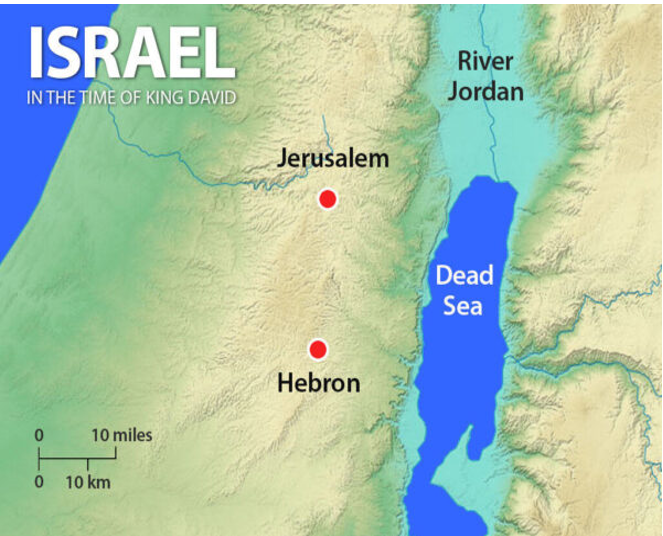
The lame and the blind which the Jebusites taunted David meaning that the lame and the blind will keep David’s forces out, for the defenses of the Jebusites were so strong. They were hated of David’s soul and as a result he promised that whosever would go up first and smite the Jebusites and these “blind and lame defenders” would be chief.
2 Samuel 5:11, 12:
11) “And Hiram king of Tyre sent messengers to David, and cedar trees, and carpenters, and masons: and they built David an house.
12) And David perceived that the LORD had established him king over Israel, and that He had exalted His kingdom for His people Israel’s sake.”
This would be a good Bible trivia question: Who built David his house when he became king of Israel? The answer would be Hiram, king of Tyre. The king of Tyre supplied carpenters, masons, cedar, and bricks. God was exalting the Kingdom of Israel.
2 Samuel 5:13-16:
13) “And David took him more concubines and wives out of Jerusalem, after he was come from Hebron: and there were yet sons and daughters born to David.
14) And these be the names of those that were born unto him in Jerusalem; Shammuah and Shobab, and Nathan, and Solomon.
15) Ibhar also, and Elishua, and Nepheg, and Japhia,
16) And Elishama, and Eliada, and Eliphalet.”
How many wives and concubines and children did David have? What was the purpose of his multiplying wives? This sin cost David much suffering as some of his own children revolted against his rule.
2 Samuel 5:17-21:
17) “But when the Philistines heard that they had anointed David king over Israel, all the Philistines came up to seek David; and David heard of it, and went down to the hold.
18) The Philistines also came and spread themselves in the valley of Rephaim.
19) And David inquired of the LORD, saying, Shall I go up to the Philistines? Wilt thou deliver them into mine hand? And the LORD said unto David, Go up; for I will doubtless deliver the Philistines into thine hand.
20) And David came to Baalperazim, and David smote them there, and said, the LORD hath broken forth upon mine enemies before me, as the breach of waters. Therefore he called the name of that place Baalperazim.
21) And there they left their images, and David and his men burned them.”
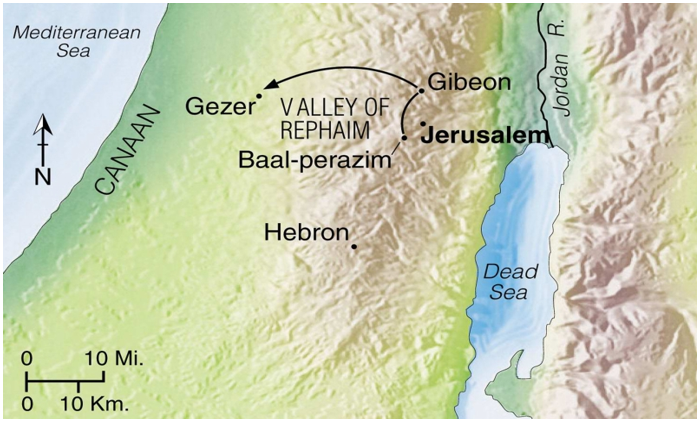
I wonder what the Philistines thought when they had David in their hands and let him go twice. Back in those days, it was the Philistines versus the kingdom of Saul (11 tribes of Israel) and now, the fugitive that was in the city of Gath for a while was the king over all of Israel (12 tribes)!
How many different times did the Philistines and the Israelites fight against each other? This time the Philistines came and were spread out in the valley of Rephaim or the valley of the Giants. These were giants who lived in this valley. There were other giants in the area too, like Nephilim, Zuzim, Emim, and Anakim.
But what is the one advantage that Israelites have over every other nation? It is that the LORD God of Israel is on the side of the Israelites and He will at some time show His lovingkindness to them. God will always honor the covenant that He had made with Abraham, Isaac, Jacob, and his seed even if the recipients are unfaithful and disobedient.
David inquires of the former king of Israel (God) and asks Him, “Shall I go up and meet the Philistines in battle?” And the LORD God answered, “Go up. I [the LORD God of Israel] will deliver them into your hand.”
The LORD God Israel delivers the Philistines once again into David’s hand. What happened next?
2 Samuel 5:22:
22) “And the Philistines came up yet again, and spread themselves in the valley of Rephaim.
The Philistines came up to fight the Israelites again with a larger army than before and spread themselves once more in the valley of the giants where the second battle was fought.
2 Samuel 5:23-25:
23) “And when David enquired of the LORD, he said, Thou shalt not go up, but fetch a compass behind them, and come upon them over against the mulberry trees.
David once again inquires of the LORD by the Urim and Thummim by the high priest. What does “fetch a compass behind them” mean?
To fetch a compass meant to go around the Philistines until they were behind the Philistines to attack them over against the grove of mulberry trees on the other side.
2 Samuel 5:24, 25:
24) “And let it be, when thou hearest the sound of a going [a clashing together, Septuagint] in the tops of the mulberry trees, that then thou shalt bestir thyself: for then shall the LORD go out before thee, to smite the host of the Philistines.
25) And David did so, as the LORD had commanded him; and smote the Philistines from Geba until thou come to Gazer.
When David got behind the army of the Philistines, he was not to attack them until the very moment he heard a sound on the tops of the mulberry trees. It was the sound of a mighty army on the march, which struck terror to the Philistines and caused them to be confused and panic stricken.
Perhaps it was the sound of the noise of horses’ hoofs, which maybe made the Philistines think the David was before them and maybe another army was suddenly behind them. This other army was perhaps helping David’s army. The Philistines would have thought that they were surrounded. So, they fled immediately and were pursued.
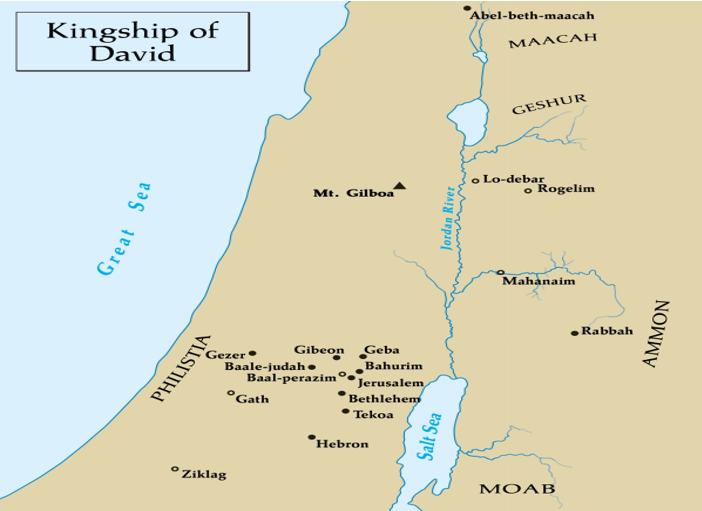
How is the nation of God doing now? I would say that it is doing the best that it has in the life of David so far. They are now one kingdom, and they have had victories in two battles against the Philistines. They have survived the many assassinations that have occurred.
What will happen next? To be continued in part nine.
Blessed be the LORD God of Israel.