German Defeat in WWII
Treason and Sabotage = German Defeat in WWII
by Harald Zieger
May 10, 2026
Scripture Reading: 2nd Corinthians Chapter 10:4-6
4) For the arms of our warfare are not fleshly, but through Yahweh they are able to destroy strongholds, 5) destroying reasonings and every bulwark, raising itself up against the knowledge of Yahweh, and taking captive every thought into obedience of the Anointed; 6) also being in readiness to avenge all disobedience whenever you shall have fulfilled your obedience
Betrayal on the Eastern Front (Part 1)
As in Normandy in 1944, there was also well-organized betrayal and systematic sabotage by high-ranking German officers on the Eastern Front. In the first volume, Friedrich Georg outlines why the final victory was not secured. Did the individual acts of sabotage contribute significantly to the German defeat in 1945? Who were these people who spared nothing in their power and region of influence to destroy the National Socialist Movement to re-install the so-called Democracy of the Weimar Republic, the den of iniquity and decay, out of which Hitler and the NSDAP had restored a cultural and racist clean country?
There was the General Staff Officers, such a General Ludwig Beck, without doubt men highly qualified in their fields, sat hunched over the battle plans and waited in cold hatred for their learned understanding of warfare to gain him just ascendancy over that outsider, Hitler — they despised, that corporal from the war, where they were already accomplished leaders
Claus von Stauffenberg went to work — without having even the foggiest idea of what was to become of Germany after his success. The pious officer and jurist Fabian von Schlabrendorff dreamed up a ‘state under the sway of a lawless régime’ to justify his bomb, without, however, feeling obliged today to fight against the injustices of the victors.
The theologians, such as Dietrich Bonhoeffer, who spent the war years praying to their dogmatically, clear-cut false God, the god of those whom Jesus called the seed of the devil, for the defeat of their own people, which could result in nothing other than godlessness and the chaotic world we have today.
They were joined by all those strictly-Catholics, strictly-Protestants, strictly-unionists, strictly scientists who were of little significance themselves, but who had strategic intellectual influence, who saw their restful self-sufficiency threatened, and thus may well have honestly believed that they would ‘save everything’ by helping to wreck it all.
Nothing remained secret or there was a systematic leakage of state & military secrets during the reign of the National Socialist Workers Party.
Friedrich Georg answers, among other things, the following questions in his first 2 books: VERRAT AN DER OSTFRONT Parts 1 & 2.
To whom did a future star diplomat betray crucial details about the Hitler-Stalin Pact even before the outbreak of war?
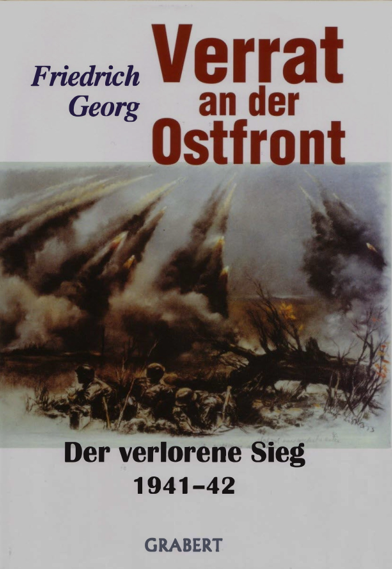 What was behind the inadequate German preparations for the Eastern Campaign?
- "Storm" against "Barbarossa": Did Stalin not really react to the numerous warnings and reports of betrayal before the German attack?
- From what point did Hitler know that the German attack date forBarbarossa had been betrayed?
- What significance did Russian telephone cables have for the initial German successes?
- Why were the German flamethrower tanks and giant guns not used effectively in the fighting around the Lviv salient?
- Why did the German advance stall for several weeks in late July and early August 1941?
- How was it possible that Moscow was informed about important German attack plans more quickly than the German front commanders?
- Why did Luftwaffe officers armed with submachine guns travel on supply trains in 1941 and 1942?
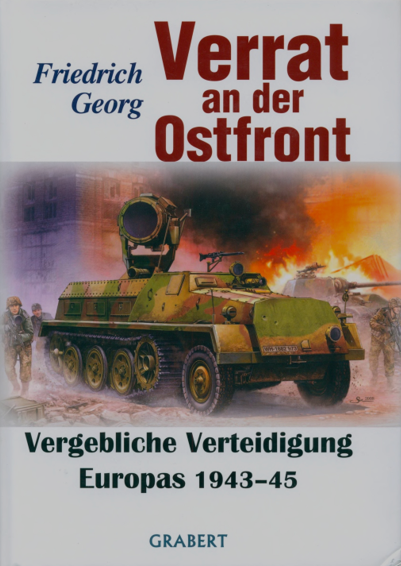
- Were winter uniforms intended for the Eastern Front actually blocked on the railway or delivered to Africa?
- Did the decisive Red Army counteroffensives before Moscow and Stalingrad come as a surprise to German intelligence?
- Why was the textile industrialist Josef Neckermann secretly drafted into the Wehrmacht under cover of darkness?
- With which thwarted technology could the Allied air forces in the East and West have been rendered obsolete as early as 1942?
- How did Admiral Canaris use the communist spy organization "Red Orchestra" for his own purposes?
- What secret remains undiscovered at the former Führer Headquarters in Vinnytsia (Ukraine)?
- Was the introduction of the new heavy Tiger tank to be thwarted in 1942?
- What crucial role did Generals Fellgiebel, Oster, Thomas, Haider, and Gehlen play in the first phase of the invasion of Russia?
- Who prevented Germany from exploiting the oil fields of the Caucasus?
- What role did insubordination and deception at the highest levels play in the loss of the Battle of Stalingrad?
- Could the encirclement of Stalingrad have been prevented on multiple occasions?
- Was the air supply to the starving population in Stalingrad artificially disrupted?
- Were there repeated Russian peace feelers from the summer of 1941 onward, and why did nothing come of them?
- The Russian "Miracle of the Marne": Who prevented the Wehrmacht from capitalizing on Manstein’s great victory at Kharkiv in 1943?
- Why was General Dietl forbidden from capturing the Arctic port of Murmansk in 1943, thereby cutting the Soviet Union off from vital Western Allied supplies?
- Did the Luftwaffe detect the trap at Kursk? And why did the Germans fail to react?
- Was an intelligence failure behind the German near-victory on the southern flank at Kursk?
- Were the mysterious plane crashes involving high-ranking Generals mere coincidences or part of a larger conspiracy?
- Who prevented the Wehrmacht from being equipped with helicopters?
- Did the agent codenamed "Werther"— allegedly operating within the Führer Headquarters — exist actually, or was the entire story a fabrication?
- Were over 600,000 reinforcements—intended for the fighting fronts—deliberately held back in the German homeland during the spring of 1944?
- Could direct communication links between the Führer Headquarters and the Allied powers ever be substantiated?
- Why were combat-ready German bomber squadrons forbidden from waging a strategic air campaign against the Soviet Union’s highly vulnerable key industries?
- Was General Gehlen’s intelligence service— "Foreign Armies East” the secret undoing of the German Army in the East?
- Did the German Ambassador to Romania, Baron von Killinger, know months in advance about the defection of the Reich’s most vital oil supplier?
- Is it true that, on multiple occasions in 1943 and 1944, massive Luftwaffe detachments were withdrawn from threatened front sectors just prior to decisive battles in the East?
- How was a solution to Germany’s critical supply problems deliberately thwarted?
- Why did the Soviets begin designing tank destroyers equipped with exceptionally long barreled guns starting in 1944?
- Were there instances of forged "Führer Orders" that resulted in catastrophic consequences?
- The Best Tanks of the War, or: What Is the Story Behind the "King Tiger" Grave on the Vistula?
- Did Stalin know about the planned final German offensive, Operation *Frühlingserwachen* (Spring Awakening) in Hungary, even before the German front commanders did?
- Are the reports true that former German prisoners of war actively fought on the Russian side, or did they merely engage in propaganda?
- Who opened the gates to Austria for Stalin?
- From whom did Stalin receive timely intelligence regarding the German atomic bomb tests in Thuringia?
- Who prevented the potential deployment of these "wonder weapons" on the Eastern Front?
- Who bears responsibility for the fact that, in the post-war period, numerous leading members of the anti-communist resistance were liquidated across Germany?
All these questions are thoroughly investigated, and facts from archives, battle reports, and intelligence reports of the Allies and the Axis are used to find answers. Most often, the documents that could provide clear answers are either destroyed or access to them is forbidden for Germans (see printout).
The real catastrophe was the unbelievable treason surrounding the D-Day landing, and the last nail in the coffin for the defense of the Deutsche Reich.
The first question we want to try to answer is this one:
To whom did a future star diplomat betray crucial details about the Hitler-Stalin Pact even before the outbreak of war?
On August 23, 1939, Germany and the Soviet Union concluded the German-Soviet Pact. The intriguing aspect of this treaty was a secret supplementary protocol, which stipulated the division of Poland into spheres of influence between Germany and the Soviet Union.
On August 24, 1939, around two o'clock in the morning, Reich Foreign Minister Joachim von Ribbentrop telephoned Hitler to report the conclusion of the German-Soviet Non-Aggression Pact. It was regarded worldwide as a sensation.
Herwarth von Bittenfeld (Agent Johnny) had handed over a copy of the secret supplementary protocol to the US diplomats stationed in Moscow, George F. Kennan, Charles Bohlen, and Charles Thayer.
The US diplomats had already forwarded the contents to Washington on August 24, around noon, via a coded telegram.
Herwarth von Bittenfeld justified his act of betrayal in his bestselling memoirs, *Between Hitler and Stalin* by arguing that he had proceeded on the assumption that the USA would immediately inform England and France as well. However, the Americans had no intention of passing this extremely important piece of intelligence on to the English, the French, or the Poles.
However, English post-war sources reported that von Bittenfeld had simultaneously provided the British with a copy of the German-Soviet Pact. Presumably, von Bittenfeld simply forgot to mention this in his memoirs.
In mid-August 1940, while in France, von Bittenfeld learned from his cousin, Colonel Bernhard von Lossberg, that Hitler had ordered the preparation of a study for a possible attack on Russia. Naturally, this directive was strictly secret and known to only a very few high-ranking officers.
In the autumn of 1940, the former diplomat Herwarth von Bittenfeld, availing himself of his diplomatic passport, which he had simply retained, and with the express permission of the commander of his cavalry regiment, traveled to Moscow to purchase caviar. To this end, the officer transformed himself in Warsaw into a civilian and diplomat before setting off by train. It was in this manner that the Americans in Moscow learned of Hitler's highly secret plans.
At the turn of the year 1940–41, Herwarth von Bittenfeld was in Berlin, where, serving as a Russian interpreter at the Reich Ministry of Aviation (RLM), he assisted Chief Engineer Dietrich Schwenke in analyzing studies on
Soviet air armaments. He immediately passed on to the Americans in Berlin everything he learned there, including information derived from classified documents.
One might be led to believe that the cases of "Agent JOHNNY"—as well as that of the German Ambassador to Moscow, von der SCHULENBURG, mentioned below—were isolated incidents.
However, in reality, Ernst von WEIZSÄCKER and numerous other high-ranking officials at the Foreign Office in Berlin devoted a portion of their working hours—even during the pre-war period—to sending messages, intelligence, and proposals abroad that bore no relation to official policy. These diplomats also exchanged information with Admiral Canaris's *Abwehr*.
It was not only the British who, within a matter of days, learned of Hitler’s Directive No. 21 through an act of betrayal. It subsequently came to light that, in early January 1941, a carbon copy of the authentic "Barbarossa" Directive—dated December 18, 1940— was handed to the American Commercial Attaché, Sam E. Woods, by a high-ranking German official in a darkened Berlin cinema. To this day, the Americans have kept secret the name of this man, known as an "anti-Nazi."
Even before the commencement of >Operation Barbarossa<, Helmuth James Count von Moltke—head of the >War and International Law< Department within the High Command of the Wehrmacht—had, in a memorandum dated April 24, 1941, characterized Germany's defeat as certain and absolutely necessary. However blatant the betrayal of the attack plans by Canaris and von Bittenfeld may appear, it is merely a part of a larger narrative. According to Valentin Falin, the former Soviet Ambassador to Bonn, Soviet military intelligence—the GRU—received more than 120 reports by June 1941 alone regarding Hitler’s intention to wage war against the Soviet Union.
Why Hitler Was Faster Or How Did Stalin React to the Reports of German Betrayal?
To this day, politically correct historiography still attempts to claim that peace-loving Soviet Union was completely taken by surprise by the German attack on June 22, 1941.
The "peaceful victims" then, naturally, had to defend themselves and liberate the world from the criminal dictator Hitler, by May 8, 1945.
In fact, the numerous intelligence reports regarding German intentions did not go without consequences for the Soviets. The problem, however, was that STALIN became confused by the sheer volume of incoming reports (120) and increasingly doubted their veracity, as the reported dates passed without the predicted attack. This was, however, due to the fact that the German attack dates had to be repeatedly postponed.
Contrary to the accusation still frequently leveled today—that Stalin had sunk into a state of virtually suicidal passivity in the spring of 1941, the Russian dictator was, in fact, acutely aware of the grave danger.
Since the collapse of the old Soviet Union and the— yet only partial—opening of the Russian archives, it has become clear what had been asserted in hushed tones for decades. It is now more or less proven that Stalin was, in fact, preparing an attack on Germany. In 1990, a document came to light that was subsequently published in the journal of the Russian General Staff. This document consists of a deployment plan for the Red Army, drafted by General Alexander Vasilevsky and dated May 15, 1941.
It is signed by the Soviet Minister of War, Timoshenko, and the Chief of the General Staff, Zhukov. Only a single copy of this document existed, and it was intended for Stalin. It was not until Japanese Foreign Minister Yosuke Matsuoka visited Moscow and signed a neutrality pact with Russia in April 1941 that Stalin set in motion the final preparations for a preemptive strike against Germany.
This took place between April 15 and May 5, 1941. Beginning in April 1941, a massive concentration—carried out with the utmost haste—of the 247 divisions designated for deployment against Germany commenced in the future theater of war. These divisions accounted for 81.5 percent of the Red Army's total personnel strength.
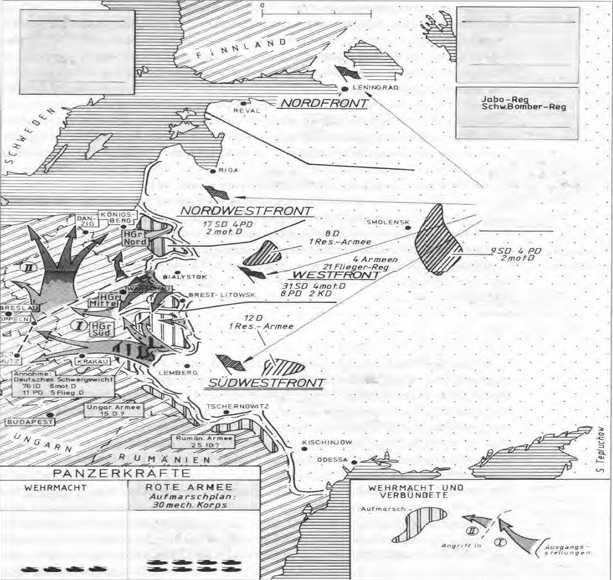
The Red Army and the German Wehrmacht demonstrably massed for attack in parallel. Whoever struck first would plunge the opponent's deployment and war plans into chaos and seize the strategic initiative—a move that was bound to yield decisive advantages for the subsequent course of the war.
How Germany Prepared for the Eastern Campaign
In all likelihood, no campaign has ever been launched with such negligence. Underlying many of the German errors in the preparation and execution of "Barbarossa" was an incredible underestimation of Russian strength. To this day, the truth of how this came about is not to be brought to light. Did Chief of the General Staff Halder not really know any better?
On January 17, 1941, during a meeting at the Reich Chancellery with Hitler and Walter von Brauchitsch, the Chief of the General Staff, General Franz Halder, expressed great optimism about the combat strength of the Red Army. He claimed it possessed obsolete equipment— and, above all, few aircraft and old tanks.
As has only come to light in recent years, German intelligence services on the Eastern Front—despite strict Soviet secrecy- learned significantly more than has generally been assumed until now. Indeed, German intelligence regarding Russia prior to the outbreak of the war was precise, comprehensive, and timely. The German General Staff ignored it all from the beginning. However, in contrast to the operational advantage the Allies derived from their advance knowledge gained through Ultra and espionage German intelligence had considerably less influence on the course of the war.
To this day, no one has ever been able or are willing to fully disclose the precise reasons behind this failure. Can the Operation “Documents” be related to this?
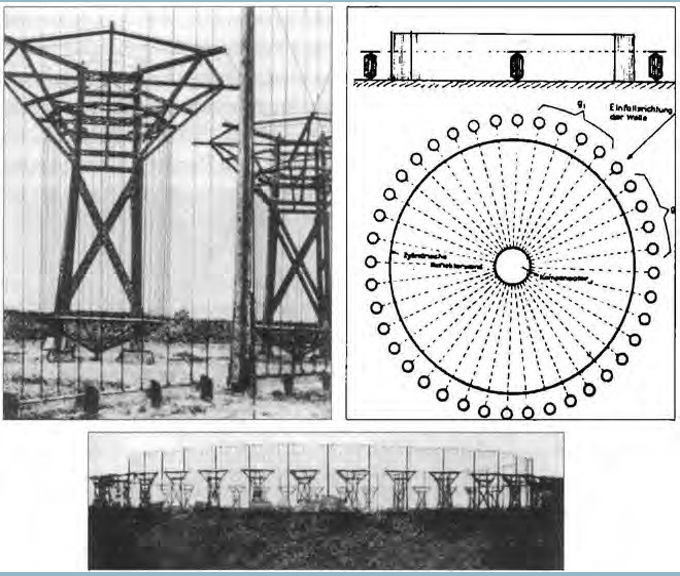
The Wullenwever circular shortwave direction finder system from Telefunken was unrivaled worldwide until the end of the war. This type of system found a successor in the USA after the war, which, to be fair, bore the name Wullenwever
The Blitzkrieg Is Squandered: Was an Aborted Coup to Blame That the Eastern Campaign Was Not Won by Germany in Summer of 1941?
During the early stages of the Second World War, the motorized units of the German Wehrmacht achieved numerous successes through the application of the *Blitzkrieg* strategy.
These triumphs—even against materially far superior adversaries—can be attributed both to the fighting troops themselves and to the astute strategies and professional expertise of their commanders. Operation *Barbarossa*, too, was conceived as a *Blitzkrieg*.
By July 10, 1941—just three weeks after the commencement of the German offensive, the Wehrmacht had already covered nearly half the distance to Moscow and Leningrad and had all but reached Kiev.
Hundreds of thousands of Soviet prisoners of war, along with colossal stockpiles of supplies, had fallen into German hands.
On July 4, 1941, Hitler declared to his inner circle: "Practically speaking, they, the Russian, has already lost the war."
By the middle of the month, the German advances had reached a point almost exactly corresponding to the projections made during the pre-campaign planning phase.
However, the gears now began to grind; preparations for the subsequent phase proceeded far more slowly than anticipated.
In **Directive No. 21 (Operation Barbarossa) ** of December 18, 1940, the general line **"Volga– Arkhangelsk"** had already been designated as the ultimate objective. The purpose was to annihilate the Red Army in western Russia, prevent its retreat into the vast Russian interior, and subsequently establish a defensive line against "Asiatic Russia." This clearly supports the thesis that Arkhangelsk and the Volga lay within Hitler's strategic horizon. ([German History in Documents and Images][1])
As early as December 1940, a conflict had been developing between Hitler and his advisors from the Army High Command regarding the objectives of the Eastern Campaign. Chief of the General Staff Franz Halder, for instance, maintained that the primary objective of the campaign must be Moscow. However, he refrained from arguing his case to his superior, Hitler, and instead worked on an operational plan that aligned with his own concept.
Wherever this plan diverged from Hitler's original blueprint, Halder simply ignored the discrepancies and proceeded as if he and Hitler were in complete agreement—even though this was far from the truth. The altered final plan for the operation Barbarossa. The white arrows show the alteration that was not in agreement with Hitlers main objectives.
The Chief of the General Staff even went so far as to have Colonel Lassberg insert misleading wording into Directive No. 21.
Consequently, when the deployment instructions and attack orders for the Army of the East were finalized in late January 1941, they deviated significantly from Hitler's intentions.
Yet Halder managed to deceitfully conceal this fact during his situational briefings.
After Hitler issued an order on June 25, 1941, regarding the conduct of operations by Army Groups Center and South, General Halder remarked, "The same old story! This changes nothing regarding our leadership."
He was effectively calling for a breach of orders when, on June 29, he wrote in his diary:
"It is to be hoped that the intermediate command echelons—even without explicit orders, which we are forbidden to issue due to the Führer’s directive to the Commander-in-Chief of the Army—will do the right thing of their own accord."
By this, he intended for their subordinates to ignore orders coming from above—orders that Halder and von Brauchitsch did not wish to support yet were powerless to prevent.
This amounts to nothing less than an attempt by the Army High Command to deceive Hitler—and at a time, moreover, when the Eastern Campaign was still proceeding entirely according to schedule.
ON A SIDE NOTE: The German Wehrmacht discovered the complete archives of the local Soviet administrative authorities—including the NKVD—covering the period from 1917 to 1939. These mountains of unsorted files were transported in their entirety to the German Reich. In 1945, they were transferred to the United States and subsequently published by Harvard University in 1957.
Then this happened:
In August 1941, during the capture of the command post of the Soviet 16th Army east of Smolensk, they discovered two complete attack plans from the OKW, as well as a copy of a recently issued order prioritizing the second plan over the first. Similarly, near Bryansk, they found a plan drafted by Chief of the General Staff Halder—a plan that had been submitted to Hitler just two days earlier but on which no decision had yet been reached.
By late July 1941, Hitler’s own grand strategy—which envisioned a massive flanking maneuver by Army Groups North and Mitte to encircle Moscow from the West-rear and East-rear, had met with resistance from the OKH and had been actively circumvented. Field Marshal von Brauchitsch and his staff, conversely, favored a direct assault on Moscow by Army Group Center under Field Marshal von Bock. Von Brauchitsch remained in Berlin and did not carry out Hitler’s orders.
Hitler had contracted a severe bout of dysentery in Masuria. For fourteen days—until mid-August—he suffered from diarrhea, stomach pains, nausea, body aches, chills, and fever. As the decisive confrontation between Hitler and his generals unfolded, his ability to assert himself was severely impaired by physical weakness.At that point, first plans to assassinate Hitler were discussed.
As early as July 30, 1941, Hitler had ordered that Army Group Center was to switch to the defensive.
This would effectively transform the center of the Eastern Front into a kind of strategic reserve for the main wings of the offensive.
Hitler’s generals now did what they were becoming increasingly accustomed to doing: ignoring the Führer, or— failing that—circumventing him at every opportunity.
A fierce dispute now erupted, during which Hitler brushed aside all the generals' arguments for capturing Moscow. When the generals realized that he was in earnest, several options remained. One of these was to obey the Führer. But there were others as well. Now, those who sought to alter the course of history by arresting Hitler entered the fray.
The focus of these conspirators lay on von Bock’s Army Group Centre—the very army group whose glorious path to Moscow had now been diverted by Hitler.
The conspirators occupied such high-ranking positions that it is unlikely von Bock himself remained uninformed of their plans. Indeed, his two leading aides also participated in planning the coup.
A Despite the urgent situation on the Eastern Front, one that demanded immediate decision-making, representatives of Army Group Centre took the time to search out other generals throughout the entire Wehrmacht for support in an uprising against Hitler.
This created a situation that was both intriguing and historically unprecedented: officers of an army, one that had until then been incredibly successful in campaigns across Europe, banded together to depose their head of state, thereby failing to press their advance against a faltering enemy.
They planned their coup d'état for August 3, 1941, when the gravely ill Hitler announced that he would leave his headquarters—the
*Wolfsschanze* (Wolf's Lair)—to visit von Bock at the headquarters of Army Group Centre in Borisov. Hitler deemed it necessary to reassure his senior generals and to persuade them to understand—or, better yet, to accept—his strategy.
He did not know, or perhaps refused to acknowledge, that his life was in danger. However, Hitler complicated the plans of the young officers intending to launch the coup by repeatedly postponing his arrival.
Von Tresckow and von Schlabrendorff intended to intercept their Commander-in-Chief during the drive from the airfield to headquarters..
But when Hitler arrived in Borisov in the early morning hours of August 4, 1941, he thwarted the officers' scheme. He declined to use a vehicle belonging to Army Group Centre; instead, he boarded a heavy Mercedes G4 staff car from his own motorcade, which he had sent ahead.
The conspirators were now unable to determine which of the nearly identical vehicles Hitler was occupying, and—reportedly—could not get close enough to shoot him during the four-kilometer drive to headquarters. The rest was left to Hitler's SS bodyguard, the same unit that had accompanied him on his public appearances during the pre-war years.
Hitler now dealt with his rebellious commanders. He questioned each one individually: Von Beck, Guderian, Hoth, and the representative of the Chief of the General Staff, Adolf Heusinger. Thus, the generals could never form a united front; their discussions with Hitler showed that they were, in fact, divided among themselves.
After the meeting with von Bock and Guderian, Hitler even spoke briefly with von Treskov about the final victory. Even now, von Treskov did not seize the opportunity for assassination that presented itself. In the afternoon, Hitler flew back to Rastenburg to his headquarters, the Wolf's Lair. But even after the conference, which was not entirely unfavorable for Hitler, Chief of the General Staff Halder and the other generals continued to stonewall.
Halder wrote in his diary that the OKH's plans for Moscow remained the same. More days passed inactively, which the Russians were able to exploit. Guderian and von Bock tried to keep the possibility of a Moscow offensive alive by keeping Roslavl and Jelnia open as a preemptive strike, an attack along the highway to Moscow.
Hitler had now clearly enough. On August 18, 1941, he issued Directive 34, attempting to end the indecisiveness and insubordination of his high commanders. According to the new directive, the main German thrust was now to be directed south. Kyiv, resource-rich Ukraine, and the Caucasus were to be reached.
His generals remained inactive. Von Bock decided that Guderian should now take on the task of changing the Führer's mind.
On August 23, 1941, Panzer General Guderian and General Halder took off in a Ju-52 to make this attempt. Hitler listened patiently to Guderian, only to then reiterate his opinion on the southern thrust.
Now Guderian changed sides. He agreed to turn his tanks south, but asked to be allowed to take his entire corps with him. In this way, he ensured that General von Bock could no longer have any hope of advancing with Army Group Center. Some members of the von Bock commando, such as von Treskow, never forgave Guderian for this stab in the back.
The second major encirclement battle took place near Kyiv, in an area roughly the size of Hamburg, Cologne, and Frankfurt combined. Five Soviet armies were surrounded, and 700,000 prisoners were taken. Afterward, the Southern Panzer Army turned south again and finally advanced through the Donets Basin to the Sea of Azov.
The victory was still beneficial to the German Wehrmacht if the Panzer units withdrawn from Army Group Center remained with Army Group South. If they returned to the Moscow front, the victory at Kiev would have been nothing more than an unnecessary waste of time. And again, a sabotage of Hitler’s clear instruction.
But that is precisely what the General Staff and the commanders of Army Group Center insisted upon. The back-and-forth transport wasted more time, combat power, and fuel. All of this no longer corresponded to the Blitzkrieg principle!
Nevertheless, the Germans made good progress in the south towards Kharkiv, threatened two Soviet armies in the rear along the lower Dnieper, and took another 100,000 prisoners.
Von Kleist's tanks then advanced as far as Rostov-on-Don, which, as the gateway to the Caucasus, held great strategic importance. Here, near Rostov, the German troops were already able to tap oil from a pipeline that, coming from the Caucasus, was still fully operational.
Colonel Oleg Gordievsky, a former high-ranking Soviet KGB officer who had access to KGB files for 23 years, stated that the GRU, was surprised by the sudden southward movement of German troops (Kyiv!). The preparation and attack there completely escaped Soviet intelligence.
This means that the traitor in Hitler's headquarters did not learn the outcome of the disputes between Hitler and the generals in time. Hitler, however, did not fully implement his strategy. In July/August 1941, this was likely a consequence of his illness. Why he ultimately relented in September/October 1941 regarding Operation Typhoon, the conquest of Moscow, remains his secret. Had he simply grown weary of the debates, did his deep-rooted respect for the authority of German Wehrmacht generals prevail, or were the final decisions made because of the completed preparations? We will probably never know.
There were three factions of the German peoples who despised and resisted the Authority of the elected sole leader and that disobedience determined the outcome of Hitler’s struggle:
- There were those who did not understand that the Jews were the force behind the decay of German moral, and did everything in their power to undermine the affords to create a clean bloodline and strong race without the danger of decay through miscegenation. There were those among the nobility who were dependent of the money of the Jews for which they sold the heritage.
- There were those among the nobility who were dependent on the money of the Jews, for which they sold their heritage. As Adolf Hitler wrote in his book, My Struggle, the German nobility had long ago lost the inherited conviction to lead their people by example and encourage them to be a strong nation. Jewish Money had corrupted them.
- There were those in the military, who could just not bear the thought that a simple Corporal who was a subordinate in World War 1. They could not bear that a random person, with no military education and no commanding experience would tell them how to run a war. They completely missed that this “Nobody” was responsible for the greatest success of German Military since 1871.
2nd Corinthians Chapter 10:6
"also being in readiness to avenge all disobedience, whenever you shall have fulfilled your obedience"