The Life of David - Part 7
“Two Kingdoms”
Copied from the Sermon notes of Pastor Don Elmore
November 1, 2026
2 Samuel 1:11, 12
11) “Then David took hold on his clothes, and rent them; and likewise all the men that were with him:
12) And they mourned, and wept, and fasted unto even, for Saul, and for Jonathan his son, and for the people of the LORD, and for the house of Israel; because they were fallen by the sword.”
Have any of you seen the movie, “Rudy.” The story of the small, persistent Notre Dame player, who was too little in stature and not talented enough to play for the major football power but struggled to get accepted to go to Notre Dame. He was one of the players who was always playing at practice as the opponent’s defense to help the Fighting Irish’s offense. He would never even get to dress for one of the Notre Dame games, but he served a good purpose by practicing day-after-day helping the team prepare for their next opponent. Their coach, Ara Parseghian, who retired from coaching due to heath reasons the next season, said that all these practice players would get dressed on Senior Day at home. But after he said this, the NCAA changed the rule and limited the number of players to just sixty and not an unlimited number.
But, in the movie, they didn’t tell what had happened. They showed that at the end of Rudy’s career, Rudy wanted to dress for one home game and eventually play for at least one play. The movie showed all the players, one by one, putting their jerseys on the coach’s desk, telling the new coach, Dan Devine, to let Rudy at least get to dress for the game.
One by one, all the regular players put their jerseys on the coach’s desk several hours before the game was about to start, telling the coach that they wanted Rudy to dress for their last home game. Then they, and the crowd, rooted for him to get into the game and play the last two plays. Notre Dame had an unsurmountable lead, so it made sense that Rudy could play at least one play. On the last play of the game, Rudy broke the opponent’s offensive line and tackled the quarterback for a loss and his team, as his four year reward, put him on their shoulders and carried him off the field. He was the last player that this has happened to since 1975.
That coach, who was made out to be the villain, was coach Dan Devine. He wasn’t really the villain in real life; he was the direct opposite. The movie made him a villain. The writers of the film said that they needed a villain for the film, and they asked Coach Devine if it would be okay if they made him out to be the villain. He agreed.
But the coach was not the villain in real life; he was the one who put Rudy on the roster for the last home game; he was the one who got Rudy into the game; he was the one who gladly saw his players carrying Rudy on their shoulders after the game.
Rudy said it, the coach said it, and even hall of fame football quarterback Joe Montana, who was there, said it. But the movie is more powerful than speeches or a book. The coach suffered because of the movie when he shouldn’t have. I wondered, as I saw this movie several times, why was the coach so unappreciative of what Rudy had done. Now I know the truth. It took me over 50 years to find out what really happened. Beware of the media.
How strange was the behavior of David and his small army of 600 men. How utterly unlike the natural man! To rend their clothes, fast, cry, and mourn over a man who had made twenty-one attempts to kill David, who sought to kill his father, mother and other family members, and drive him from his own country and tried in every conceivable way to get rid of him – that was a rare thing indeed.
Ask any Judeo-Christian: Is Rudy saved or lost? Was King Saul a saved or a lost man? Are they going or are they now in “heaven” or hell? What about Abner or Ishbosheth? One will get a lot of different opinions. Their concept of everyone on the earth is destined for either, “heaven” or hell, is not backed up by the Bible.
The Bible tells us that David mourned and wept for Saul and for Jonathan, and for the house of Israel. And his men (all 600 of them) followed his example. He counted Saul equal with Jonathan in his affection and called the king the LORD’s anointed, the beauty of Israel, the mighty, swifter than eagles and stronger than lions, and as being lovely and pleasant in life. He exhorted Israel to weep as much for Saul as for Jonathan.
13) “And David said unto the young man that told him[about how King Saul was killed], Whence art thou? And he answered, I am the son of a stranger, an Amalekite.”
An Amalekite! Of all people…an Amalekite! David had just annihilated the Amalekites who had burned his city (Ziklag) and kidnapped his and his men’s wives and children. The Amalekites were descended from Esau; they were descended from his grandson. The Amalekites were hated by God because they killed the weak and sick who were traveling from behind the rest of the Israelites when they came out of Egypt. After the attack at Rephidim, God told Moses to write down that He would “utterly blot out the memory of Amalek from under heaven” (Deuteronomy 25:19).
Saul was instructed by Samuel that God had said that he was to utterly destroy all the Amalekites and all that they had in their possession in the upcoming battle. But Saul failed to do so.
1 Samuel 15:9:
9) “But Saul and the people spared Agag [the king of the Amalekites], and the best of the sheep, and of the oxen, and of the fatlings, and the lambs and all that was good, and would not utterly destroy them: but every thing that was vile and refuse, that they destroyed utterly.”
This failure to obey God’s command, was the third thing that Saul failed to do, and God said through Samuel that since He had “rejected the word of the LORD, He hath also rejected thee from being king” (1 Samuel 15:23b). First, was his impatience and unlawful sacrifice at Gilgal (1 Samuel 13), Second was his erratic leadership during the campaign against the Philistines (1 Samuel 14), and third his disobedience regarding the Amalekites.
What was an Amalekite doing near or in Saul’s army, anyway? David had just defeated the Amalekites who had burned down his city (Ziklag) and kidnapped his and his men’s wives and children. And now an Amalekite lied to him and told David that he murdered King Saul!
2 Samuel 1:14-16:
14) “And David said unto him, How wast thou not afraid to stretch forth thine hand to destroy the LORD’s anointed?
15) And David called one of the young men, and said, Go near, and fall upon him. And he smote him that he died.
16) And David said unto him, Thy blood be upon thy head; for thy mouth hath testified against thee, saying I have slain the LORD’s anointed.”
Regardless of whether the young Amalekite told the truth in everything, he at least testified that he had killed Saul; and on this basis David acted to execute him. It could be that he mutilated Saul’s body or struck him with a sword to be sure that he was dead, doing so in vengeance because of what Saul had done to his own people. In either case he dishonored Saul in word and deed – the one who had failed to obey the command of God to kill all the Amalekites in his battle with them.
It is interesting to note that the crown which Saul had forfeited by failure to obey God regarding the Amalekites, was taken by an Amalekite. David took the view that if the Amalekite was bold enough to kill Saul, or bold enough to brag about it, whether he did it or not, he was worthy of death; and so, he commanded one of his soldiers to execute him. He did so on the grounds of the young man’s own confession.
And where did the Amalekite get the crown of Saul? I don’t think that Saul would wear it and his bracelet to battle. That would distinguish him as being king and make him a target for the enemies’ arrows and swords. The Bible doesn’t tell us.
2 Samuel 1:17-27:
17) “And David lamented with this lamentation over Saul and over Jonathan his son:
18) (Also he bade them teach the children of Judah the use of the bow: behold, it is written in the book of Jasher.)
19) The beauty of Israel is slain upon thy high places: how are the mighty fallen!
20) Tell it not in Gath, publish it not in the streets of Askelon; lest the daughters of the Philistines rejoice, lest the daughters of the uncircumcised triumph.
21) Ye mountains of Gilboa, let there be no dew, neither let there be rain, upon you, nor fields of offerings: for there the shield of the mighty is vilely cast away, the shield of Saul, as though he had not been anointed with oil.
22) From the blood of the slain, from the fat of the mighty, the bow of Jonathan turned not back, and the sword of Saul returned not empty.
23) Saul and Jonathan were lovely and pleasant in their lives, and in their death they were not divided: they were swifter than eagles; they were stronger than lions.
24) Ye daughters of Israel, weep over Saul, who clothed you in scarlet, with other delights, who put on ornaments of gold upon your apparel.
25) How are the mighty fallen in the midst of the battle! O Jonathan, thou was slain in thine high places.
26) I am distressed for thee, my brother Jonathan: very pleasant hast thou been unto me: thy love to me was wonderful, passing the love of women.
27) How are the mighty fallen, and the weapons of war perished!
This was David’s lamentation for Saul and Jonathan. David’s own suffering, and there were many, are forgotten while his fervent love and deep grief for his king and his best friend, Jonathan are expressed.
The tribe of Benjamin, which was the tribe Saul and Jonathan were descended from, was noted for their use of the bow. David could hardly forget the “bow of Jonathan” which sent the arrow used as a sign for his departure from his own home and country. It was the time when the covenant was made and eternal affection was expressed between them, which David calls wonderful, passing the love of women.
Notice in verse 18, the mention of the Book of Jasher. It says, it is written in the “Book of Jasher” which would mean that the Book of Jasher was authorized to be okay for the Israelites to read.
2 Samuel 2:1:
1) “And it came to pass after this, that David enquired of the LORD, saying, Shall I go up into any of the cities of Judah? And the LORD said unto him, Go up. And David said, Whither shall I go up? And He said, Unto Hebron.”
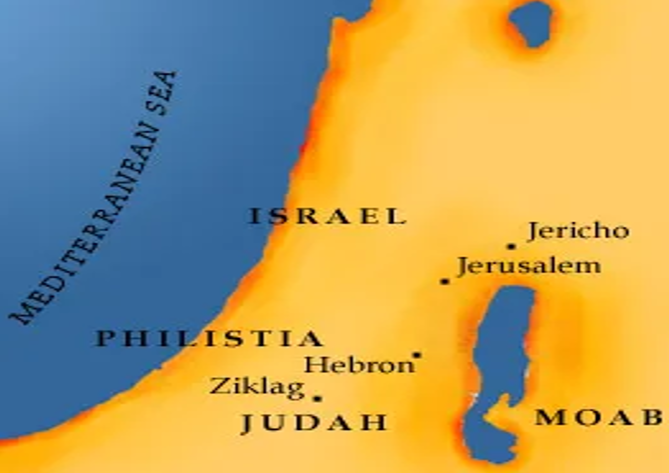
After the king and his family are buried and lamented and grieved for, David and the LORD have a series of two questions that are asked by David and answered very quickly by the LORD. David asks two questions: Should he go and where should he go in the land of Judah? The LORD answered that he should go to Hebron.
2 Samuel 2:2-4:
2) “So David went up thither, and his two wives also, Ahinoam the Jezreelitess, and Abigail Nabal’s wife the Carmelite.
3) And his men that were with him did David bring up, every man with his household: and they dwelt in the cities of Hebron.
4) And the men of Judah came, and there they anointed David king over the house of Judah. And they told David, saying, That the men of Jabeshgilead were they that buried Saul.
David goes from Ziklag to Hebron (about 30 miles). He takes all 600 men of his army, (with their wives and children) along with his two wives, to Hebron. Hebron proper was crowded with David’s court and priests, so David dispersed his men into the satellite towns and villages surrounding Hebron.
While there, the men of Judah came and anointed David king over the house of Judah. These men also mentioned to their new king what the brave men of Jabesh did when they rescued the bodies of the former king (Saul) and his sons and buried them. When David heard this news, what was his response?
2 Samuel 2:5-7:
5) “And David sent messengers unto the men of jabesh-gilead, and said unto them, Blessed be ye of the LORD, that ye have shewed this kindness unto your lord, even unto Saul, and have buried him.
6) And now the LORD shew kindness and truth unto you: and I also will requite you this kindness, because ye have done this thing.
7) Therefore now let your hands be strengthened, and be ye valiant: for your master Saul is dead, and also the house of Judah have anointed me king over them.”
One of David’s first things that he did when he was king of Judah was to honor the men of Jabesh for what they did for their king (Saul). David showed his love for Saul during his life and after Saul was dead. David expressed his appreciation for what they did when they risked their lives to take back the bodies of their royal family and give them a decent burial.
Notice the two words translated “kindness” that are in blue highlighted in 2 Samuel 2:5 and 6. The word is sometimes translated as “lovingkindness” in one word. The Hebrew word which is often translated “lovingkindness” (one word) is checed, which literally means “covenant loyalty.” Most newer English translations of the Bible substitute more common English words such as “faithfulness, kindness, unfailing love, mercy, steadfast love, covenant loyalty, or good favor.” All of these are viable substitutions, but, as with many Hebrew words, checed has no exact match in English. It means a rich, multi-layered term that refers to covenant loyalty, steadfast love, and mercy in the context of an established relationship.
Randa, my wife, pointed this word out to me as she studied the word “lovingkindness” because it was one word instead of two. It was first translated as two words to express the what the word means. But the Protestant Reformation began to translate it as one word to express the love of God to His covenant people.
Here is what she found:
The word means a deep, committed love rooted in a binding promise or relationship. This love sticks by someone through thick and thin, fulfilling an obligation of care, mercy, generosity, and protection even when the other person does not deserve it.
This is what makes Israel the special nation for it only has God’s relentless, unbreakable faithfulness to His people despite their failures, rebellion, or sin. Lovingkindness is God’s kindness and steadfast love for His children, especially evident in His condescending to meet our needs. In Scripture, God shows His lovingkindness in saving His children from their enemies and delivering them from their trouble. His lovingkindness comforts us, redeems us from sin, shows the mercy and forgiveness, and assures us of His promises. That is why Israel will never be defeated in the end.
WHAT HAPPENS NEXT?
By now, I’m sure that you are thinking that David will have a period of rest. But that is not the case once again. He will have some more trouble. And it will not be from the Philistines, the Edomites, or the Amalekites, but from His own people.
2 Samuel 2:8-10:
8) “But Abner the son of Ner, captain of Saul’s host, took Ishbosheth the son of Saul, and brought him over to Mahanaim:
9) And made him king over Gilead, and over the Ashurites, and over Jezreel, and over Ephraim, and over Benjamin, and over all Israel.
10) Ishbosheth Sauls’ son was forty years old when he began to reign over Israel, and reigned two years. But the house of Judah followed David.”
Here we go again. Hebron was a walled city dating back to Early Bronze Age. It was a Canaanite royal city. In Abraham’s time it was populated by Hittites. During the conquest, Caleb led the Israelites who conquered the city (Joshua 11:21; 14:6-15). Now, it serves as David’s capital city for seven and a half years (2:11).
Now that he can settle down, David begins to raise a family in Hebron with his various wives.
2 Samuel 3:2-5:
2) “And unto David were sons born in Hebron: and his firstborn was Amnon of Ahinoam the Jezreelitess:
3) And his second, Chileab, of Abigail the wife of Nabal the Carmelite; and the third, Absalom the son of Maacah the daughter of Talmai king of Geshur;
4) And the fourth, Adonijah the son of Haggith; and the fifth, Shephatiah the son of Abital;
5) And the sixth, Ithream, by Eglah David’s wife. These were born to David in Hebron.
David now had six sons with six different wives! That was an increase of four wives compared to when he entered Hebron. No information is given to us in the Bible as to how he met these wives. By the end of his life, David had many sons and daughters, some of them are not listed in the Bible. He had ten concubines when he later lived in Jerusalem and over nineteen sons. These many wives and children led to David’s downfall as there was no way he could keep up with that many children and wives.
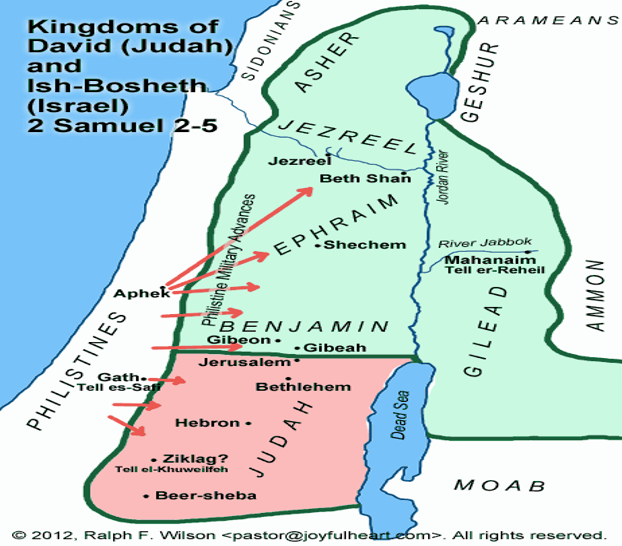
Israel was split into two different kingdoms with two different kings. They had a divided monarchy:
- Ishbosheth; last remaining son of Saul who ruled over every tribe of Israel except for Judah
- David: ruled over just the tribe of Judah
1 Samuel 2:11-14:
11) “And the time that David was king in Hebron over the house of Judah was seven years and six months.
12) And Abner the son of Ner, and the servants of Ishbosheth the son of Saul, went out from Mahanaim to Gibeon.
13) And Joab the son of Zeruiah, and the servants of David, went out, and met together by the pool of Gibeon: and they sat down, the one of the one side of the pool, and the other on the other side of the pool.
14) And Abner said to Joab, Let the young men now arise, and play before us. And Joab said, Let them arise.”
David ruled only 1/12 of the tribes of Israel for seven and a half years. He ruled in Hebron all this time. Abner made Ishbosheth king over more people, but David did not contest it. He just waited patiently for God to make him the king over all Israel.
Until finally Abner decided to change the capital of Israel (not Judah) to Gibeon, which was in the tribe of Benjamin. It was because he wanted to be in a better position to attack David at Hebron.
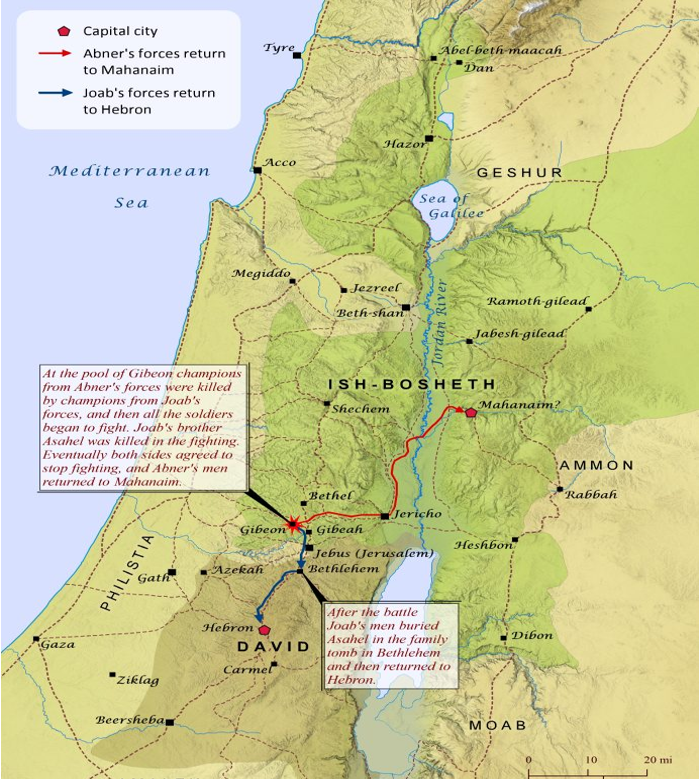
When Abner came to Gibeon the two armies met. Twelve young men on each side were to make sport by entering a match of skill, or perhaps it was decided that a championship match should be fought as was sometimes the custom between opposing armies. This did not settle the differences between the two forces but rather incensed them to a fierce battle.
2 Samuel 2:15-17:
15) “Then there arose and went over by number twelve of Benjamin, which pertained to Ishbosheth the son of Saul, and twelve of the servants of David.
16) And they caught every one his fellow by the head, and thrust his sword in his fellow’s side; so they fell down together: wherefore that place was called Helkath-hazzurim, which is in Gibeon.
17) And there was a very sore battle that day; and Abner was beaten, and the men of Israel, before the servants of David.”
The location where the “twelve against twelve contest” took place was called in English: The Field of the Swords. So-called because of the 24 men, twelve on both sides, died by sharp swords in the field near Gibeon. This was a bizarre, senseless contest. What was the purpose of the contest, anyway? After all the contestants died, Abner and his army were quickly put to flight in a crushing defeat.
2 Samuel 2:18:
18) “And there were three sons of Zeruiah there, Joab, and Abishai, and Asahel: and Asahel was as light of foot as a wild roe.”
Zeruiah was the sister of David and was the mother of the three sons mentioned in this verse. These three sons of David’s sister were nephews of David, or we could say the reverse; David was their uncle. While the army of Joab was chasing the army of Abner, we have an incident in which Abner, the leader of the pro-Ishbosheth forces, slays Asahel, one of the sons of David’s sister.
2 Samuel 2:19-24:
19) “And Asahel pursued after Abner; and in going he turned not to the right hand nor to the left from following Abner.
20) Then Abner looked behind him, and said, Art thou Asahel? And he answered, I am.
21) And Abner said to him, Turn thee aside to thy right hand or to thy left, and lay thee hold on one of the young men, and take thee his armour. But Asahel would not turn aside from following of him.
22) And Abner said again to Asahel, Turn thee aside from following me: wherefore should I smite thee to the ground? How then should I hold up my face to Joab thy brother?
23) Howbeit he refused to turn aside: wherefore Abner with the hinder end of the spear smote him under the fifth rib, that the spear came out behind him; and he fell down there, and died in the same place: and it came to pass, that as many as came to the place where Asahel fell down and died stood still.
24) Joab also and Abishai pursued after Abner: and the sun went down when they were come to the hill of Ammah, that lieth before Giah by the way of the wilderness of Gibeon.”
How is God’s nation doing now? They are having a minor civil war! And where are the two kings of the two kingdoms: Ishbosheth and David? The Scripture doesn’t mention what they were doing or where they were. It was a civil war between Abner and Joab, the two generals of the opposing forces.
Abner and his army are being “run out of town” by the army of Joab. One of Joab’s brothers, Asahel, a great runner, was pursuing Abner to kill him and take his armor. Abner talks to him several times to quit following him, for he didn’t want to kill him. But Asahel refused to quit chasing after Abner and Abner finally killed him with his spear. Asahel’s two brothers, Joab and Abishai, pursued after Abner until the sun went down.
2 Samuel 2:25-28:
25) “And the children of Benjamin gathered themselves together after Abner, and became one troop, and stood on top of an hill.
26) Then Abner called to Joab, and said, Shall the sword devour for ever? Knowest thou not that it will be bitterness in the later end? How long shall it be then, ere thou bid the people return from following their brethren.
27) And Joab said, As God liveth, unless thou hadst spoken, surely then in the morning the people had gone up every one from following his brother.
28) So Joab blew a trumpet, and all the people stood still, and pursued after Israel no more, neither fought they any more.
Abner called to Joab, the other general on the opposite army, “Why don’t we just stop fighting? Brother should not be killing brother.” Joab agrees, blows the trumpet and all the people stop pursuing after their foe and the fighting stops for now. The fighting in the short civil war has been concluded for a while, but it will continue for many years.
And do you notice that the civil war is between the tribe of Judah and the rest of Israel? There are no Edomites, Canaanites, or Kenites involved in the strife. It is Israelite verses Israelite.
2 Samuel 2:29:
29) “And Abner and his men walked all that night through the plain, and passed over Jordan, and went through all Bithron, and the came to Mahanaim.”
Abner and his army walked all night and crossed the Jordan River and went through the craggy ravine called the Bithron and then came to Mahanaim.
2 Samuel 2:30:
30) “And Joab returned from following Abner: and when he had gathered all the people together, there lacked of David’s servants nineteen men and Asahel.”
David’s men lost 20 soldiers: 12 in the bizarre competition that began the conflict, plus seven in the fierce fighting that took place after the dreadful contest and Asahel.
2 Samuel 2:31-32:
31) “But the servants of David had smitten of Benjamin, and of Abner’s men, so that three hundred and threescore men died.
32) And they took Asahel, and buried him in the sepulcher of his father, which was in Bethlehem. And Joab and his men went all night, and they came to Hebron at break of day.”
David’s army slew 360 soldiers of Abner’s forces. It was a 1:18 ratio of deaths in the battle; 20:360.
I don’t think that we can really call this a civil war, just like we can’t accurately call America’s war a civil war: it wasn’t a war among states of one nation. Israel’s fighting wasn’t a war among tribes of one nation. It was a divided monarchy with different governments; the house of Saul and the house of David (Judah). They had different kings and different armies. It was a war of 11 tribes verses one tribe (Judah). And Judah won.
2 Samuel 3:1:
1) “Now there was long war between the house of Saul and the house of David: but David waxed stronger and stronger, and the house of Saul waxed weaker and weaker.”
The war between the two kingdoms lasted for seven and one half years, but the strife continued until the last great division which occurred over 80 years later; with Benjamin forced to join Judah.
The next four verses tell of David’s six sons that were born when he was in Hebron with six different wives. David had thirteen more sons and a daughter born in Jerusalem that were named and several that were not. He had nine wives and many concubines. This caused David many problems in his future.
But now we have a disagreement between Abner and King Ishbosheth.
2 Samuel 3:6-8:
6) “And it came to pass, while there was war between the house of Saul and the house of David, that Abner made himself strong for the house of Saul.
7) And Saul had a concubine, whose name was Rizpah, the daughter of Aiah: and Ishbosheth said to Abner, Wherefore hast thou gone in unto my father’s concubine?
8) Then was Abner very wroth for the words of Ishbosheth, and said, Am I a dog’s head, which against Judah do shew kindness this day unto the house of Saul thy father, to his brethren, and to his friends, and have not delivered thee into the hand of David, that thou chargest me to day with a fault concerning this woman?”
Abner had moved Ishbosheth from Saul’s capital of Gibeah to Mahanaim on the east side of the Jordan, the place where Jacob had wrestled with the angel 800 years before (Genesis 32:1). Here the monarchy of Saul’s house might be reestablished in relative safety. Ishbosheth’s territory, however, is substantially diminished. Though Gilead, east of the Jordan, is fairly secure, Asher and Jezreel, plus part of Ephraim and Benjamin are now under the control of the Philistines.
Finally, Ishbosheth does something stupid. He rebukes Abner, who is the only reason he remains king. Ishbosheth is justified, of course. Abner had been sleeping with Saul’s concubine Rizpah, which was probably construed (perhaps correctly) as Abner asserting a claim to the kingship himself. Elsewhere in the David saga, taking a king’s wife or concubine was a political act of asserting the rights of a king (2 Samuel 12:8; 16:21; 1 Kings 2:13-22).
Although Abner is clearly guilty of overreaching, he deeply resents Ishbosheth’s rebuke. “You owe your very life to me,” Abner is thinking, “and you accuse me of something so petty?” Abner has probably been looking for some kind of provocation and Ishbosheth provides it.
2 Samuel 2:8-11
Abner says: “Am I a dog’s head -- on Judah’s side? This very day I am loyal to the house of your father Saul and to his family and friends. I haven’t handed you over to David. Yet now you accuse me of an offense involving this woman! May God deal with Abner, be it ever so severely, if I do not do for David what the LORD promised him on oath and transfer the kingdom from the house of Saul and establish David’s throne over Israel and Judah from Dan to Beersheba." Ishbosheth is afraid to say another word.
2 Samuel 3:9, 10:
9) “So do God to Abner, and more also, except, as the LORD hath sworn to David, even so I do to him;
10) To translate the kingdom from the house of Saul, and to set up the throne of David over Israel and over Judah, from Dan even to Beersheba.”
Abner, in his wrath against Ishbosheth, his nephew, because of being charged with wrongdoing in connection with one of Saul’s concubines, now fully decided to unite the kingdom of Israel under David. He knew David had been anointed king of Israel by Samuel, and that God had sworn to give the kingdom to David. The fact that he had been fighting against God all this time was not sufficient conviction to make him act in God’s will; but when something personal like this had happened, it was more than he could bear, so he plainly spoke his mind to his king regarding his intentions.
2 Samuel 3:11:
11) “And he (Ishbosheth, the king) could not answer Abner a word again, because he feared him.”
David had not made an attack against Abner’s forces all the while he was in Hebron. David just waited until God granted him what He had promised. David did not want brother to fight against brother. The only exception was the battle at Gibeon which was self-defense and didn’t last long. David knew that he would be made king over all of Israel…so, he just waited. But he might have been surprised at what happened next.
2 Samuel 3:12:
12) “And Abner sent messengers to David on his behalf, saying, Whose is the land? Saying also, Make thy league [covenant, Septuagint] with me, and, behold, my hand shall be with thee, to bring about all Israel unto thee.
This was Abner’s first step in carrying out his threat that he had made to Ishbosheth. He acted immediately by sending messengers to David, proposing to unite the two kingdoms.
“Whose is the land?” is omitted in the Septuagint. I don’t know why it is omitted. But the land was David’s. The LORD had already promised the kingdom and its land to David when Samuel anointed him.
What happens next?
- Will the two separate kingdoms be joined into one mighty kingdom under the rule of David?
- What about Abner? He was the dividing force, who now wants the uniting of Israel.
- How will David answer Abner's request?
- Will God’s lovingkindness be displayed to His covenant people once again?
Till next time, part eight.
Blessed be the LORD God of Israel.