The Life of David - Part 6
“The Sick Slave”
Copied from the Sermon notes of Pastor Don Elmore
October 25, 2026
Scripture Reading: 1 Samuel 30:6a:
6a) “And David was greatly distressed; for the people spake of stoning him, because the soul of all the people was grieved, every man for his sons and for his daughters…”
Before we continue our story of the life of David, let me just say, “Does any know where the deadliest massacre of civilians in the United States has occurred outside of a battle in war?”
It was in Las Vegas, where there were at least 58 deaths and almost 500 injuries in the mass shooting (this is what the government’s story is) from the 32nd floor of the Mandalay Bay Resort and casino’s window by one man – Stephen Paddock.
But there is a lot more to the story that we will never know, like there always is when the government wants to cover up the story. There were shootings at most of the other casinos, machine gun shots taken from helicopters, and the Las Vegas airport shut down when they said that a gunman was on the runway. Some of the killings were not at the festival that was being held.
Las Vegas police and the FBI determined the 64-year-old retired accountant and high-stakes poker player meticulously planned the attack and acted alone. They theorized he may have sought notoriety, but said they never determined a clear motive for the attack.
The story just stopped after about five days of reporting. It is just like the J. F. K. assassination, the Charlie Kirk murder, the Viet Nam War, the Desert Storm war, the Iranian war, WWI, WWII, 9/11 episode, Jeffrey Epstein’s death, the Korean war, etc. All the information about the incident or war becomes classified for national security reasons.
What ever happened that day on October 1, 2017, there will never be full accounting. But I believe that there wasn’t one man (for it couldn’t be, for most of the shooting came after the supposed killer shot himself), and there were a lot of supposed Saudi’s attempting to kill one of their leaders at the Casino. But we will never know, unless someone releases the classified information on the case.
But the Bible tells us the things that we need to know. This is where we left off at our last sermon. David was greatly distressed. Why? Because his own men in his small army (600 men) were talking about stoning him. What! His men were raising the question of whether to kill the anointed future king of Israel!
King Saul fell flat on his face and was in sore trouble. He had just heard the words that the familiar spirit of the witch that his days would be over in the next day. He had eaten nothing for about 24 hours. In this weak state he was ready to return to the battlefield. But the witch and his men convinced him that he needed to eat, and she fixed them a meal, and they ate and then made the 12-mile journey back to the battlefield to fight the Philistines the next morning.
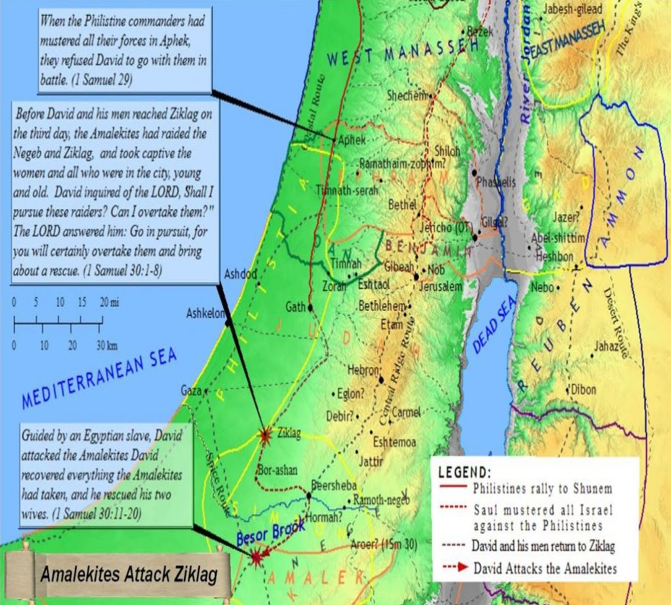
The Philistines were ready to attack the forces of Israel under the leadership of King Saul. David was saved from fighting with the Philistines, but when he went home to Ziklag, he found that the city was burnt and no one, including the children and wives of his men, was there. They were all gone. Were they still alive? Where were their wives and children, if they were still alive? How could they get them back without them being killed if they were not already dead?
David’s men argued that their wives and children would not have been kidnapped or killed if David wouldn’t have lied to the king of Gath and made him think that David would be his protector. As a result, they left the city (Ziklag) defenseless and now they have nothing. Everything is either burned or killed or kidnapped and David is to blame for all of this.
How is that for God’s special nation? But wait a minute…what happens next? What does the rest of verse six say?
1 Samuel 30:6:
6) “And David was greatly distressed; for the people spake of stoning him, because the soul of all the people was grieved, every man for his sons and for his daughters; but David encouraged [strengthened, Septuagint] himself in the LORD his God.”
I have suffered many times, but it was not as great as David’s suffering, when I became depressed. My problems were a lot smaller than David’s were, or his men, or the children and wives of David and his men, or even King Saul’s. I never cried till I couldn’t cry any more. I was never so depressed that I fell flat on my face and didn’t want to eat anything. And when I was in that depressed state, I didn’t seek encouragement or strength in the LORD as fast as David did. In fact, in many cases it took me months and sometimes years to find encouragement in the LORD. But that wasn’t wrong. Aren’t we supposed to find encouragement from the LORD as soon as possible?
Philippians 4:13:
13) “I can do all things through Christ which strengtheneth me.”
Notice, it says that “David encouraged himself in the LORD his God.” It wasn’t the god of everyone who was living on the earth. The Philistines didn’t have this God that the Israelites had. In fact, when the Philistines got possession of the Ark of the Covenant, that belonged only to Israel and their God, they suffered greatly because of it; so much so that they voluntarily returned it.
How did David get the ephod? Remember, after Saul killed all the priests of Nob, except for Abiathar, Abiathar went to David with the ephod, Urim and Thummim. Saul no longer had access to them or to any priest for that matter, because they were all dead but one.
1 Samuel 30:7:
7) “And David said to Abiathar the priest, Ahimelech’s son, I pray thee, bring me hither the ephod. And Abiathar brought thither the ephod to David.
So, David inquired of the LORD by using the ephod. This was one of the advantages that David had after Saul killed all the priests but Abiathar.
1 Samuel 30:8-10:
8) “And David enquired at the LORD, saying, Shall I pursue after this troop? Shall I overtake them? And He answered him, Pursue: for thou shalt surely overtake them, and without fail recover all.”
9) “So David went, he and the six hundred men that were with him, and came to the brook Besor, where those that were left behind stayed.
10) But David pursued, he and four hundred men: for two hundred abode behind, which were so faint that they could not go over the brook Besor.”
The brook Besor was about 15 miles south of Ziklag. By this time 200 of the 600 men of David, one-third of the men, had become so weary that they had to stay at this brook while the rest of the army went after the Amalekites.
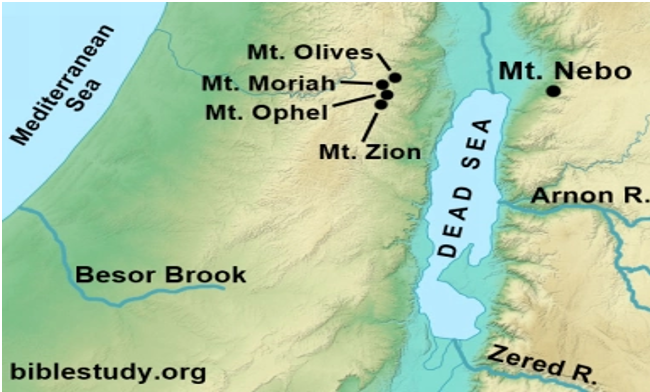
But David needed help to find the kidnappers and the arsonists. Where would he find that help? But David had encouraged himself in the LORD his God, and God had said that “he without fail would recover all.”
1 Samuel 30:11, 13:
11) “And they found an Egyptian in the field, and brought him to David, and gave him bread, and he did eat; and they made him drink water;
12) And they gave him a piece of a cake of figs, and two clusters of raisins: and when he had eaten his spirit came again to him: for he had eaten no bread, nor drunk any water, three days and three nights.
13) And David said unto him, To whom belongest thou? And whence are thou? And he said, I am a young man of Egypt, servant to an Amalekite; and my master left me, because three days agone [ago] I fell sick.”
The three “theys” in verses 11 and 12, mean the men of David’s army. The men were the ones that found him in the field starving to death and brought him to David.
This Egyptian (probably a descendant of Ham) traveled with the Amalekites (descendants of Esau) until he had become sick and too weak to continue. He was cast out of the group of Amalekites and left to die in a field on the side of the road. When David’s men found him, he had gone three days with no food or drink. A sick man who had no water to consume would be close to death after three days.
What if David and his men found him on the fourth day or later, when he probably would not have been able to survive? What good would he have been to them if he was dead or so weak that he couldn’t communicate? God puts the right person in our path to benefit us when we ask Him for His help. Has that ever happened in your life? I would guess that it has.
David begins to question the young Egyptian. The young man tells David that he was a servant (slave) to one of the Amalekites and he got sick and his master left him to die alone by himself. He just left him on the ground with no food or water.
First, we must stand in awe in the sovereignty of God which allowed this Egyptian slave to fall sick at just the right time. He didn’t get so sick that he died, but that he got sick enough that he was cast out of the group of Amalekites because he was so weak and he couldn’t continue with them.
Second, God in His sovereignty permitted the slave’s master to act so inhumanly, by leaving him to perish by the wayside alone with no food or water.
Third, God in His sovereignty moved David’s men to spare his life, when they had every reason to believe he had taken part in the burning of Ziklag and the kidnapping of their wives and children.
Fourth, God in His sovereignty provided an Egyptian and not an Amalekite, for had he been the latter, they were bound to kill him. That was what King Saul forgot and therefore lost his kingship over this grave error.
Deuteronomy 25:17-19:
17) “Remember what Amalek did unto thee by the way, when ye were come forth out of Egypt;
18) How he met thee by the way, and smote the hindmost of thee, even all that were feeble behind thee, when thou wast faint and weary; and he feared not God.
19) Therefore it shall be, when the LORD thy God hath given thee, rest from all thine enemies round about, in the land which the LORD thy God giveth thee for an inheritance to possess it, that thou shalt blot out the remembrance of Amalek from under heaven; thou shalt not forget it.”
Fifth, God is His sovereignty moved David to show this helpless slave kindness.
Sixth, God in His sovereignty caused the food and water given to him to quickly revive him.
Seventh, God in His sovereignty inclined the Egyptian slave to freely answer David’s questions and to be willing to lead him to the camp of the Amalekites.
Each of these seven factors had to combine, or the result would have never been reached: God made “all things work together” (Romans 8:28) for David’s good.
1 Samuel 30:14-16:
14) “We [the Egyptian slave and the Amalekites] made an invasion upon the south of the Cherethites, and upon the coast which belongeth to Judah, and upon the south of Caleb; and we burned Ziklag with fire.”
15) And David said to him, Canst thou bring me down to this company? And he said, Swear unto me by God, that thou wilt neither kill me, nor deliver me into the hands of my master, and I will bring thee down to this company.
16) And when he [the Egyptian slave] had brought him [David] down, behold, they were spread abroad upon all the earth [land, Septuagint], eating and drinking, and dancing, because of all the great spoil that they had taken out of the land of the Philistines, and out of the land of Judah.”
I must point out that the Amalekites were not “spread abroad upon all the earth” as the King James Version says. This has caused a lot of confusion among Bible readers. Notice what the Septuagint says about where they were spread: “They were scattered abroad upon the surface of the whole land.” This is another case of where a bad translation has made many Christians arrive the wrong conclusion. In other words, they have made their conclusion based on a wrong translation.
David asked the Egyptian slave if he could help them find the Amalekites who did this to them, and he replied that he would if he would grant him the positive answer to two promises. That David would not kill him afterwards or give him back to his master. David replied that he would honor the two requests that he made and the slave took them to where the Amalekites were.
The Amalekites, in all probability, knew that the Israelites and Philistines were engaged in fighting each other a considerable distance away. They also supposed that David and his men were assisting the king of Gath. Deeming themselves secure, they imprudently began to riot and make merry over the abundance of spoils they had captured, without so much as placing guards to give notice of an enemy’s approach. They lay not in a regular order, much less in any military formation, but were scattered in groups, here and there.
So, when David and his men approached, it was a great surprise to the Amalekites. And they were in the worse position to fight them off.
1 Samuel 30:17, 18:
17) “And David smote them from the twilight even unto the evening of the next day: and there escaped not a man of them, save four hundred young men, which rode upon camels, and fled.
18) And David recovered all that the Amalekites had carried away: and David rescued his two wives.”
David and his men were weary after a few days of fast pursuit (remember they left one-third of their attack force at the Besor brook who were too weary to continue.) But the hope of recovering their wives and children gave them the adrenaline that they needed to continue. They smote the invaders all night and all the next day, allowing only four hundred men to escape. They must have really been worn out after all that fighting!
I have never been up that long without sleeping, let alone travelling at a fast pace and fighting for twenty-four hours after my journey. I wonder what the two hundred men did while the four hundred were fighting for a full day once they arrived at the camp of the Amalekites?
Where were the children and wives when all this fighting took place? When were they reunited with their husbands and fathers? The Philistines, the four hundred young men who had survived, must have fled rather quickly to leave without being killed.
1 Samuel 30:19, 20:
19) “And there was nothing lacking to them, neither small nor great, neither sons nor daughters, neither spoil, nor any thing that they had taken to them: David recovered all.
20) And David took all the flocks and the herds, which they drave before those other cattle, and said, This is David’s spoil.”
This was another divine miracle. How did David recover everything that was taken from them? David committed genocide when he had attacked the Amalekites a few months before. Why didn’t the Amalekites do the same thing to David and his and his men’s wives and children? It was a miracle. But there was another problem.
1 Samuel 30:21, 22:
21) “And David came to the two hundred men, which were so faint that they could not follow David, whom they had made also to abide at the brook Besor: and they went forth to meet David, and to meet the people that were with him: and when David came near to the people, he saluted them.
22) Then answered all the wicked men and men of Belial, of those that went with David, and said, Because they were not with us, we will not give them ought of the spoil that we have recovered, save to every man his wife and his children, that thy may lead them away, and depart.”
Another major problem for David. Some of the four hundred men who had fought all day, and night said that the two hundred men who were so weary that they couldn’t cross the brook Besor and fight with them, should only recover their wives and children. They should not share in the spoils that they gained, because they did not fight for it. What did David do? What would you do? Do you agree or disagree with what some of David’s men said.
1 Samuel 30:23-25:
23) “Then said David, Ye shall not do so, my brethren, with that which the LORD hath given us [which the LORD has delivered the enemy to us, Septuagint], who hath preserved us, and delivered the company that came against us into our hand.
24) For who will hearken unto you in this matter? But as his part is that goeth down to the battle, so shall his part be that tarrieth by the stuff [baggage, Septuagint]: they shall part alike [they shall share alike, Septuagint].
25) And it was so from that day forward, that he made it a statute and an ordinance for Israel unto this day.”
David was tested once again. His answer, “Ye shall not do so, my brethren, with that which the LORD hath given us” resulted in a quieting of the selfish followers of David. They must not ascribe victory to their own prowess, and therefore they could not claim the booty as wholly belonging to themselves. It is not a time to give way to a spirit of greed when the Lord has particularly manifested His kindness to us.
David, when he returned to Ziklag, sent gifts to all the places where he had sojourned in his exile (verses 26-31). He sent some of the spoil that the LORD had given them to the elders of Judah, even his friends, saying: “Behold a present for you of the spoil of the enemies of the LORD.”
So, David enjoyed a great victory. I am sure that he awaited the news of what happened in the battle between the Philistines and the Israelites that was going on while he was battling with the Amalekites.
1 Samuel 31:1:
1) “Now the Philistines fought against Israel: and the men of Israel fled from before the Philistines, and fell down slain in mount Gilboa.”
After Saul returned from the witch of Endor, the battle began. The Philistines routed the Israelites from the beginning.
1 Samuel 31:2, 3:
2) “And the Philistines followed hard upon Saul and upon his sons; and the Philistines slew Jonathan, and Abinadab, and Melchishua, Saul’s sons.
3) And the battle went sore against Saul, and the archers hit him; and he was sore wounded of the archers.”
The Philistines killed three of Saul’s sons and the archers wounded him severely. Was there any hope that Saul could survive?
1 Samuel 31:4-6:
4) “Then said Saul unto his armourbearer, Draw thy sword, and thrust me through therewith; lest these uncircumcised come and thrust me through, and abuse me. But his armourbearer would not; for he was sore afraid. Therefore Saul took a sword, and fell upon it.
5) And when his armourbearer saw that Saul was dead, he fell likewise upon his sword, and died with him.
6) So Saul, died, and his three sons, and his armourbearer, and all his men, that same day together.”
Saul, being fatally wounded, requested his armorbearer to finish killing him, so that he would not fall into the hands of his enemies who, he knew, would make sport of him and give him a slow and terrible death. The young man was afraid to kill his king, so Saul took a sword and committed suicide. Then his armorbearer did likewise.
“All his men,” that is, all the men who were the personal bodyguards of Saul also were killed. For most of the army of Israel fled at the very beginning of the battle and many escaped, among them Abner.
1 Samuel 31:7:
7) “And when the men of Israel that were on the other side of the valley, and they that were on the other side Jordan, saw that the men of Israel fled, and that Saul and his sons were dead, they forsook the cities, and fled; and the Philistines came and dwelt in them.”
How many cities were forsaken is not stated, but it appears that all of them on the west of the Jordan River in this battle section became Philistine cities for a time, for about a dozen years. When David became king over all Israel these cities had to be retaken and the kingdom of Israel for the first time became truly great and extended to the river of Egypt and the gulf of Akabah, and north to the Euphrates, taking in all of Philistia, Amalek, Edom, Moab, Syria, and other countries.
1 Samuel 31:8-10:
8) “And it came to pass on the morrow, when the Philistines came to strip the slain, that they found Saul and his three sons fallen in mount Gilboa.
9) And they cut off his head, and stripped off his armour, and sent into the land of the Philistines round about, to publish it in the house of their idols, and among the people.
10) And they put his amour in the house of Ashtaroth: and they fastened his body to the wall of Bethshan.”
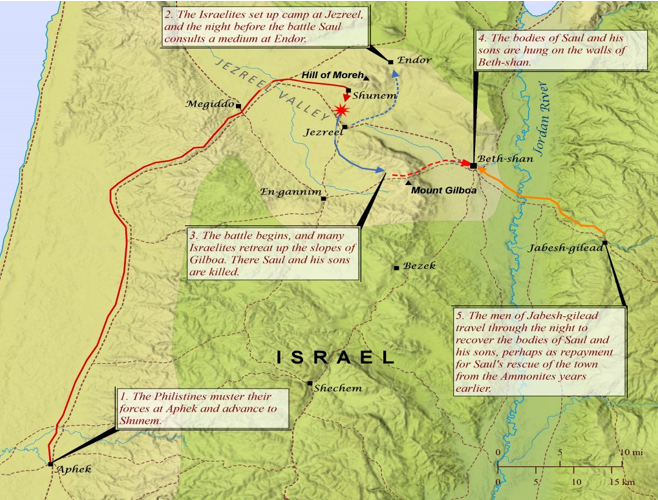
It was a great victory for the Philistines. They took Saul’s head and fastened it in the temple of Dagon, the half fish, half man god at Bethshan. They took his armor and put it in the house of their god Ashtaroth in Bethshan. Thus, the amour and head of King Saul were divided among the idol gods of Philistines.
Let’s do a quick review of the history of this area:
Joshua 17:11-12 and Judges 1:27, 28:
11) “And Manasseh had in Issachar and in Asher Beth-shean and her towns, and Ibleam and her towns, and the inhabitants of Dor and her towns, and the inhabitants of Endor and her towns, and the inhabitants of Taanach and her towns, and the inhabitant of Megiddo and her towns, even three countries.”
12) Yet the children of Manasseh could not drive out the inhabitants of these cities: but the Canaanites would dwell in that land.”
The Canaanites remained in the city of Bethshan and the surrounding area. Manasseh failed to drive them out.
Later we found out what David did near the end of his kingship:
2 Samuel 21:12-14:
12) “And David went and took the bones of Saul and the bones of Jonathan his son from the men of Jabesh-gilead, which had stolen them from the street of Bethshan, where the Philistines had hanged them, when the Philistines had slain Saul in Gilboa:
13) And he brought up from thence the bones of Saul and the bones of Jonathan his son: and they gathered the bones of them that were hanged.
14) And the bones of Saul and Jonathan his son buried they in the country of Benjamin in Zelah, in the sepulcher of Kish his father: and they performed all that the king commanded. And after that God was entreated for the land.”
David gave the first Israelite king, Saul, and his son, Jonathan, their final burial. It was almost forty years later after their death. David was inspired by the actions of Rizpah, the daughter of Aiah who covered the rock for about five months over the bodies of her two sons and five others related to King Saul. This act of Rizpah was not equaled in human history. This act of devotion stirred David to take the bones of Saul and Jonathan and the seven men who were hanged and buried them in the sepulcher of Kish in Bethlehem. We will study this in more detail in the coming months ahead. The future king of Israel was accused of causing his men to lose everything they had, including their wives and children. Many of its cities were being taken over by the Philistines as the people fled before the attackers arrived at their city. What would happen next?
Well, David, because of divine intervention, found a sick slave who led them to the Amalekites, and they destroyed all of them except for four hundred who fled by camel. David retrieved everything.
What about King Saul? Did anyone do anything about his disgrace of hanging on the wall of the temple of the false god, Dagon?
1 Samuel 31:11-13:
11) “And when the inhabitants of Jabesh-Gilead heard of that which the Philistines had done to Saul;
12) All the valiant men arose, and went all night, and took the body of Saul and the bodies of his sons from the wall of Bethshan, and came to Jabesh, and burnt them there.
13) And they took their bones, and buried them under a tree at Jabesh, and fasted seven days.”
The people of Jabesh-Gilead were the first to be helped by Saul in the beginning of his reign, so they naturally felt they owed him a debt of gratitude. It had been almost twenty years previous that Saul rescued the people of this city.
Nahash, the king of Ammon, demanded to gouge out the right eye of every man in Jabesh-Gilead as a condition of peace. When messengers brought news of this to Saul, he became filled with the Spirit of God. He cut a pair of oxen into pieces and sent them across the tribes of Israel as a warning: anyone who failed to follow Saul and Samuel would have their oxen cut up the same way. An ox was a farmer’s most valuable livelihood and tool for survival. Threatening a man’s oxen with being cut to pieces was a severe warning that destruction would hit his property if he failed to answer this national emergency.
This urgent call mustered a massive force – roughly 300,000 men from Israel and 30,000 from Judah (330,000 total) at Bezek. Saul sent word to the desperate people of Jabesh-Gilead promising that they would be rescued by the next day when the sun grew hot. Saul divided his massive army into three divisions and launched a surprise attack against the Ammonite camp during the morning watch. They completely vanquished and scattered the Ammonites before midday. Following the victory, Saul refused to execute those who had previously doubted his leadership, and the people gathered at Gilgal to joyfully renew and affirm his kingship before the LORD.
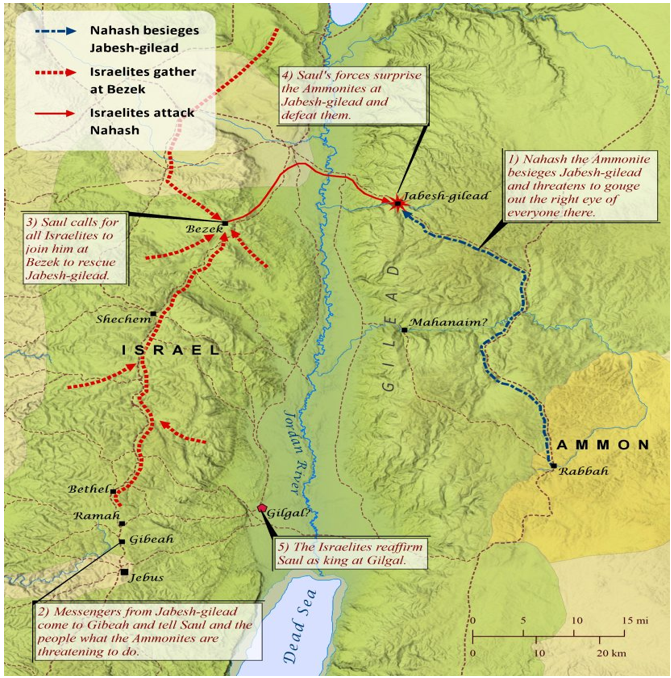
No wonder the men of Jabesh-Gilead risked their lives to save the man who saved them from having their right eye gouged out. Yikes! Things were tough back in those days. What would you do if the enemy forces occupied your town and said that they were going to put out one of the eyes of all the men.
The men from Jabesh took not only the bodies of Saul but also of his three sons, from the wall of Bethshan, and came to Jabesh and burnt them there. The men of Israel ordinarily did not burn the bodies of their dead, but in this case, it might have been because of all the diseases the decaying bodies would carry. I do not know for sure, but they did it at night and then they buried their bones under a tree at Jabesh.
Where was this city located? How did the men of Jabesh do this without a battle with the Philistines. The Bible doesn’t tell us. They were able to go at night and take down their bodies without fighting with the Philistine army.
2 Samuel 1:1-3:
1) “Now it came to pass after the death of Saul, when David was returned from the slaughter of the Amalekites, and David had abode two days in Ziklag;
2) It came even to pass on the third day, that, behold, a man came out of the camp from Saul with his clothes rent, and earth upon his head: and so it was, when he came to David, that he fell to the earth, and did obeisance.
3) And David said unto him, From whence comest thou? And he said unto him, Out of the camp of Israel am I escaped.”
With Saul dead, we now take up a more detailed study of the life of David, from this point onward, for the next forty years. David returned from the annihilation of the Amalekites to the burned-out city of Ziklag for three days. It had been a little more than a week since he left the Philistines before they attacked Israel. David hadn’t yet heard what happened when the Philistines and Israel fought in Mt. Gilboa.
Suddenly, a man appears who said he was in the camp of Israel and had escaped. David, anxious to hear what happened asks the man several questions.
2 Samuel 1:4-5:
4) “And David said unto him, How went the matter? I pray thee, tell me. And he answered, That the people are fled from the battle, and many of the people also are fallen and dead; and Saul and Jonathan his son are dead also.
5) And David said unto the young man that told him, How knowest thou that Saul and Jonathan his son be dead?”
David asked the young man how the battle had gone. The young man reported that Israel had lost the battle, many were killed, including Saul and his son Jonathan. The man presented himself as a mourner for the dead king, and as a loyal subject to the one who should succeed Saul. No doubt he wanted himself to be the first to pay homage to the sovereign elect, expecting to be rewarded for bringing such good news.
To all men, except very rare ones like David, such news would be good news – hearing that their chief enemy was dead. That the only man who was standing between him and his promotion was gone; but not so in this case. It is hard for selfish and carnal men to understand the true feeling of David and his acts on this occasion. David then asked the young man how he was aware the Saul and Jonathan were dead.
2 Samuel 1:6-10:
6) “And the young man that told him said, As I happened by chance upon mount Gilboa, behold, Saul leaned upon his spear; and lo, the chariots and horsemen followed hard after him.
7) And when he looked behind him, he saw me, and called unto me. And I answered, Here am I.
8) And he said unto me, Who are thou? And I answered him, I am an Amalekite.
9) He said unto me again, Stand, I pray thee, upon me, and slay me: for anguish is come upon me, because my life is yet whole in me.
10) So I stood upon him, and slew him, because I was sure that he could not live after that he was fallen: and I took the crown that was upon his head, and the bracelet that was on his arm, and have brought them hither unto my lord.”
Is this the same story that we studied in 1 Samuel 31:3-5 also repeated in 1 Chronicles 10:3-5? No, it is not. In the earlier story we learned that Saul was hit by arrows and was mortally wounded. He asked his armor bearer to kill him so that the Philistines wouldn’t have the opportunity to torture him before he died. The armor bearer was afraid to kill his king, so Saul fell on his own sword and died. He committed suicide.
The discrepancy between this young man’s testimony and the true record of Saul’s killing of himself must be attributed to his seeking to impress David with his part in doing away with his chief enemy, thinking that he would be rewarded.
Saul is dead. Israel is occupied by enemy forces. David is in Ziklag and he hears of Saul’s death by a stranger.
What a great nation is Israel! It has no king and it is overrun with enemy forces. But just wait…
To be continued in sermon #7.
Blessed be the LORD God of Israel.