The Life of David - Part 3
“Nabal and Abigail”
Copied from the Sermon notes of Pastor Don Elmore
September 13, 2026
Scripture Reading: 1 Samuel 24:1
1) “And it came to pass, when Saul was returned from following the Philistines, that it was told him, saying, Behold, David is in the wilderness of En-gedi.
Holocaust Sunday
Holocaust Sunday occurs on the second Sunday of September. Historically, this was the first Sunday following the Saturday of September, AD 70, when the Roman soldiers finally completed the destruction of the temple in Jerusalem and razed it to the ground. At this time, it took three days to complete this destruction, which according to the best calculations then fell on September 9, 10, and 11. Holocaust Sunday marks the day when some Christians first celebrated the killing of close to one million Edomite Jews in Jerusalem, the destruction of the Jewish economy, and the leveling of the Jerusalem Temple. This year it falls on September 13, 2026. This was from Pastor Jim.
The Edomite Jews were either put in slavery or were killed as a punishment for killing our Savior. The Jews admit in their many writings that several years after 70 A.D., when their ancestors were put in diaspora, the Jews were spread over Africa, Asia and Europe.
Now, what do these days bring up in remembrance now? September 10th is the death of Charlie Kirk, which the trial of the supposed alleged killer, Tyler Robinson hasn’t even started and there are many irregularities in the story. And September 11th is the attack on the three World Tower Centers in New York City which led to the United States fighting for Israeli, against Iraq, looking for “weapons of mass destruction.” Both two stories are false flags and have ties to the people who have been the enemy of our LORD and Savior and us for thousands of years.
I don’t know if ancient Christians celebrated September 9-11 as a holiday or something else, but they now celebrate false flags as being a reality which is worse. May our God have mercy on our souls.
Nabal and Abigail
From these words of the Scriptural reading, we gather that Saul had been successful in turning back the invading Philistines. This illustrates a principle which is often lost sight of: human success is no proof of divine approbation. The mere fact that a man is prospering outwardly, does not, of itself, demonstrate that his life is pleasing unto the Lord. Only an infidel would deny that it was God who enabled Saul to clear his land of the Philistines, yet we err seriously if we conclude from this that He delighted in him.
1Samuel 24:2:
“Then Saul took three thousand chosen men out of all Israel, and went to seek David and his men upon the rocks of the wild goats.”
Saul had been providentially blocked while pursuing David, by the invading Philistines; but now, as soon as this hindrance by the invading Philistines was removed, he redoubles his evil efforts. One would think that the very invasion of the Philistines changed Saul’s attitude toward the one whom he was so causelessly and relentlessly pursuing. Ought he not to have realized now, more forcible than ever, that he needed David at the head of his army to repulse the common enemy? Very few people thrive as well in times of prosperity as they do in seasons of adversity.
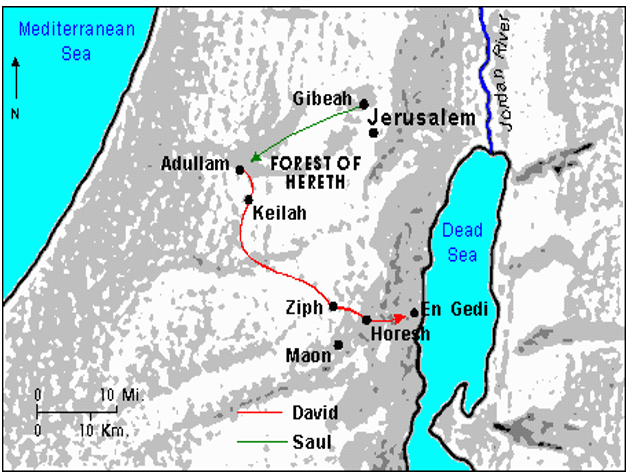
Saul chose three thousand of the best of all his soldiers and went after David who was now hiding in En Gedi. Saul still had a five to one advantage: 3,000 to 600 men army.
1 Samuel 24:3:
“And he [Saul] came to the sheepcotes by the way, where was a cave; and Saul went in to cover his feet: and David and his men remained in the sides of the cave.”
What does it mean when it says that “Saul went in to cover his feet”? It means that Saul answered the “call of nature” or “relieved himself.” Afterwards, Saul laid down to rest and fell asleep.
Saul went into the cave alone, with his guards protecting him outside the cave. They were to keep anyone from David’s army from going into the cave, when they were unknowingly already there! No one of Saul’s army knew that David and his men were hiding inside the very cave that Saul entered.
1 Samuel 24:4:
“And the men of David said unto him [David], Behold the day of which the LORD said unto thee[David], Behold, I [the LORD God] will deliver thine enemy into thine hand, that thou mayest do to him [David’s enemy] as it shall seem good unto thee. Then David arose, and cut off the skirt of Saul’s robe privily”
David’s men whispered quietly to their leader that God had said that He would deliver your enemy, King Saul, into your hand. Do what seems good for you to do. They emphasized to him that this was the time that God meant. Immediately after his men told him this, David arose and he cut part of the skirt of Saul’s robe privily.
1 Samuel 24:5-7:
5) “And it came to pass afterward, that David’s heart smote him, because he had cut off Saul’s skirt.
6) And he said unto his men, The LORD forbid that I should do this thing unto my master, the LORD’s anointed, to stretch forth mine hand against him, seeing he is the anointed of the LORD.
7) So David stayed his servants with these words, and suffered them not to rise against Saul. But Saul rose up out of the cave, and went on his way.”
This was a moment in history that would have changed the course of the future events in Israel’s kingship. What if David had listened to what his men told him and then he killed the king of Israel? What changes would have occurred?
One stroke of his sword, and he steps into a throne. His poverty would end. The life of an innocent fugitive would also cease. Reproaches, sneers, defeat, would no longer be the case. He would receive adulations, triumphs, and riches would be his.
But he would receive this at the sacrifice of faith; at the sacrifice of a humbled will, ever waiting on God’s time; at the sacrifice of a thousand precious experiences of God’s care. No, David did not want the throne at that price. It was too much of a price. He would wait till God told him that it was his time to take the throne.
David needed to be exceedingly cautious on how to interpret the events of Providence and what conclusion that can be drawn from them. God had promised David the throne. Had his time now come for removing the one obstacle which stood in his way? It sure seemed that way.
Saul had shown David no mercy; was it God’s will that David should be His instrument for taking vengeance upon him? It seemed that way or why should He have delivered him into his hand? David had cried to God for deliverance and had appealed unto divine justice for vindication. Did God set this unusual situation up for David to take advantage of? Or was it another test?
Psalm 54:1:
“Save me, O God, by Thy name, and judge me byThy strength.”
Had the hour come for his supplication to be answered? David and his men had unexpectedly seen King Saul asleep at their feet. Was this the time for David to act? It would have been very easy for David to have made an erroneous deduction from the event of Providence on this occasion. His cutting off part of his skirt showed that he almost deducted wrongly.
God was testing David’s faith. He was testing his patience. He was testing his piety. It was a very real test and David passed.
David considered the Providence more carefully and concluded that he should not kill the LORD’s anointed. This meant David should not kill a man anointed by oil to be king of Israel. Saul also had the Spirit of God from the time he was converted till the time he was rejected by God. Saul did not have the Spirit of God now!
David had taken no thought of killing the giant champion of the Philistines. David slaughtered 200 Philistines to meet the requirements of getting Saul’s daughter to be his bride. David went to battle against the Philistines many times. He thought nothing about killing them. What was the difference? Why wouldn’t he kill the man who tried to kill him over twenty times? It was because Saul was anointed by the same man who anointed him. They both were anointed by the prophet Samuel. David would not kill a man anointed by God.
The eagerness on the part of David’s men proved that they were not afraid of Saul’s army that was on the outside of the cave. Their leader, David, had so inspired them with the acts of faith and bravery that they also had faith in the LORD that He was on their side. The sheep (who were his army) were influenced by the guidance of their shepherd (who was the future king David).
1 Samuel 24:8-11:
8) “David also arose afterward, and went out of the cave, and cried after Saul, saying, My lord the king. And when Saul looked behind him, David stooped with his face to the earth, and bowed himself.
9) And David said to Saul, Wherefore hearest thou men’s words, saying, Behold, David seeketh thy hurt?
10) Behold, this day thine eyes have seen how that the LORD had delivered thee to day into mine hand in the cave: and some bade me kill thee: but mine eye spare thee; and I said, I will not put forth mine hand against my lord; for he is the LORD’s anointed.
11) Moreover, my father, see, yes, see the skirt of the robe in my hand: for in that I cut off the skirt of thy robe, and killed thee not, know thou and see that there is neither evil nor transgression in mine hand, and I have not sinned against thee; yet thou huntest my soul to take it.”
When Saul rose from his rest and left the cave to go on his way, he, no doubt, was shocked by what took place next. For the man he was hunting, followed him out of the cave and addressed him as his lord and king. Saul looked back and saw David bowing before him to the earth with his face down. David told the king that he was misguided by listening to evil remarks about him being in rebellion. If he was in rebellion against the king, why didn’t he kill him when he had the golden opportunity? To prove it, he held up part of Saul’s outer garment David had just cut off, revealing that he could have just as easily cut off his head.
How did Saul react? Saul wept.
1 Samuel 24:12-16:
12) “The LORD judge between me and thee, and the LORD avenge me of thee: but mine hand shall not be upon thee.
13) As saith the proverb of the ancients, Wickedness proceedeth from the wicked: but mine hand shall not be upon thee.
14) After whom is the king of Israel come out? after whom dost thou pursue? after a dead dog, after a flea?
15) The LORD therefore be judge, and judge between me and thee, and see, and plead my cause, and deliver me out of thine hand.
16) And it came to pass, when David had made an end of speaking these words unto Saul, that Saul said, Is this thy voice, my son David? And lifted up his voice, and wept.”
This was a life-changing moment. It was a moment that was important in the history of Israel. It was important in the life of Saul because he had a “David deranged syndrome” for so long that it must have been very difficult for him to acknowledge his wickedness. It was important in the life of David, for he kept the faith instead of just seeking revenge on the anointed of God.
David had been more than fair with Saul and demonstrated one unfailing law of God –- do good to them that despitefully use you and persecute you and overcome evil with good. Saul recognized that it was unusual for a man to have an enemy in his hands and then let him go. Saul knew that if he was David, if the roles had been reversed, he would be dead.
1 Samuel 24:17-20:
17) “And he said to David, Thou are more righteous than I: for thou hast rewarded me good, whereas I have rewarded thee evil.
18) And thou hast shewed this day how that thou hast dealt well with me: forasmuch as when the LORD had delivered me into thine hand, thou killedst me not.
19) For if a man find his enemy, will he let him go well away? wherefore the LORD reward thee good for that thou hast done unto me this day.
20) And now, behold, I know well that thou shall surely be king, and that the kingdom of Israel shall be stablished in thine hand.”
Do you remember what Saul’s son, Jonathan, had said to David while he was in Ziph? David, you will be the king of Israel, and Saul, my father, knows this. Isn’t this just what Saul said?
Saul knew that if he could get David to swear not to destroy his family the oath would be honored, and he could rest assured that they would be well taken care of, even though Saul had destroyed the priests and wanted to destroy David’s family. David could easily swear all that Saul wanted him to, for he had no intention of harming Saul or his family.
1 Samuel 24:21, 22:
21) “Swear now therefore unto me by the LORD, that thou will not cut off my seed after me, and that thou will not destroy my name out of my father’s house.
22) And David sware unto Saul. And Saul went home; but David and his men gat them up unto the hold.”
Saul went home to Gibeah and quit pursuing after David and his men. Was the battle between Saul and David finally over? Would Saul give up his throne and have David take over? No.
David and his men went to an undisclosed location, but they were not going to let their guard down. They were not going to trust this wicked, depraved, demon-possessed backslider. Do you think Saul would once again be seeking after David?
1 Samuel 25:1:
“And Samuel died: and all the Israelites were gathered together, and lamented him, and buried him in the house at Ramah. And David arose, and went down to the wilderness of Paran.”
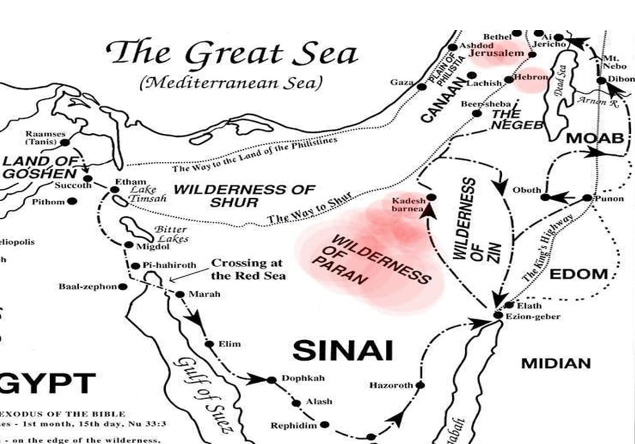
The prophet of God, Samuel, the man who anointed both Saul and David to be kings of Israel, died. Samuel died when he was around 90 years old. The exact date of how many years he lived is not revealed in the Bible but is an educated guess of many Bible commentators. He was buried where he lived, in the town of Ramah. After the funeral, David went south to the wilderness of Paran (see map above).
1 Samuel 25:2:
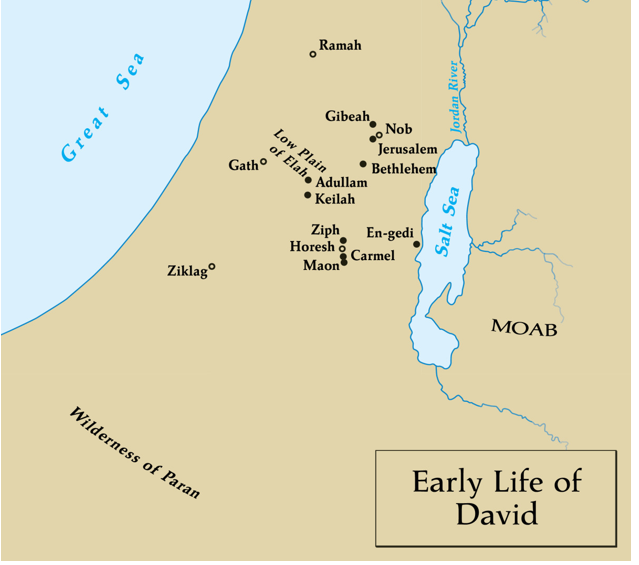
“And there was a man in Maon, whose possessions were in Carmel; and the man was very great, and he had three thousand sheep, and a thousand goats: and he was sheering his sheep in Carmel.”
This man, who was very wealthy, lived in Maon, but he sheared his sheep in Carmel, which was about two miles north from Maon. This was not Mt. Carmel which was located further north on the Mediterranean Sea.
1 Samuel 25:3:
“Now the name of the man was Nabal; and the name of his wife Abigail: and she was a woman of good understanding, and of a beautiful countenance: but the man was churlish and evil in his doings; and he was of the house of Caleb.
Nabal was churlish (rude, surely, bad-tempered, and lacking basic manners or courtesy) and he was of the house of Caleb. This is another case of a beautiful woman, inside and out, who is married to a very selfish man? Why? Why would these two opposites be married? Were they opposites when they married? The Bible doesn’t tell us.
And who was Caleb that Nabal was descended from? Caleb represented Judah as one of the 12 spies sent to explore the land of Canaan. Ten of the twelve spies claimed the land was too dangerous to conquer because of giant inhabitants, causing the people to rebel. Only Caleb and Joshua urged the people to move forward, stating that God would give them victory. Because of his “different spirit,” God promises that Caleb and Joshua would survive the 40 years of wilderness wandering that punished the disbelieving generation.
At 85 years old, Caleb received Hebron as his personal inheritance, where he successfully drove out the remaining giant warriors, the Anakites. Caleb drove out the three giant sons of Anak: Sheshai, Ahiman, and Talmai. How Nabal could become so far from Caleb in his actions is regrettable.
As bad and evil as Nabal was, he was married to the most beautiful, sensible, and clever woman. Was he wealthy when they got married? Was their marriage arranged by their parents?
1 Samuel 25:4-9:
4) “And David heard in the wilderness that Nabal did shear his sheep.
5) And David sent out ten young men, and David said unto the young men, Get you up to Carmel, and go to Nabal, and greet him in my name;
6) And thus shall ye say to him that liveth in prosperity, Peace be both to thee, and peace be to thine house, and peace be unto all that thou hast.
7) And now I have heard that thou hast shearers: now thy shepherds which were with us, we hurt them not, neither was there ought missing unto them, all the while they were in Carmel.
8) Ask thy young men, and they will shew thee. Wherefore let the young men find favour in thine eyes: for we come in a good day: give, I pray thee, whatsoever cometh to thine hand unto thy servants, and to the son David.
9) And when David’s young men came, they spake to Nabal according to all these words in the name of David, and ceased.”
Here we go again! David sends ten of his young men to this wealthy man from Maon who was shearing his three thousand sheep in Carmel. These messengers from David explained to Nabal that they protected his sheep as well as his shepherds. You can ask your men, they said, and they will verify what we are saying. None of your sheep or goats were lost. So, we are asking for a small gift from you, as we are rather poor and hungry. We are asking for a little bit of your harvest for our protecting your sheep and goats.
1 Samuel 25:10-12:
10) “And Nabal answered David’s servants, and said, who is David? and who is the son of Jesse? there be many servants now a days that break away every man from his master.
11) Shall I then take my bread, and my water, and my flesh that I have killed for my shearers, and give it unto men, whom I know not whence they be?
12) So David’s young men turned their way, and told him all those sayings.”
What was Nabal’s, the very wealthy man from Maon, answer? It was not good. Nabal acted like he never heard of David, but how did he know that he was the son of Jesse? And what was the remark about every man breaks away from his master. Was he referring to David and Saul?
David’s young men returned and relayed to David everything that transpired. Nabal had told the ten men that he was not going to give David and his men anything. He was not going to reward them anything for being a protective shield by keeping away the Philistines from capturing some of his flock.
David had to take care of his six-hundred-man army. Like everything else, it takes money of some kind. When someone has so much money that he can’t spend it all, he should help the poor in his area. Nabal violated Deuteronomy 15. Let’s just look at one verse.
Deuteronomy 15:7:
“If there be among you a poor man [or men] of one of thy brethren with in any of thy gates in the land which the LORD thy God giveth thee, thou shalt not harden thine heart, nor shut thine hand from thy poor brother[s]:”
What an insulting answer to return unto so mild a request. To justify a refusal, he heaped insults on the head of David. If Nabal was anything like Caleb, he could have made a good gift to the future king of Nabal’s nation and what would have happened to him is anyone’s guess, but I believe it would have been good.
The ingratitude which Nabal had shown, and the provoking language he had used, were hard to endure. His only recourse lay in God, but momentarily David forgot that he had committed his cause unto the LORD and took matters into his own hands.
What had happened to David? He had just won a great victory in not letting his flesh take over and kill Saul. And now he was seeking his own revenge on a wealthy sheep owner?
Why did God permit this breakdown? To show that David was far from perfect. These “breakdowns” in the lives of ALL the LORD’s servants, including us, are no better than any other of our brethren. A person who rises above all the misfortunes of his life is simply because of the supernatural power of the Holy Spirit.
1 Samuel 25:13:
“And David said unto his men, Gird ye on every man his sword. And they girded on every man his sword; and David also girded on his sword: and there went up after David about four hundred men; and two hundred abode by the stuff.”
This was another test by God. And David failed. What made this test more poignant to David’s soul was the fact that he himself had acted honorable and kindly toward Nabal. When, on a previous occasion, he had sojourned in these parts, he had not only restrained his own men from preying upon Nabal’s flocks but had been a defense to them from the wandering bands of the Philistines. It was, then, the least that this wealthy sheep owner could do, to now show his appreciation and make present of a little food to David’s men. Instead, he mocked them. Ingratitude is always trying to flesh and blood, but more so when it is coupled with gross injustice.
Why does God test David (and us) in this way? For various reasons. Among other things, to furnish us opportunities to act out what we profess.
1 Samuel 25:14-17:
14) “But one of the young men told Abigail, Nabal’s wife, saying, Behold, David sent messengers out of the wilderness to salute our master and he [Nabal, her husband] railed on them.
15) But the men were very good unto us, and we were not hurt, neither missed we any thing, as long as we were conversant with them, when we were in the fields:
16) They were a wall unto us both by night and day, all the while we were with them keeping the sheep.
17) Now therefore know and consider what thou wilt do; for evil is determined against our master, and against all his household: for he [Nabal, her husband] is such a son of Belilal, that a man cannot speak to him.”
What if this one young man had said nothing? Would history have changed? I think we must conclude that it was divine intervention that one of Nabal’s young men spoke up and he spoke just in time. He told Abigail, Nabal’s wife, what Nabal had just done. The young man probably drew the logical inference that David would avenge his insult, and anxious for his own safety, as well as for the other members of the household, and yet not daring to voice his fear unto Nabal, he informed his wife, Abigail. Did Abigail take any action?
1 Samuel 25:18-20:
18) “Then Abigail made haste, and took two hundred loaves, and two bottles of wine, and five sheep ready dressed, and five measures of parched corn, and an hundred clusters of raisins, and two hundred cakes of figs, and laid them on asses.
19) And she said unto her servants, Go on before me; behold, I come after you. But she told not her husband Nabal.
20) And it was so, as she rode on the ass, that she came down by the covert of the hill, and, behold, David and his men came down against her; and she met them.”
Abigail quickly rounded up supplies to give to David’s men. It would be difficult to estimate how much these food items would cost, but they were only a partial supply for 600 men and their wives and children. Abigail did not tell her husband, for she knew him and that he would not allow her to do this for David’s men and there would have been much bloodshed. Here we have the instance of a good wife pleading for the life of her husband and taking responsibility for his evil ways.
When David met her, he told her all the things that were true about his men and her men. They had protected their sheep so that none was missing. And while David talked to her, he became aware of his wrong behavior. In verses 32-35, David, no doubt impressed by her, accepted her plea and blessed her for being an instrument of God in keeping him from sinning against innocent blood. He recognized her as an agent of God to turn him from his bloody purpose.
1 Samuel 25:36-38:
36) “And Abigail came to Nabal; and, behold he held a feast in is house, like the feast of a king: and Nabal’s heart was merry within, for he was very drunken: wherefore she told him nothing, less or more, until the morning light.
37) And it came to pass in the morning, when the wine was gone out of Nabal, and his wife had told him these things, that his heart died within him, and he became as a stone.
38) And it came to pass about ten days after, that the LORD smote Nabal, that he died.”
Though Nabal could slaughter many of his sheep (he had three thousand of them) and spend much on a great feast for himself and his servants and friends, he was so mean and selfish that he would not consider the request of David who no doubt was in desperate need of food for his men and the women and children with them.
Nabal, as soon as his wife told him what happened, became paralyzed with fear and pined away so that he died in ten days. Now what good were his three thousand sheep and one thousand goats after he was dead? How many regret all the wealth that they had when they died and didn’t give it to those who could have used some of it when they were alive.
1 Samuel 25:39:
“And when David heard that Nabal was dead, he said, Blessed be the LORD, that hath pleaded the cause of my reproach from the hand of Nabal, and hath kept his servant from evil: for the LORD hath returned the wickedness of Nabal upon his own head. And David sent and communed with Abigail, to take her to him to wife.”
This was the second time David recognized that God had kept him from evil in killing Nabal. And what did David do next? He sent his servants to commune with the widow of Nabal and asked her to marry him.
Now, who received Nabal’s wealth when he died? One would think that it would be Abigail, his wife. Did David now receive what Nabal owned when he was alive? How could David run his operation, when he was fighting to be king of Israel? The Bible is silent on this.
In my last sermon, I mentioned that it used to be that a man would ask the woman’s father for permission to begin to get to know her with the possibility of marrying her. The woman didn’t know that this event happened if the father didn’t reveal it to her.
Then it changed to dating, where the proposal is made to the woman who makes the decision on her own. I then reveal something that I didn’t know that a man asks the preacher of his church to ask the proposal on his behalf to the woman. Now we have another way. For David had his servants propose to Abigail. The new widow, Abigail, accepted and became David’s second wife.
1 Samuel 25:43, 44:
43) “David also took Ahinoam of Jezreel: and they were also both of them his wives.
44) But Saul had given Michal his daughter, David’s wife, to Phalti the son of Laish, which was of Galim.”
What is David doing? Why does he marry Abigail now? He was a homeless wanderer and in no condition to give unto a wife the care and devotion to which she is entitled. Should he wait a little bit, after the death of her husband, before she was asked to be his wife? Doesn’t the Scripture teach “to everything there is a season” (Ecclesiastes 3:1).
And how did David know Ahinoam? What happened? The Bible does not tell us anything about their relationship. He was still homeless and in no way to provide for her. When did they meet? How soon after he asked Abigail to marry him did, did he ask Ahinoam?
Would he be chastised for these marriages? We will see what happens in my next sermon.
How many wives did David have in his lifetime? Eight! Saul’s older daughter was to have married David because she was one of the prizes given to the person who murdered Goliath. But she was given in matrimony to Adriel the Meholathite, while David married:
- Michal: King Saul’s younger daughter, who was madly in love with him.
- Abigail: The widowed wife of Nabal from Carmel, and the mother of Chileab (also called Daniel)
- Ahinoam: From Jezreel, and the mother of David’s firstborn son, Amnon
- Maachah (or Maacah): the daughter of Talmai, king of Geshur, and the mother of Absalom and Tamar (daughter)
- Haggith: The mother of Adonijah
- Abital: The mother of Shephatiah
- Eglah: The mother of Ithream
- Bathsheba: the widow of Uriah, the mother of Solomon, who succeeded David on the throne
King David had at least 20 children by his 8 wives, including 19 sons and one daughter, plus an unknown number of children with his concubines (women with lower social status than wives).
This would be a good place to stop this lesson. David’s love life was a place where David needed some work. It proved disastrous for him. David just keeps on being the subject of attacks on his life, he keeps on getting into hot water, many times it was his own fault…And having all these wives and concubines, with all these children, I believe, was his own fault.
To be continued.
Blessed be the LORD God of Israel.