The Life of David - Part 2
ABIATHAR
Copied from the Sermon notes of Pastor Don Elmore
August 30, 2026
Scripture Reading: Psalm 52:1-9:
“Why boastest thou thyself in mischief, O mighty man? The goodness of God endureth continually.
Thy tongue deviseth mischiefs; like a sharp razor, working deceitfully.
Thou lovest evil more than good; and lying rather than to speak righteousness. Selah.
Thou lovest all devouring words, O thoudeceitful tongue.
God shall likewise destroy thee for ever, He shall take thee away, and pluck thee out of thy dwelling place, and root thee out of this land of the living. Selah.
The righteous also shall see, and fear, and shall laugh at him.
Lo, this is the man that made not God his strength; but trusted in the abundance of his riches, and strengthened himself in his wickedness.
But I am like a green olive tree in the house of God: I trust in the mercy of God for ever and ever.
I will praise Thee for ever, because Thou hast done it: and I will wait on Thy name; for it is good before Thy saints.”
Who are the pronouns “thou,” “thyself,” “thy,” “thee,” “him,” “his,” in the first seven verses on this Psalm referring to? The heading of this Psalm tells us this:
“A Psalm of David, when Doeg the Edomite came and told Saul, and said unto him, David is come to the house of Ahimelech (1 Sam 21).”
This Psalm, Psalm 52, is about Doeg and what he said to Saul about David’s visit to Nob. Saul had just criticized his Benjaminite servants that they had conspired against him when Doeg, the Edomite, answered him.
Who is an Edomite? It is a descendant of Esau. What is a descendant of Esau doing making comments, or even being in the army of the descendants of Jacob? Doeg served King Saul as the chief of his herdsmen. The Bible does not explicitly state how a foreigner (stranger) and an enemy from Edom joined Saul’s royal staff. But most historians and scholars suggest Doeg may have been taken as a captive during Israel’s military campaign against Edom or entered service as a political ally or high-ranking servant.
Israel, the descendants of Jacob, have never learned their lesson as many battles were lost when they had an Edomite(s) as one of their political or military allies. For example, there were between 2,000 to 3,000 military and governmental Jews in the Confederate States of America when they fought against the Union. Judah P. Benjamin was the most prominent Jewish official in the Confederacy. He served as Confederate Attorney General, Secretary of War, and Secretary of State under Jefferson Davis. He was not born in the United States but on the island of St. Croix in the Danish West Indies which is now part of the U. S. Virgin Islands. After the war was over, he escaped capture and left the country and went to England where he served as the Queen’s chief lawyer.
A few other prominent members were David Levy Yulee (Jew), a former U. S. Senator from Florida who helped lead Florida into secession and served in the Confederate Congress. Abraham C. Myers (Jew) who served as Quartermaster General of the Confederate States. And Benjamin F. Jonas (jew) who served as a Confederate artillery private from Louisiana and later a U. S. Senator. There were Jews on both sides in the most atrocious battle the U. S. has ever fought.
The Bible indicates that there was only one Edomite that responded to Saul’s bitter words to his men. The man was Doeg who carries his ancestry in the text: the Edomite. He made known David’s secret visit to Ahimelech (high priest), and his obtaining bread and the sword of Goliath (verses 9 and 10 of 1 Samuel 22) from the high priest.
1Samuel 22:9, 10:
9) “Then answered Doeg the Edomite, which set over the servants of Saul, and said, I [Doeg] saw the son of Jesse coming to Nob, to Ahimelech the son of Ahitub.
10) And he [Ahimelech] inquired of the LORD for him [David], and gave him [David] victuals, and gave him [David] the sword of Goliath the Philistine.”
Nothing was mentioned by Doeg of the high priest being imposed upon, but the impression was left that he joined with David in a conspiracy against Saul. Let us learn from this that we may not “bear false witness against our (racial) neighbor” by maliciously withholding part of the truth, the same as deliberately inventing a lie. When we are called upon to express our honest opinion of another requires that we impartially recount what is in his favor, as well as what is against him. Note how in His addresses to the seven churches in Turkey, the LORD commended the good, as well as rebuked that which was evil. But Doeg was an Edomite, who had the DNA of a liar.
The terrible sequel is recorded in verses 11-19. Ahimelech and all his subordinate priests were promptly summoned in the king’s presence. Though Ahimelech was by rank the second person in Israel, Saul repeatedly called the high priest “the son of Ahitub” (verse 12).
1 Samuel 22:12:
12) “And Saul said, Hear now, thou son of Ahitub. And he [Ahimelech] answered, Here I [Ahimelech] am, my [Ahimelech’s] lord.”
Quietly ignoring the insult, Ahimelech addressed the king as “my lord,” thus giving honor to whom honor was due – the occupant of any office which God has appointed is to be honored, no matter how unworthy of respect the man may be personally.
Next, the king charged the high priest with rebellion and treason (verse 13).
1 Samuel 22:13:
13) “And Saul said, unto him [Ahimelech], Why have ye [Ahimelech] conspired against me [king Saul], thou [Ahimelech] and the son of Jesse, in that thou hast given him [David] bread, and a sword, and hast inquired of God for him [David], that he [David] should rise against me [King Saul], to lie in wait, as at this day?”
Ahimelech then gave a truthful account of his transaction with David (verses 14 and 15).
1 Samuel 22:14, 15:
14) “Then Ahimelech answered the king, and said, And who is so faithful among all thy servants as David, which is the king’s son in law, and goeth at thy bidding, and is honourable in thine house?
15) Did I then begin to enquire of God for him? Be it far from me: let not the king impute any thing unto his servant, nor to all the house of my father: for thy servant knew nothing of all this, less or more.”
But nothing could satisfy the incensed king but death, and orders were given for the whole priestly family to be butchered in the rest of chapter 22 of 1 Samuel. Now, here is the part to consider: who obeyed Saul’s order to kill the priests? Saul ordered his servants to kill the eighty-five priests. But none of Saul’s soldiers would lay their hands on any of God’s priests. They believed there was not the slightest justice in such an execution. They didn’t believe what Saul had accused the priests of doing.
So, who killed the priests? It was Doeg the Edomite! One of the most heartless executioners in history, for he sought the momentary favor of Saul. Murdering one man is a horrible crime, but deliberately killing eighty-five men of God for a little favor with another is unthinkable.
My one question would be, why didn’t Saul’s soldiers stop Doeg from murdering the eighty-five priests. It would take some time for one person to execute that many priests. It wouldn’t be difficult for three or four soldiers to surround the executor and stop him from his murderous rampage.
But there was a reason. There was a prophecy to Eli that his house would be cut off from being priests. It was almost fulfilled on this murderous day (1 Samuel 2:31). God stated that Eli’s house will be cut off so that no descendant would reach old age or remain in the priestly office. God warned Eli that his wicked sons, Hophni and Phinehas, would both die on the same day, when the Philistines would capture the Ark of the Covenant, as well as Eli’s own death. God promised to raise up a faithful priest to replace Eli’s lineage.
On this day, eighty-five, all but one of Eli’s descendants, would be dead. That was the reason, I believe, that Saul’s soldiers didn’t stop Doeg from killing the priests. It was only a few decades later, that King Solomon (David’s son) removed Eli’s last major descendant, Abiathar the priest. He replaced him with Zadok, explicitly fulfilling this spoken word (1 Kings 2:27).
1 Kings 2:27:
27) “So Solomon thrust out Abiathar from being priest unto the LORD; that he [King Solomon] might fulfil the word of the LORD, which He spake concerning the house of Eli in Shiloh.”
Then King Saul did something even worse. He destroyed completely the city of the priests—Nob. The Scripture says that Saul destroyed the men, women, children and infants, oxen, donkeys, and sheep with the edge of the sword. Saul (his army) destroyed every person and animal of the priests through jealousy, but he did not obey the command of God to do this to the enemies of both God and Israel—the Amalekites, the grandson of Esau.
There was only one priest who escaped Saul’s wrath of killing. It was Abiathar. All his family and animals were slain. Where did Abiathar go? No one was left. Where would you go if this catastrophe happened to you? No more parents, uncles, aunts, grandparents, brothers, sisters, cousins, friends, neighbors, pets, animals—all gone. Abiathar, the remaining priest was all alone.
Where did he go? He went to the person that Saul wanted to kill the most—David. And Abiathar brought something that was used by David several times that helped him greatly. Remember, Abiathar was a priest of God, and he brought with him from Nob the ephod when he fled the destroyed city of Nob.
1 Samuel 23:6:
6) “And it came to pass, when Abiathar the son of Ahimelech fled to David to Keilah, that he came down with an ephod in his hand.”
The ephod was a sacred priestly garment containing the Urim and Thummim, used to seek divine guidance and inquire of God. David used the ephod that was brought to him by Abiathar to ask God for direction during his time as a fugitive and to help keep him from being captured and/or killed.
David inquired of the LORD many times about what he was to do, by using these three objects—the Urim, Thummim and the ephod. He wouldn’t have been able to do this if Saul hadn’t killed all the priests but one. Saul didn’t know that one priest was left at Nob, for what reason we are not told. If Abiathar had not remained at Nob, then Saul would have completely killed all the priests of Eli. And there would be no one left to bring to David the Urim, Thummim, and ephod. What a wonderful God we have.
When Abiathar fled to David, he told him that all Israel’s priests had been slain and the city of Nob destroyed. He was the only one left. Abiatha was Eli’s great-great-grandson (Abiathar, the son of Ahimelech, the son of Ahitub, the son of Phinehas, the son of Eli).
David told Abiathar that he knew, when he spoke to Ahimelech, that Doeg, the Edomite, was there and he would surely tell King Saul what he witnessed. He confessed that he had occasioned the death of all the priests of Eli’s house.
David then promised the last refuge of the priests of Eli’s house, to fear not, for if you stay with me, you will be in safeguard. So, Abiathar joined with David’s army and served as the priest for his army. After David became king, he appointed Abiathar and Zadok to serve jointly as high priests.
Abiathar was loyal to David, but when Adonijah plotted to usurp the throne that Solomon was to inherit, Abiathar supported and sided with Adonijah (1 Kings 1:7). After David’s death, Solomon succeeded him as king. When Adonijah attempted another rebellion, he was killed by Solomon. However, King Solomon, remembering that Abiathar had shared in the sufferings of his father David, spared his life but removed him from his priestly office. The priestly line of Eli’s house was thus cut off, fulfilling the word the LORD had spoken earlier (1 Kings 2:27; 1 Samuel 2:27-36).
WHAT HAPPENS NEXT?
What would it be like to live the life of David? What a life! He was the youngest of eight sons and was so little thought of that when the prophet of God came to anoint one of Jesse’s sons to be king, that they didn’t even have David present. He was still working outside as a shepherd. He would be anointed king of Israel but wouldn’t serve as being king over all Israel until almost twenty years later.
A little bit later, David, still a teenager, went to deliver food to his three oldest brothers in Saul’s army. He was surprised that no one answered Goliath’s call to fight him. David thought that the giant was defying their LORD. It is like today, when the ancestors of the Edomites say in their “holy” book—the Talmud, that the Savior of the White race is now in hell, and that is where all His followers will go too; isn’t that not even more blasphemous? And the average Christian doesn’t lift a finger against them. Jesus wouldn’t even live in their capital, Jerusalem, because they sought to KILL him (John 7:1).
John 7:1:
1) “After these things Jesus walked in Galilee: for he would not walk in Jewry, because the Jews sought to kill him.”
So, David began questioning the soldiers asking them what the reward was for killing Goliath. But his older brother immediately began to offer rude, false statements about what his youngest brother was doing at the battle ground camp.
After young David defeated Goliath, he became the hero of Israel. He was the musician who played for the king and put him in a relaxed mood. But suddenly, King Saul became jealous of David and threw two spears at him to kill him. This was the first of twenty-one times he tried to murder his “best” friend.
David was banished from the court and made captain over a thousand men. Saul hoped that he would be killed, but, instead, David had great success. So, Saul gives one of his daughters to be his wife, but he must kill 200 Philistines to marry her. Saul hoped that David is killed. But he is not killed but is very successful.
His wife warned David just in time and David’s escapes one of Saul’s plans to kill him. David then flees to Nob, the city of the priests. He asks them for some food and the only food they had on hand was the consecrated showbread, which was set before the LORD in the tabernacle and reserved exclusively for the priests under Mosaic Law. David told Ahimelech that his men had kept themselves from women, making them ceremonially clean, and the priest gave David the showbread, which only the priests could eat. But this incident was cited by Jesus in the New Testament to show that if the context was one of immediate need and survival it was permitted and overruled the ritual law.
Matthew 12:3, 4:
3) “But He [Jesus Christ] said unto them[Jewish Pharisees], Have ye not read what David did, when he was an hungred, and they that were with him;
4) How he entered into the house of God, and did eat the shewbread, which was not lawful for him to eat, neither for them which were with him, but only for the priests?”
David also, besides being given some bread to eat, was also given the sword of Goliath that was kept there. David was given Goliath’s weapon of war, because he didn’t have any since he had to flee in a hurry and didn’t have time to gather his weapons.
The Bible doesn’t tell us, that when he leaves Nob, if he took the sword of Goliath back to the Philistine city where the giant had lived with his giant family. Nevertheless, the Bible tells us that David went to Gath and asks the king for protection from King Saul.
While the king of Gath, Achish, was considering what to do with David, his servants began to question David’s request. They couldn’t believe that the Hero of Israel would want the King of Gath, where the Philistine’s giant and family had lived, to protect him from his own king. Why is he here? The king began to consider killing David.
What is David to do? David changes his behavior and begins to act like he is crazy or insane. The Bible doesn’t go into detail on what he did except to say that he committed pure deception. He escaped the danger that he was in because the king rejected him and threw him out of the city.
David then goes to the cave in Adullam. He is alone and all by himself. He has just been disgraced in Gath, and now he doesn’t even have any soldiers under his command.
But then his family finds out that he is there and joins him. Then about four hundred discontented, in debt, and distressed individuals, join him. He becomes their captain.
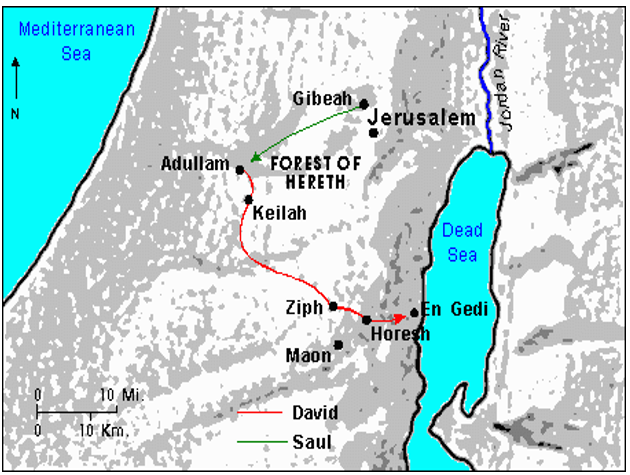
He then takes his parents to Moab for protection from King Saul. He is then ordered by a prophet of God to return to Judaea. So, David obeys and goes to the forest of Hareth, Saul hears that there is where he is. He begins to plan to attack and kill him.
Doeg, the Edomite, tells Saul that the high priest aided David while he was fleeing him. Saul calls for all the priests to come to him, and he tells them that they are guilty of treason and he orders them to be killed. None of his soldiers will obey that order, but Doeg, the Edomite, kills all eighty-five priests. Saul then goes to Nob and commits, what he didn’t do against the Amalekites, genocide against the people of the priests. Only one priest escapes being murdered.
Then they told David some terrifying news. The Philistines were fighting against the city of Keilah and were robbing the threshing floors (1 Samuel 23:1). It was a favorite practice of the near-by pagan nations to wait until the wheat was ripe and threshed, then invade the country to carry off the harvest.
David was in a dilemma. Though his hands were full in seeking to hide from Saul and provide for the needs of his now six hundred men army, yet David unselfishly thought of the welfare of his countrymen.
David now had the Urim and Thummim, brought to him by Abiathar, and he asked God if he should go and smite the Philistines? God answered and said to go and fight against the Philistines and drive them out of Keilah.
But his men were fearful of fighting the Philistines in Keilah, for they feared that Saul would find out and attack them too (1 Sameul 22, verse 3). This presented a real test to David’s confidence in the LORD, for if his men were unwilling to accompany him, how could he expect to relieve the besieged town?
1 Samuel 23:3:
3) “And David’s men said unto him, Behold, we be afraid here in Judah: how much more then if we come to Keilah against the armies of the Philistines?”
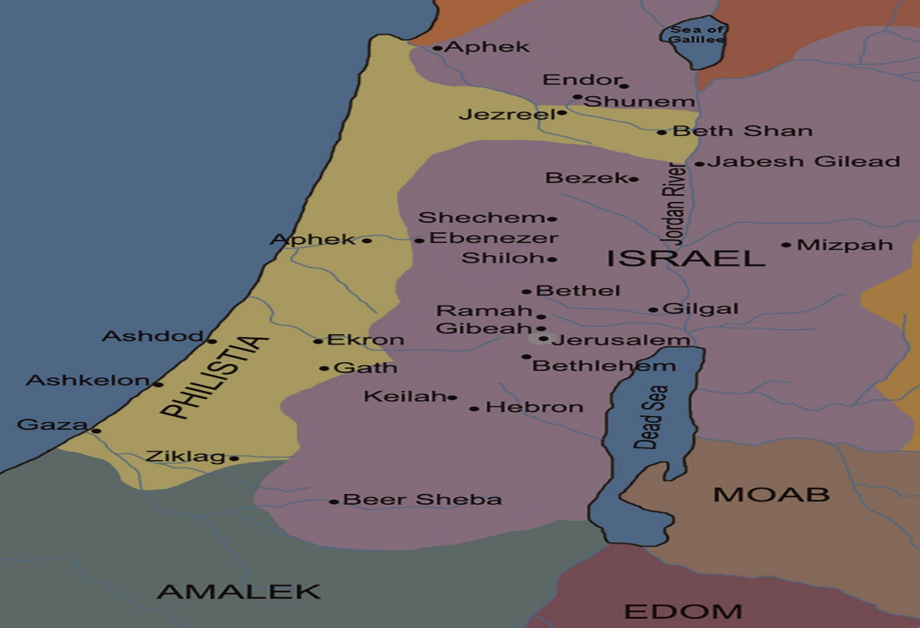
David’s men (only 600) were afraid of being caught between two armies—the Philistines and the Israelite. Were they to advance upon the Philistines and Saul’s army should follow them up in the rear, then where would they be? Their eyes were not upon the living God, but upon their “difficult” circumstances, and to be preoccupied with these is always discouraging to the heart.
What did David do? He enquired of the LORD yet again (1 Samuel 23: verse 4).
1 Samuel 23:4:
4) “Then David inquired of the LORD yet again. And the LORD answered him [David], and said, Arise, go down to Keilah; for I[the LORD] will deliver the Philistines into thine [David’s] hand.”
God replied that David was to go and fight the Philistines at Keilah and he would be successful. David did not allow the unbelieving fears of his men to drive him to despair. He knew how God works. He who had given him orders to go to the relief of Keilah, could easily quiet the hearts of his followers, remove their fears, and make them willing to follow his lead.
So, his men were convinced and they went to Keilah and fought against the Philistines and brought away their cattle. David and his men smote them with a great slaughter, so David saved the inhabitants of Keilah (1 Samuel 23: verse 5).
1Samuel 23:5:
5) “So David and his men went to Keilah, and fought with the Philistines, and brought away their cattle, and smote them with a great slaughter. So David saved the inhabitants of Keilah.”
But did you notice one thing that was said in verse 5? Not only did they completely rout the enemy, but they captured their cattle, which supplied food for David’s men; food which the men greatly needed.
And what about the Philistine army? How did this “crazy man” defeat them. There must have been some disputes about what the king did to let him go and then shortly thereafter, the so-called “crazy man” defeated them.
But what about Saul’s army? He was told that David had come to Keilah. Saul thought in his mind that God had delivered him into his hand. Instead of feeling grateful for David’s victory over the common enemy that should have reconciled Saul to David, Saul planned to attack David. But David escaped.
Now, isn’t that something? Instead of thinking how he might most suitably reward David for his courageous and unselfish generosity, Saul desired only to do him mischief.
Saul called all the people together to war, to go down to Keilah, to besiege David and his men. This was the 16th of 21 attempts that Saul made to kill David. He was 0 for 15 so far. For David enquired of the LORD once more, this time with the Urim and Thummim that Abiathar had brought from Nob. Following what the instruments that the priest brought to David said, allowed David to escape Saul another time.
David then asked the ephod that, Abiathar had brought to him, if Keilah would help Saul or defend David. The answer David received was that the men of Keilah would betray David by telling Saul where he was.
Can you believe that? David risked his life driving the Philistines out of Keilah and saving the town. He risked Saul finding out where he was, which is exactly what happened. If Saul came marching in to fight David, the townspeople would deliver David up to his death? What gratitude.
But they probably, no doubt, heard of the genocide of the priests and their families in the city of Nob. They were scared that Saul could repeat the action again, and this time against them. They were not depending on their LORD God for guidance and protection.
When Saul arrived at Keilah, David and his men, because of the message that David had received from the ephod, had speedily left the town. They journeyed south to the wilderness of Ziph and hid in the mountains. Saul sought after David every day (this was the 17th attempt by Saul to kill David) and God delivered him not into his hands (1 Samuel 23:14). David was willing to expose himself and his men to further hardships, rather than endanger the lives of the people of Keilah. Having no particular place in view, they went forth wherever they thought best. It was always one step ahead of King Saul.
And then something strange happened. Saul’s son, Jonathan, left his home in Gibeah and came to the wilderness of Ziph, and unlike his father, he found David. It must show the protection of God that He had over Saul’s being unable to find David after days of searching. Jonathan tells David four things:
- Fear not, for my father, King Saul, will never find you.
- You will be king over Israel.
- I will be next to you.
- Even my father knows all this.
The two of them, David and Jonathan, made a covenant before the LORD and David remained in the forest and Jonathan went home (Gibeah).
I am sure that this covenant that they made gave David the strength to endure the next betrayal that he suffered. Just like the men of Keilah had done, the men of Ziph also went to Saul in Gibeah and told him where David was hiding. Saul goes after David in a desperate search to find him and kill him.
None but an Almighty hand could deliver him. Blessed is it to see David turning at this time unto the living God and spreading his urgent case before Him. It was then that he prayed the prayer, which is recorded in Psalm 54; the superscription of which reads,
“A Psalm of David, when the Ziphites came and said to Saul, Doth not David hide himself with us?”
Let’s read what Psalm 54 says about his situation.
Psalm 54:1-7:
1) “Save me, O God, by Thy name, and judge me by Thy strength.”
David was in a position where he was beyond the reach of human assistance: only a miracle could now save him, therefore did he supplicate the miracle-working God. But David could remember that Saul’s son had just found him and they made a covenant before the Lord and he had told David,
“To fear not, for my father, King Saul, will NEVER find you” (1 Samuel 23:17).
2) “Hear my prayer, O God; give ear to the words of my mouth.”
How we need to remember and turn unto the LORD when enduring the contradiction of sinners against ourselves. If God has an open ear, we cannot be shut up in trouble.
3) “For strangers are risen up against me, and oppressors seek after my soul: they have not set God before them. Selah.”
Those who had no acquaintance with David, and so could have no cause for ill will against him, were his persecutors; strangers were they to God. In such a circumstance it is well for us to pled before God that we are being hated for His sake.
4) “Behold, God is mine helper: the Lord is with them that uphold my soul.
5) He shall reward evil unto mine enemies: cut them off in thy truth.”
Verse 5 was not spoken in revenge, but as an “Amen” to the sure sentence of the just Judge.
6) “I will freely sacrifice unto Thee: I will praise Thy name, O LORD; for it is good.
7) For He hath delivered me out of all trouble: and mine eye hath seen His desire upon mine enemies.”
David’s absolute confidence that his prayer was answered. It could be compared to Mark 11:24.
Mark 11:24:
24) “Therefore I [Jesus Christ] say unto you[Peter], What things soever ye [Peter] desire, when ye [Peter] pray, believe that ye [Peter] receive them, and ye [Peter] shall have them.”
And now remains for us to observe how God answered David’s prayer.
1 Samuel 23:24-26:
24) “And they arose, and went to Ziph before Saul: but David and his men were in the wilderness of Maon, in the plain on the south of Jeshimon.
25) Saul also and his men went to seek him, And they told David: wherefore he came down into a rock, and abode in the wilderness of Maon. And when Saul heard that, he pursued after David in the wilderness of Maon.
26) And Saul went on this side of the mountain, and David and his men on that side of the mountain: and David made haste to get away for fear of Saul: for Saul and his men compassed David and his men round about to take them.”
Saul was about to feel his success in finally killing David. It was the 19th time he had tried. But do you think David rehearsed what Saul’s son had just told him a few days before:
“Fear not, for King Saul, my father, will NEVER find you.”
 Saul had David outnumber 5 to 1: 3,000 to 600. Saul would have captured David in just a few minutes. Escape was quite cut off: outnumbered, surrounded, further flight was out of the question. At last, Saul’s evil object appeared to be at the very point of attainment.
David would be dead very soon. The anointed of God to be the king of Israel would be vain. The words of Jonathan would be vain. The flight of David from Saul would have been in vain. David’s cry unto God for relief, but before His answer comes, matters appear to get worse. Maybe that is in order that His hand may be the more evident. But man’s extremity is God’s opportunity.
How was David saved from the clutches of King Saul? Just at the right time. If it had come a little bit later, it wouldn’t have mattered, for David would have been already killed.
1 Samuel 23:27:
27) “But there came a messenger unto Saul saying, Haste thee, and come; for the Philistines have invaded the land.”
And how did the Philistines know when to invade Judah. If they wouldn’t have invaded, David would have been dead. If they would have invaded a day later, David would have been dead.
“All things work for good for those that love the LORD (Romans 8:28).”
The Philistines invaded; a messenger was sent; the messenger finds Saul just at the right time; he tells the king that he is needed to fight the Philistines; and what does the king do?
1 Samuel 23:28:
28) “Wherefore Saul returned from pursuing after David, and went against the Philistines: therefore they called that place Selahammahlekoth.”
This was divine intervention to protect David when Saul was about to overtake him. They called that place “Selahammahlekoth” or The Rock of Divisions. The mountain separated the army of Saul from that of David, and because it was here that Saul was obliged to separate himself from David and his men in order to go after the Philistines. God raised up the Philistines to occupy Saul at the exact time he was about to surround David.
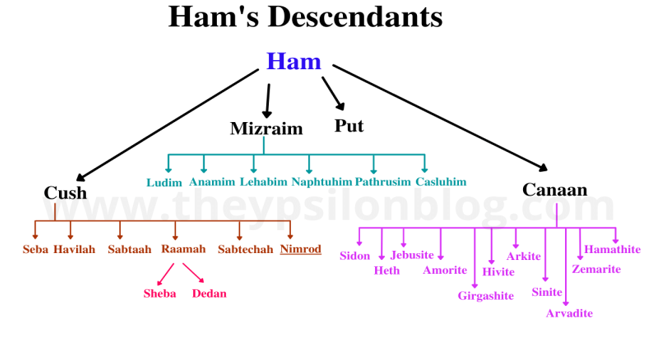
So, while Saul left the mountain and went back to fight the Philistines, David and his 600 men left the area and went to the strongholds at En-gedi. En-gedi was a city on the western shore of the Dead Sea, about the middle section. It was home of the Amorites in the days of Abraham.
The Amorites were the descendants of Ham. They were his grandchildren: Ham, his son, Canaan, and his grandson Amorite.
CONCLUSION
God doesn’t always rescue the afflicted from the physical danger which menaces him. There are many cases in which God did save the person from death that immediately threatened them:
- Elijah from the murderous intentions of Ahab and Jezebel,
- Daniel from the lion’s den,
- Paul was stoned, incited by Jewish leaders, but was revived.
On the other side of the coin, are people who God did not save from being killed:
- The martyrdom of Zechariah,
- The stoning of Stephen,
- One of the twelve apostles, James (son of Zebedee), who was executed by King Herod (he was an Edomite).
David life has been more frequently placed in jeopardy than anyone else. And few men have experienced the Lord’s delivering hand as he did. But there was a special reason for that, and it is this to which we would now call attention. David was one of the progenitors of Israel’s Messiah, and it is indeed striking and blessed to note the wonderful works of God of old in His miraculously preserving the chosen seed from which Christ, after the flesh, was to spring. Indeed, it is this more particularly, which supplies the key to many a divine interposition on behalf of the patriarchs and others, who were in the immediate line from which Jesus of Nazareth issued.
1 Samuel 24:1:
1) “And it came to pass, when Saul was returned from following the Philistines, that it was told him, saying, Behold, David is in the wilderness of En-gedi.
From these words we gather that Saul had been successful in turning back the invading Philistines. This illustrates a principle which is often lost sight of: human success is no proof of divine approbation. The mere fact that a man is prospering outwardly, does not, of itself, demonstrate that his life is pleasing unto the Lord. Only an infidel would deny that it was God who enabled Saul to clear his land of the Philistines, yet we err seriously if we conclude from this that He delighted in him. As oxen are fattened for the slaughter, so God often ripens the wicked for judgment and damnation by an abundance of His temporal mercies.
We will end our lesson here where David and his men are at En-gedi and Saul is coming there to find him. We will continue the amazing story of David in our next sermon.
To be continued.
Blessed be the LORD God of Israel.