Who are the Modern-Day Descendants of Esau? - Part 1
Copied from the sermon notes of Pastor Don Elmore
May 31, 2026
Scripture Reading: Genesis 27:29:
29) “Let people serve thee, and nations bow down to thee: be lord over thy brethren, and let thy mother’s sons bow down to thee: cursed be every one that curseth thee, and blessed be he that blesseth thee.”
This is a series about twin boys who lived about four thousand years ago. Are their lives of any importance in today’s world? Their mother was Rebekah and she was having difficulty while she was pregnant. For the twins struggled so violently while they were in her womb that she asked the LORD what was happening. The LORD answered that there were two manners of people that were in her womb; and “the elder would serve the younger” (Genesis 25:22-23).
Besides dispelling abortion, these two little beings in her womb were the beginning of the history of the world after about four centuries after the flood of Noah. Two world powers, which would come from the descendants of each twin, would fight each other to the death. They would hold vastly different opinions, and views, on most topics.
Who is represented by the pronouns “thee” and “thy” in our introductory verse? Is this the verse that conservative interviewer Tucker Carlson could have used to further embarrass Senator Ted Cruz and Israeli Ambassador Mike Huckabee who showed that they were very pro-Zionists and said that they felt that whosoever “cursed” the Jews would “be cursed.”? This verse, like the one that these pro-Christian Zionists use, Genesis 12:3, didn’t have anything to say about the Jews at that time; for, in fact, it was many centuries before there were any Jews or Christians in the entire world.
The context of the verse in Genesis 27, that is used in our introductory scripture, is the story of the blessings that Isaac, the father, gives to his twin sons. The father is set to give the elder son the greater of the two blessings: the younger son the inferior blessing. Isaac, who was practically blind, called his eldest son, Esau, and told him to go into the field and kill a deer, and then prepare his favorite venison meal for his father. After eating this savory dish, Isaac said he would give Esau the blessing of the first born. So, Esau goes off into the field to accomplish the first portion of his father’s request.
Meanwhile Esau’s mother, Rebekah, who loved Jacob more than she did Esau, overheard what her husband said to Esau and determined that Jacob should get the blessing that Isaac was preparing to give to his oldest twin. Rebekah explained to Jacob how he could deceive his father, who had bad eyesight. Rebekah explained that Jacob could fool his father by impersonating Esau. Jacob would make his father believe that he was his older brother--Esau!
But what if Esau had previously not despised the Abrahamic Covenant? What if Esau had not sold his birthright? What if Esau had not married foreign wives but had wives from his own race? If that happened, wouldn’t Esau’s seed have been the chosen seed of the Abrahamic covenant, and wouldn’t Esau be the one who received the greater blessing from his father? Yes, he would have. But that was not the case. Esau lost the greatest inheritance of anyone in the world.
And what if Jacob failed in his attempt to persuade his father that he was his older twin brother? What would happen then? Jacob rightly feared that if his impersonation were discovered by his father, he would be “cursed” instead of “blessed.” So, the stakes were high.
Did Rebekah ever tell Isaac what God said about the two boys when she was pregnant with them, that “the elder should serve the younger.” And did either or both parents know that Jacob had started the process of having this prophecy come true when he bought the birthright from Esau sixty-two years previously?
But before we go on, there is something that needs to be drawn to the attention of anyone who reads this story: Jacob and Esau were not just brothers, they were fraternal twins. You cannot get much closer than that unless you are identical twins. Twins have a special relationship with each other. It would be highly unusual for twins to develop an intense hatred for each other, for most twins are remarkably close and love each other. So, this story of twins who are so different from each other is very unusual.
But only one of the twins could inherit Abraham’s covenant blessing. And this leads to the greatest question of all: Who are the descendants of the twins? Where and who are they today—after almost four millenniums? Do they still exist?
WHAT HAPPENED BEFORE JACOB GOT MARRIED?
1. Esau sold his birthright.
First, Esau had sold to Jacob his birthright. The Bible doesn’t give the details of what happened, just that Esau was “faint” (Genesis 25:30) and Jacob said to Esau, “Sell me this day thy birthright” (Genesis 25:31). Esau answered Jacob’s question by saying that he was “at the point to die; and what profit shall this birthright do to him? (Genesis 25:32). So, Esau sold Jacob his birthright for a bowl of red lentil soup.
These twins had been two different people from the very beginning of their lives. Esau was an avid hunter who learned war and was fierce and never learned to read and write; while Jacob was an upright man who was a good reader and writer.
The family of Esau (Edomites) was stronger at first than Jacob’s for they had dukes and kings long before Israel did and they were powerful enough to resist Israel’s passage through their land when coming out of Egypt. Their land was south of Judah on the King’s Highway where various traders from different countries traveled and did business with the Edomites.
But years later, King David completely defeated the Edomites and made them subject to Israel for about a century and a half. After the Babylonian captivity, the Maccabees compelled Edom to either leave, die by execution, or embrace the religious ways of the Israelites. After a few decades, after the Edomite/Jews chose the latter, they began to rule over ancient Israel. The Edomite/Jews gained control of Judaea till they were decimated and scattered in 70 A.D., when their capital city, Jerusalem, was destroyed by the Roman Army.
But back to the beginning of the unique story of the different twin boys. The prophecy of the birthright would fail to happen if one or both twins died without having any children. They both had to have at least one child, for if they died childless, they would have not any descendants.
So, according to the pre-birth prophecy, Esau could not die at the time he sold his birthright because he was childless. Therefore, he must not have believed the covenant promises that God had made with his grandfather, Abraham; for it said that they would become a multitude of nations.
The Book of Jasher (Chapter 27), which is mentioned two times in the Bible (Joshua 10:13 and 2Samuel 1:18), gives more details on what happened. It tells the reader that Esau sold his birthright because he believed he was about to die, having ambushed Nimrod and several of his guards. Esau cut off Nimrod’s head and killed his guards that were close by. In addition, Esau stole the “valuable garments God made for Adam and Eve,” which some Bible scholars believe made the wearer invincible and a master hunter. Nimrod’s other protecters, who were a short distance away from where the murder happened, soon returned after hearing the screams of death that took place, and discovered the dead bodies and chased after Esau.
Esau fled, became weary, and exhausted from the flight, returned to his father’s house in fear of his life. Upon arriving home, Esau found Jacob preparing red lentils in a pottage. Because Esau believed his death at the hands of Nimrod’s guards was imminent, he deemed his birthright useless. So as a result, he sold his birthright to his twin brother Jacob. (Hebrews 12:16-17). But Nimrod’s guards failed to find Esau and he lived. The selling of his first-born birthright, according to the Book of Jubilees (Ethiopian Bible) happened shortly after the death of Abraham (Chapter 24:1).
Three years after the death of their grandfather, Isaac intended to send his two sons to live in Shem and Eber’s house to learn the ways of their God. The location of their home is not given in the Bible, but it probably was somewhere in Mesopotamia. But Esau was not willing to go and instead remained with his father and mother and spent his time hunting. When Esau was in his late thirties, he hunted in the land of Mt. Seir for a year and four months (Book of Jasher, Chapter 28).
2. Esau married Canaanite wives.
Second, twenty-five years after Esau had sold his birthright to Jacob; while hunting in Mt. Seir, Esau found the daughter of Berri, a Canaanite and he married her. Her name was Jehudith. He took her to his father’s house in Hebron, and they lived there with his parents.
Ten years later, when the twins were both fifty years old, Shem died and Jacob returned to Isaac’s house after being gone for thirty-two years. Shortly after Jacob returned to his parents’ home, he left again and lived with Eber for fourteen more years.
Meanwhile, Esau also left his parents’ home and lived in Mt. Seir for sixth months. During this time, he married his second Canaanite wife, Bashemath. He then returns to his parents’ home. While Esau and his two wives lived with his parents, his two wives drove his parents to the point where they were almost suicidal.
Rebekah said to her husband, “I am weary of my life because of the daughters of Heth (Hittites)” that Esau has married. If our other son, Jacob, marries any Canaanite women, “what good shall my life do me?” (Genesis 27:46).
Both twins were seventy-seven years old when Rebekah made this criticism. Esau had been married for thirty-seven years to his first wife and fourteen years to his second, while Jacob was still unmarried (Book of Jasher, Chapters 28 and 29).
And what about Abraham? Do you think that he had warned his offspring to not marry any Canaanite women? In the Book of Jubilees, Chapter 20:4b, it tells the reader that Abraham called his eight sons; Ishmael, Isaac, and the six sons of Keturah, to come together and he would talk to them and their sons, his grandchildren. He explained to all of them that they were to “not take to themselves wives from the daughters of Canaan.” This was when both twins were younger than fifteen years old. So, Esau was warned by his grandfather not to marry the Canaanite girls who were living nearby.
What about Jacob? He was seventy-seven years old and was still not married and his father repeated to him the warning that Abraham had given him, “Thou shall not take a wife of the daughters of Canaan” (Genesis 28:1). His parents did not want his other son to follow in the footsteps of his elder twin and ignore the warning of his elders. The failure of Esau to keep his part of the race pure was a grief to his parents.
Jacob was getting old and he needed to find a wife that was of the same race as him. Sixty years previous, Jacob’s grandfather, Abraham, spoke to Jacob right before he died and told him that he would be the recipient of the covenant that had been given to Him (Book of Jubilees, Chapter 22:15). He warned Jacob to not take any of the daughters of Canaan (Ibid, verse 20). He continued on his death bed to inform Jacob that it would be he (Jacob) and his seed that would inherit all the blessings of the covenant. Abraham died in the bed, with Jacob right beside him.
Why wasn’t Jacob already married? He was close to eighty years old and still a bachelor. Why didn’t Jacob make the trip to Syria and find himself his mate when he was in his twenties or thirties? The people of his kind, where both of his parents lived for a while, were living in Babylonia, Aram (parts of modern-day Syria and parts of Mesopotamia), Syria and Mesopotamia. It says in the Book of Jasher that he had lived there for forty-six out of seventy-seven years with Shem and/or Eber.
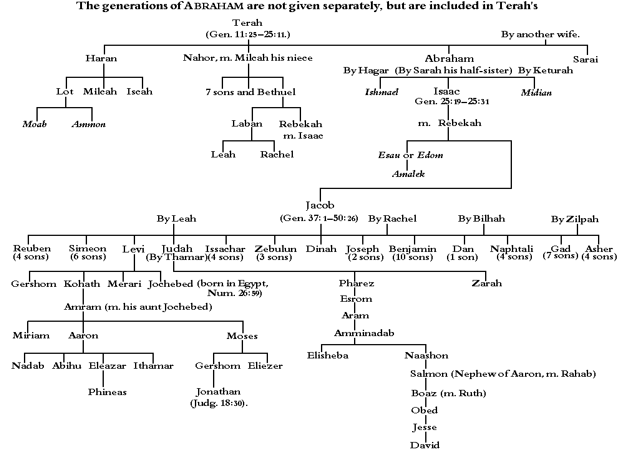
As the twins grew up, the Book of Jubilees says that Abraham loved Jacob the best of all his offspring, but Isaac, his son, loved Esau. Abraham went to Jacob’s mother and told her that her husband loved Esau, but he encouraged her to keep her love for Jacob all through her life. For Abraham said that “…all the blessings wherewith the Lord hath blessed me and my seed shall belong to Jacob and his seed always” (Chapter 19:23). Abraham had confirmed the covenant blessing to Jacob and not to Esau. This was before Esau sold his birthright and married any Canaanite women!
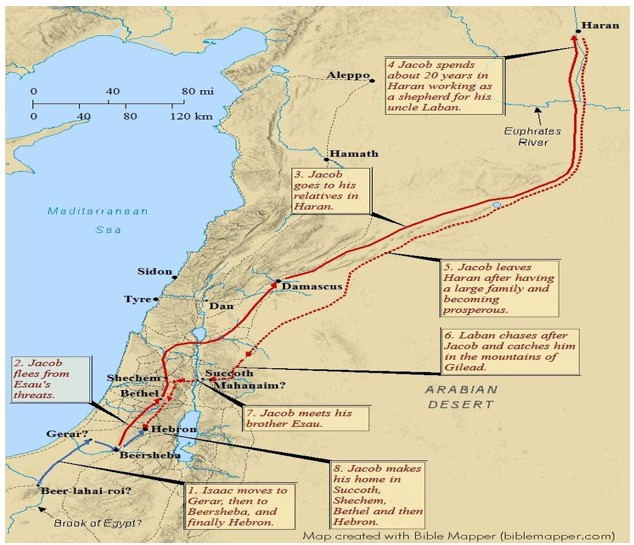
Jacob’s parents were convinced from the behavior of the Canaanite wives of Esau, that they had no choice. They had to obey Isaac’s father and have their second son marry one of their relatives. The closest ones were five hundred miles away. It would be a long journey.
3. Isaac gave the covenant blessing.
Third, Jacob went to find a wife in Haran when he was around 78 years old. But before this happened, the third event in the lives of Jacob and Esau occurred. This was a pivotal point in the story of the Bible and the history of the world.
Isaac called Esau and told him to go hunt for deer and fix him a venison meal. After he finished eating this meal, he would give Esau the blessing of the first born (Genesis 27:1-4).
What was wrong with what Isaac had just said to his first-born son Esau? It is possible that Isaac wasn’t aware that Esau had sold his birthright to Jacob (sixty years previously), but he certainly knew of his marriages to the Canaanite women. So, Esau disqualified himself from the promises of the Abrahamic Covenant. There was no way that Isaac could bless Esau with the elder son birthright. Esau’s sons were bastards; but Isaac loved Esau.
But, instead of leaving that situation up to God, Rebekah interfered. Rebekah told Jacob to go into the flock and gather two goats and after he killed and butchered them to bring them to her and she would fix a meal that would taste like venison for his father. Jacob, who had smooth skin, unlike his twin brother’s hairy skin, would put the skins of the young goats upon his arms and upon the smooth of his neck to deceive his father that he was hairy and help make him believe he was Esau. Rebekah then took a few of Esau’s clothes, which had the smell of the field, because Esau was an avid hunter and spent most of his time in the field hunting.
But there was one problem that could not be solved: it was that Jacob had a different sounding voice than his brother Esau. But the plan, (1) with the hairy goat skin on Jacob’s arms and neck, (2) the clothes of Esau which had the smell of the field, and (3) the goat meat which was fixed to taste like the venison that his father loved, would convince Jacob’s father and Rebekah’s husband that Jacob was Esau. The plan worked to perfection. Isaac blessed Jacob thinking he was blessing Esau.
Now, let’s stop and think what was taking placing place at this moment. Jacob, who was the youngest twin, received the blessing of the first- born. Esau was the first-born, but he had sold this birthright to Jacob for a bowl of soup, thinking that he was about to die. Plus, to show that Esau “despised the covenant” he had married two Canaanite wives which was forbidden by divine commandment and by his parents and grandfather. Then Jacob impersonated Esau and went to their father and received the blessing of the first born.
His father, Isaac, thinking he was blessing Esau, was blessing Jacob. But this just made the hatred of Esau towards Jacob intensify. For shortly after they discovered what Jacob had done, Esau and his father wept bitterly. Esau then vowed that he would slay his twin brother after his father’s death.
And to make matters worse, it wasn’t good that Rebekah interfered. God would not have given Esau the blessing of the Abrahamic covenant. She didn’t have to do anything. And the consequences that Jacob suffered would not have occurred.
And when Esau observed that the daughters of Canaan did not please his father, Isaac, he went to Ishmael and took one of his daughters to be his wife. He married Mahalath, the daughter of Ishmael, his uncle and Abraham’s first son (Genesis 28:8, 9) and the sister of Nabaioth, to become his third wife.
But Esau and Jacob present a major situation that is omitted from most Bible studies. Esau and Jacob were to be two distinct, different nations. They were even fighting in the womb and when Jacob came out, he had his hand on Esau’s heel.
Don’t you think that the descendants of these two twin brothers should be well known in today’s world? But that fact is that the exact opposite is true. They are unknown to most of the people of the world. More about this in my next sermon.
The descendants of Esau and Jacob have laid the foundation of what has and is happening in world history. All throughout history they have been battling each other in a furious struggle to rule the world. Millions of descendants, on both sides, have been slaughtered in the many conflicts throughout the ages. It is now coming to a great climax. The United States is in a state of being deceived by the descendants of Esau, that they are the descendants of Jacob!
Who do you think are the people of the ten “thees,” “thous,” and “thys” in the following two verses:
Genesis 28:3, 4:
3) “God Almighty bless thee, and make thee fruitful, and multiply thee, that thou mayest be a multitude of people;
4) And give thee the blessing of Abraham to thee, and to thyseed with thee; that thou mayest inherit the land wherein thou are a stranger, which God gave unto Abraham.”
1) God Almighty bless you (Jacob),
2) God make you (Jacob) fruitful,
3) God multiply you (Jacob),
4) God make you (Jacob) a multitude of people,
5) God give you (Jacob) the blessing of Abraham,
6) God give your seed (Jacob’s seed) the blessing of Abraham, and
7) God give you (Jacob’s seed) the land of Canaan, as promised Abraham (Genesis 28:3, 4).
JACOB’S LIFE IS CHANGED
After receiving the special blessing from his father, Jacob left his parents in Beersheba and started his long journey to Haran, Syria. When he was about one tenth of the way there, he stopped to rest at a place where Abraham had built his second altar—in Bethel. But something very unusual occurred here at this time. It changed Jacob’s life.
Jacob took a stone from Abraham’s altar, placed some garments as well as his head dress to soften the pillow (rock), and he went to sleep. As he slept, Jacob dreamed. What did he dream? He dreamed of a ladder (or staircase) that went from earth to heaven with angels of God ascending and descending on it.
The LORD God of Abraham was at the top of the ladder, and He proclaimed to Jacob that the Abrahamic Covenant was his. Despite the prenatal oracle which Rebekah had received concerning Jacob’s expected triumph over his twin brother, the Jacob in Genesis 25-27 had no contact with God and had given little indication of an ability to be the father of His people.
Before the dream, Jacob was a refugee from family strife, the deceiver of his father and twin, who was sent away to forestall his twin brother’s murderous intentions and to find a wife from the “old country” where he could marry one of his own.
But after the dream, Jacob is a different person, the recipient of the same divine promise which was received by his father and grandfather. He now needs the promise of a progeny and a claim to the land of Canaan.
Contact with the divine requires solitude, a distancing from friends and family, from the travails of social existence. Usually, separation is of a temporary nature, though in Jacob’s case it entails the beginning of an enforced isolation from his immediate family. The reason for the separation is clear. Contact with the divine is generally not a group experience and involves a meeting of which is fraught with danger and significance. Such a moment must take place away from the familiar and the ordinary.
As Jacob’s departure from the land is marked by the miraculous ladder dream, so his return to Canaan in Genesis 32 will be marked by another momentous encounter with the divine. In this encounter Jacob receives his new name, Israel, and his status as the father of the soon to be twelve tribes is firmly established.
Jacob made a vow with God that if He would be with him and would keep him in the correct way that he should go and would give him bread to eat and raiment to put on, so that he would come again to his father’s house in peace, then the LORD would be his God. And Jacob promised that he would tithe to God if He kept His promises.
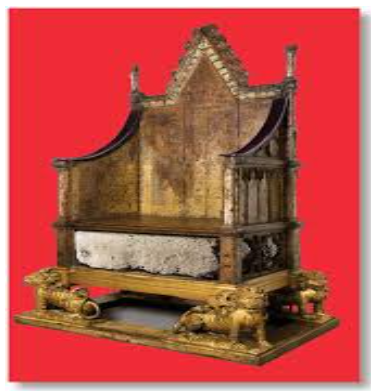
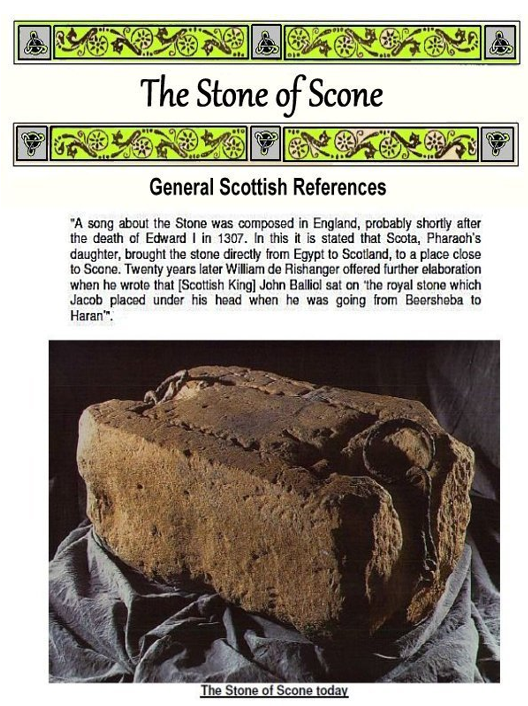
Jacob had set up the stone he slept on for a pillar and anointed it to consecrate it to God as an altar. He also called it God’s House. There are many who believe that the stone that Jacob slept on, was transported from Bethel, then it eventually reached Egypt, then went to Sicily and Spain, and reached Ireland around 700 B.C. It was set up on the hill of Tara, where the ancient kings of Ireland were crowned. Then it was taken by the Celtic Scots who invaded and occupied Scotland. About 840 A.D., it was taken by Kenneth MacAlpin to the village of Scone (“Stone of Scone,” Britannica.com).
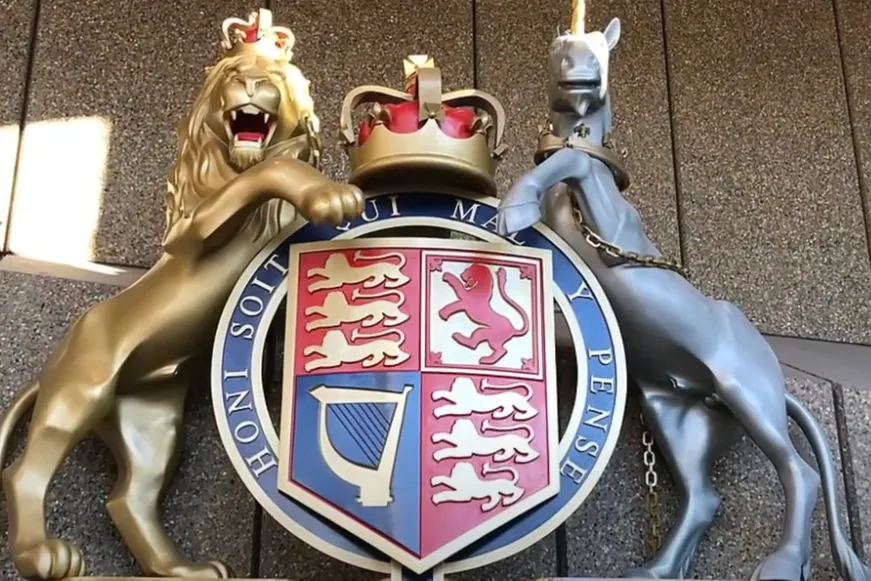
The stone stayed in Scotland until 1296, when England’s King Edward I absconded with it to Westminster, where he had a specially designed throne built with a platform and cavity to hold the prized 336-pound rock. English monarchs have been crowned while seated over the stone.
How many Christian Bible students understand God’s promise to King David of an everlasting dynasty?
2 Samuel 7:12-13:
12) “And when the days be fulfilled, and thou shall sleep with thy fathers, I will set up thy [David’s] seed after thee, which shall proceed out of thy bowels, and will establish his kingdom.
13) He [David] shall build an house for My name, and I will stablish the throne of his [David’s] kingdom for ever.
Now, wait a minute. Do you think that all the kings of Ireland, Scotland and England and the rest of Europe who have been crowned on this stone are descendants of King David and are part of his everlasting kingdom? Why would the royalty of Europe take this particular large stone and make sure that they are crowned on it?
You might recall, when Coleman Colston told of his trip to Ireland and Scotland, he also saw this Stone in Scotland. It was on his “bucket list” on things that he wanted to see, and his daughter took him to Ireland and then to Scotland to see them. If you missed his message, you could hear and read it on our website and see the pictures that he took.
JACOB ARRIVES IN HARAN
Jacob then continued his trip to Haran. It ends when he finds three flocks of sheep lying by a well in a field. He asked the men who were watering the flocks, “Do you know of Laban, the son (grandson) of Nahor.” They answered that they did. Jacob then asked them if Laban was well. And they answered that he was healthy and that his daughter, Rachel, was coming with his sheep. Jacob meets Rachel and tells her who he is, and she runs and tells her father, and they become instant friends. Jacob worked for her father for 20 years (Genesis 29:1-14).
But there is a fact that most Christians don’t think about when they read this portion of Scriptures. Jacob was about 78 years old; how old was Rachel? The Biblical concept of age differs significantly from our modern understanding, and the story of 78-year-old Jacob falling in love with 23-year-old Rachel proves that. However, we still must keep in mind the 55-year age gap between them to understand the complicated dynamics in this family. Jacob outlived the much younger Rachel by about thirty-five years.
And there is another thing that happened that kind of makes you believe that what a person does in life gets paid back to him in a comparable way. When Jacob worked for Laban for seven years, he asked him for Rachel, his daughter, to marry. Laban agreed and made a feast but took Leah, his eldest daughter, and gave her to Jacob as a wife, and gave her Zilpha for her handmaid. But Jacob did not know, because he thought that he was given Rachel (the younger) and not Leah (the oldest)! He was deceived in the same way that he fooled his father.
Jacob loved Rachel more than Leah; but he worked for another seven years for Rachel and had children with both sisters and their two handmaids. The story eventually turns out better, for after Rachel’s death, Jacob loved Leah the way he should have from the beginning.
Jacob returns to his father’s house twenty years after he left. But there is a question that few Bible students today ask: Where did the sons of Jacob get their wives since they were now living in the land of the Canaanites? The answer is that the sons of Jacob married women who were of the same race as they were except for two of them: Simeon and Judah.
Simeon repented and then married a woman from Mesopotamia and the other, Judah, was corrected from his foolishness when he had sex with a so-called prostitute, his former daughter-in-law, Tamar, who was one of the daughters of Aram, a son of Shem. This was the same family that Levi married into.
Here is what the Book of Jubilees (Chapter 34:20, 21) says are the wives of Jacob’s children:
“The name of Reuben’s wife is ’Adâ and the name of Simeon’s wife is ’Adîbâ’a, a Canaanite; and the name of Levi’s wife is Mêlkâ, of the daughters of Aram, of the seed of the sons of Terah; and the name of Judah’s wife, Bêtasû’êl, a Canaanite; and the name of Issachar’s wife, Hêzaqâ; and the name of Zebulon’s wife, Nî’îmân; and the name of Dan's wife, ’Êglâ; and the name of Naphtali’s wife, Rasû’û, of Mesopotamia; and the name of Gad’s wife, Mâka; and the name of Asher’s wife, ’Îjônâ; and the name of Joseph’s wife, Asenath, the Egyptian; and the name of Benjamin's wife, ’Îjasaka. And Simeon repented and took a second wife from Mesopotamia as his brothers.”
BRIEF HISTORY OF JACOB’S GRANDFATHER
God commanded Jacob’s grandfather, Abram, to leave his country, (ancient Babylonia), his kindred, and his father’s house for a new land. That new land was Canaan. When he was seventy-five years old, Abram obeyed, taking his wife Sarai and nephew Lot from Babylonia, to Haran, Syria to Canaan, where God promised to give this land to his descendants.
The new land that Abram went to was named Canaan Land. The land was full of seven mighty Canaanite nations. God instructed Abram to move there and he obeyed. He told him that his descendants were going to occupy that land. They were going to eventually receive instructions to destroy all the Canaanites in that land.
So, there was a very small group of future Israelites living in a land made up of anti-God people. God instructed His people to not marry any of these Canaanite individuals. But that meant that they had to go a far distance to marry one of God’s people.
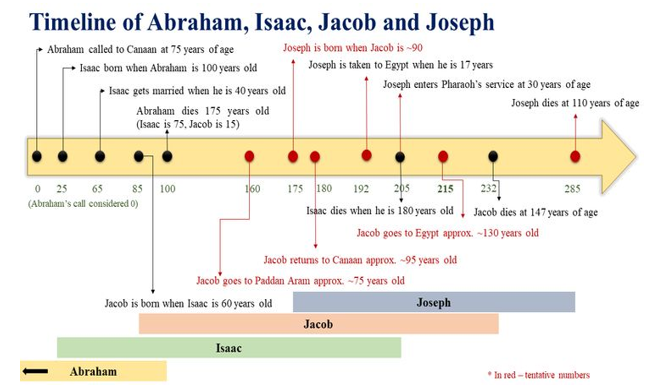
Jacob died when he was 147 years old (69 years after his marriage with Rachel), after he went to Egypt to live with his children because of the famine. Rachel died when she was in her late thirties after about 15 years of marriage. She died giving birth to her son Benjamin.
Why did Rachel die so young? It could have been related to what happened in Genesis 31, when Jacob gave his oath to her father Laban. When Jacob left Laban in Haran, Rachel stole her father’s idols. Unaware she took them, Jacob declared that whoever possessed them should not live.
Genesis 31:32:
32) “With whomsoever thou findest thy gods, let him not live: before our brethren discern thou what is thine with me, and take it to thee. For Jacob knew not that Rachel had stolen them.”
Many Biblical scholars believe her early death was a consequence of her stealing the idols.
This story has yet another unexpected implication. Many years later, after Rachel had died, Joseph’s brothers are accused of stealing by the steward of Joseph’s house (in Egypt). The brothers come back to Egypt for the second time, this time with Benjamin, and after they had accomplished their mission, they begin their journey back. But not long before they left, Joseph commanded his steward to put his – Joseph’s – silver cup into Benjamin’s sack.
Genesis 44:4:
4) “And when they were gone out of the city, and not yet far off, Joseph said unto his steward when thou dost overtake them, say unto them, Wherefore have ye rewarded evil for good?
The insulted brothers swore literally the same words as Jacob did:
Genesis 44:9:
9)“With whomever of thy servants it be found, both let him die, and we also will be my lord’s bondmen.”
Just like Jacob, they knew that stealing was sin, and even the thought that they might somehow be mixed up in theft was unbearable and offensive to them. Both searches start in almost the same way; but the end of these stories is very different: Joseph’s goblet was found in the sack of Benjamin, the youngest son of Rachel!
Benjamin did not steal the goblet, we know that all this was Joseph’s plan—however, there is a profound spiritual truth that we should learn from the comparison between these two searches. The Bible wants people to be aware of the spiritual accountability that they carry, not only for their children, but before their children as well: things they hide from God and man may, in a most unexpected way, surface in the lives of their children. This is why the search for Rachel, the mother who had stolen and yet on whom nothing was found, reverberates a generation later, in as tense a drama through the search for her son, who though innocent, was accused of stealing.
CONCLUSION
God had instructed Abram to leave his people, and he went, first to Haran and then to the land of Canaan. Sarai was barren and seventy-seven years old, and she laughed when she heard that Abram was going to have a son, and she thought that it wouldn’t be by her. So, she gave him her handmaid, Hagar, and Abram had a son by her. Hagar is sometimes described as an Egyptian princess—the daughter of Pharaoh. She was given to Sarah as a handmaiden when Pharaoh recognized the hand of God protecting Sarah in Egypt.
Abram loved this son that he had with Hagar, Ishmael, but God informed him that Ishmael would be blessed, but he would not be the one who would inherit his inheritance blessings. For Abram’s first-born son was with the wrong woman—it had to be with Sarah.
God informs Abram that it would be the son of him and his wife Sarah. But the woman who had been barren her whole life, had a son—who was named Isaac. Abraham was a century old when Isaac was born and the covenant that God made with Abraham would go to Isaac.
Isaac’s wife was the daughter of Bethuel, son of Milkah, who was the wife of Abraham’s brother Nahor. This made Rebekah a great-niece to Abraham and second cousin to Isaac. Isaac was 40 years old when he married Rebekah and 60 years old when he had his two twin sons—Esau and Jacob. But Esau “despised the Abrahamic covenant” and the covenant was given to the younger twin, Jacob.
There are six prophets that speak of the destruction of the descendants of Esau:
- Obadiah,
- Amos,
- Jeremiah,
- Isaiah,
- Ezekiel, and
- Malachi
But who are these ancient foes of Israel, God’s people? Who are the descendants of Jacob’s twin brother? Very few people know who these very prominent modern-day descendants are. The closest ones to Israel are the least known.
Oh, I forgot. Modern-day Christianity today tells us, that the blessing of the first born means nothing. Everyone is now equal. The people who hate Jesus the Christ and say He is now in hell are known as Jews today. They say that the Jews built the left and the labor movement in this country. They say that they wrote the New Deal. They say that 70% of the lawyers who worked on Civil Right cases were Jews. The Jews are pro-homosexual, pro-miscegenation, pro-abortion, and pro transgenders. They have driven the United States into their wars. They pump our nation full of pornography. The Jews were at the forefront of every liberal and leftist issue in the United States.
So, is Israeli our ally? The Jewish Bolsheviks of the Soviet Union wrote the narrative of the lies of the concentration camps of the Jews in WWII. They do not tell of the murders of up to sixty million Christians that they either shot in the head, starved to death, or blew them up with their bombs. The Jewish Bolshevik Revolution, led by figures like Leon Trotsky, was marked by extreme anti-Christian violence, including the torture and execution of priests, the destruction of churches, the forced re-education camps. The destroyed 58,000 of the 60,000 churches in Russia. Two hundred thousand clergy were executed in twenty years. The Soviet regime viewed Christianity as a threat to its “red” communist ideology and sought to eradicate it through systemic persecution.
Who are the Jews the descendants of? Jacob or Esau? That should be an extremely easy question for anyone who reads the Bible and knows a little of history to answer.
To be continued.
Blessed be the LORD God of Israel.