The Life of David - Part 1
SHAMMAH
Copied from the Sermon notes of Pastor Don Elmore
August 23, 2026
Scripture Reading: 1 Samuel 22:2:
“And every one that was in distress, and every one that was in debt, and every one that was discontented, gathered themselves unto him; and he became a captain over them: and there were with him about four hundred men.”
Who were these four hundred men who were either in (1) distress, or (2) in debt, or (3) were discontented? Who did they gather themselves to? It doesn’t sound like they would be a good group to have working in your company, or living in your neighborhood, or fighting in the foxhole on your side, or being your friends or acquaintances. But in the previous verse it adds another characteristic of this group: his father’s house and his brethren.
His father’s house would be the descendants of Jesse. Why would they go and join his son’s (David’s) group? They didn’t join because of blood relationship only, but mainly because they were all in danger of being killed by King Saul who was determined to slay David and thus get rid of his rival for king from the house of Jesse.
If any in the gathering thought it was a good chance to take vengeance on Saul, to rob and plunder, and get gain, they were disappointed, for David never misused his power; he always made it count for good and in defense of his people. And why was David to be the king of Israel, because the prophet Samuel had anointed him before he even killed Goliath, but it was after Saul had shown that he was not qualified to remain king because he disobeyed his LORD’s command to commit genocide.
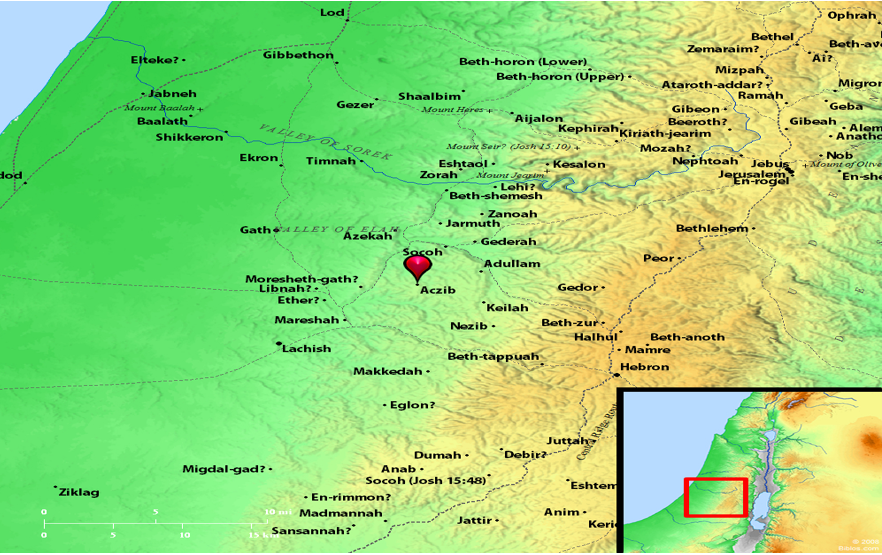
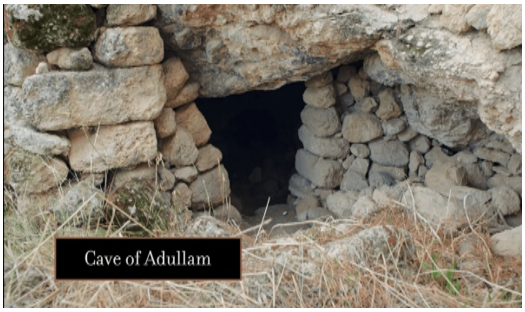
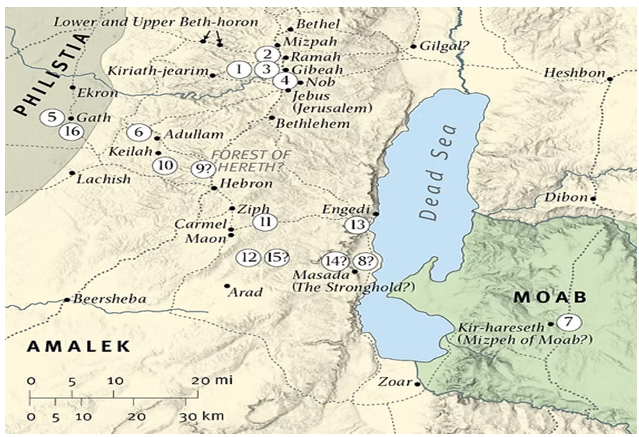
Where did the four hundred men gather themselves unto David? It was at the cave of Adullam which was about thirteen miles southwest of Bethlehem and about twenty miles from Nob, a place about two miles north of Jerusalem.
WHAT ELSE HAPPENED IN ADULLAM?
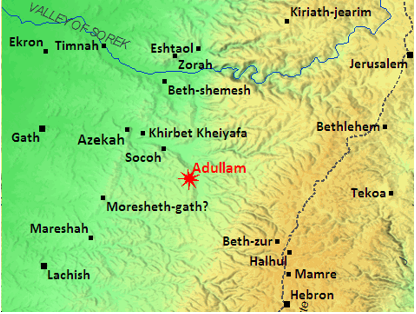 Almost nine centuries had passed when Judah and his brothers sold Joseph, who was also their brother, into slavery. Judah left home (in Hebron) and visited Hirah, an Adullamite. While there, Judah met a Canaanite woman (Betasuel or Bedsuel, The Book of Jubilees) the daughter of Shua, and he married her. Shelah, their third son, was born in Chezib or Aczib (see map), about three miles from Adullam, which was fourteen miles from Hebron.
Er and Onan, his first two sons with the Canaanite woman, were killed by the LORD God of Israel due to their disobedience. They both had the same wife—Tamar, who was a daughter of the son of Aram, a son of Shem (Book of Jubilees, chapter 41). Abraham’s family originated from the Aramean region.
Er’s father, Judah, gave Tamar to be his son’s wife. But Er hated Tamar and would not lie with her, because his mother was a Canaanite and he wanted to take him a wife of the kinsfolk of his mother (Book of Jubilees, chapter 41). But Judah, his father, would not permit it. Er, the first-born son of Judah was wicked, and the LORD slew him.
Onan, Judah’s second son, was to take Er’s widowed wife, Tamar, and raise up seed to his dead brother. But Onan didn’t want to do this because he didn’t want to raise up seed for his brother, so he spilt his seed on the ground. And the LORD God of Israel killed this son also.
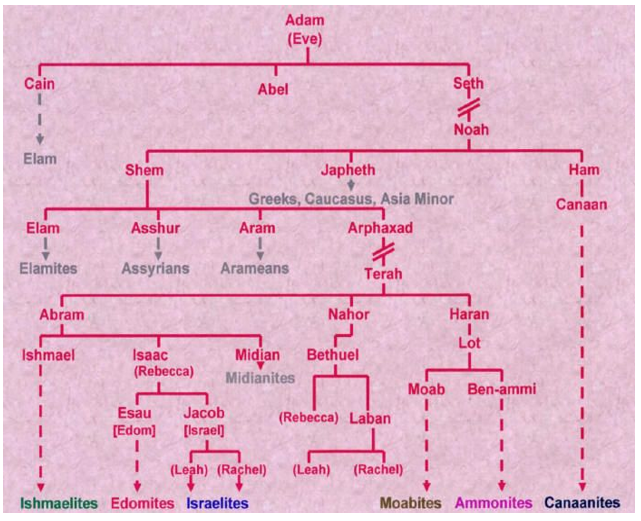 Shelah, the third Canaanite son of Judah, was a couple of years too young to marry, so Judah instructed Tamar to go to her father’s house and wait till Shelah got a little bit older. Judah would then give her as his wife. But Judah’s wife interfered and did not permit her son to marry (Book of Jubilees, chapter 41), while other sources say that she gave Shelah a Canaanite for his wife. Anyway, Shelah married a Canaanite, and the tribe of Judah was doomed to be eliminated from pure-blooded Israel.
But the tribe was saved from extinction after Judah failed to give Tamar to his youngest son. Tamar disguised herself and tricked Judah into having a one-time relationship with her and as a result fathered twins (Perez and Zerah).
Tamar, who was divinely spared with any relationship with her Canaanite husbands, Er and his jealous brother, Onan, and the youngest son, Shelah. She not only preserved the tribe of Judah but her oldest twin, Pharez, was the ancestor of both King David and King Jesus Christ.
BACK TO THE STORY OF DAVID
And in verse three of 1 Samuel 22, it tells that David traveled to Mizpeh of Moab and talked with the king of Moab. He asked him if his parents, Jesse and Nahash, could stay in his country (Moab) until the vengeance of King Saul was over. The king agreed.
There was no place in Israel where David’s parents could stay while Israel’s first king, after God’s reign was replaced, was in a jealous rage. King Saul would, no doubt, hunt down and kill everyone who was related to David. How long his parents stayed in Moab, the Bible doesn’t inform us.
In 1 Samuel 22:1 we learn that “all his family” had come to David in the cave at Adullam. His parents’ home was Bethlehem and Bethlehem was taken over by the Philistines. David did not wish his parents to share the hardships involved with his wanderings, and so now he thoughtfully seeks asylum for them. Blessed it is to see David, during his sore trials, “honoring his father and his mother.”
David asked the King of Moab if his parents could stay with him “till I know what God will do for me.” This word of David indicates that he was beginning to feel the need to wait upon God for directions: how much sorrow and suffering would be avoided did we always do the same thing.
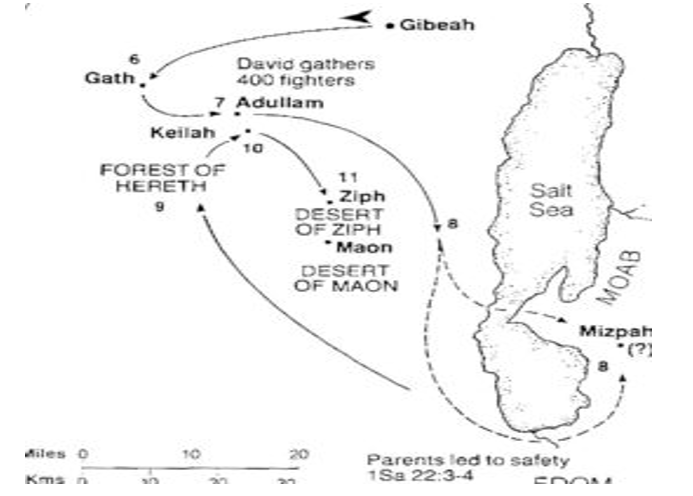
The distance from Adullam to Mizpeh in Moab would be approximately 50 to 60 miles. The route would require descending from the Judean hills, traveling around the Dead Sea, and ascending steeply onto the high plateau of modern-day Jordan. Walking this rugged terrain on foot would have taken ancient travelers approximately three to five days. How David traveled, the Bible doesn’t tell us. And how long he stayed in Moab is unknown too.
Then in verse five the prophet Gad told David to depart and go back to the land of Judah among his own people where he could have contact with his nation and they would not forget him. So, David departs Moab and goes to the forest of Hareth.
The forest of Hareth was not very far from the caves of Adullam. The caves of Adullam were set on a small hill that looked over the valley of Elah, which was where David killed the giant, Goliath. It would give some pleasure to the lonely David to remember what God gave him in the past.
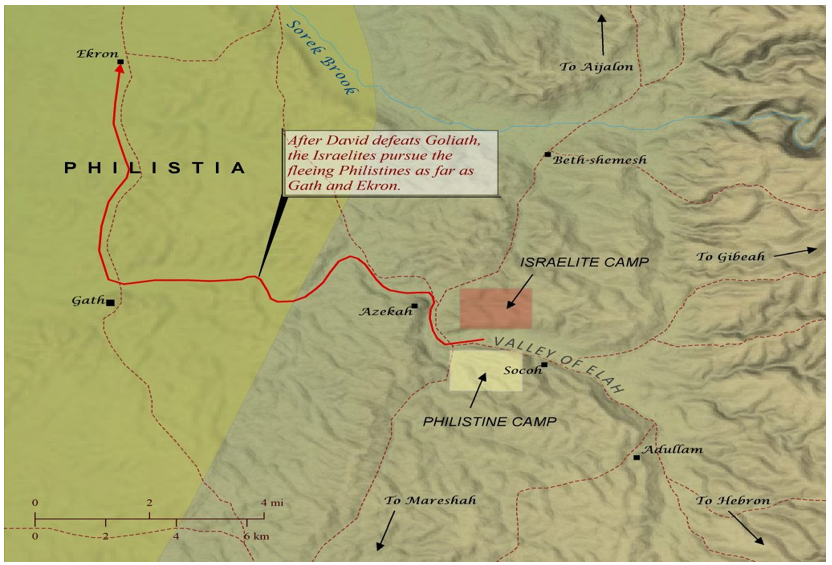
When the Philistines prepared for battle near the strategically located Valley of Elah, the Israelites assembled on the other side of the valley to face them. After the Philistines’ champion Goliath had challenged the Israelite army for forty days to select a champion to fight him, young David, who had already been anointed as the next king of Israel by the prophet Samuel, slew him with one stone from his sling. The terrified Philistines fled, and the Israelites chased them as far as Gath and Ekron.
God removed King Saul from being king because of his repeated disobedience and rebellion against divine instructions. The key actions that led to this rejection included taking on priestly duties, sparing spoils of war, and turning away from God’s command. Saul offered a burnt sacrifice himself instead of waiting for the prophet Samuel as he was commanded, overstepping his royal bounds into priestly authority.
During the war against the Amalekites, King Saul disobeyed God’s command to completely destroy everything and everyone. Saul saved the best sheep, cattle, and the enemy king, Agag, for himself and his army. What a minute! Who were the Amalekites? They were the sons of the grandson of Esau! They were Edomites!
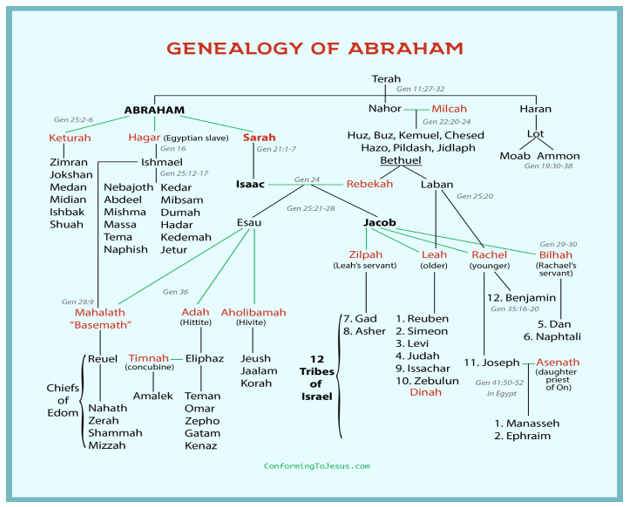
In 1 Samuel 15, God commanded King Saul through the prophet Samuel to destroy all the Amalekites (Edomites) and all their possessions as judgment for attacking Israel during the Exodus. It was total genocide. Saul disobeyed by sparing King Agag and the best livestock, leading God to reject Saul as king.
The Amalekites were a nomadic tribe mentioned repeatedly throughout the Old Testament, often as adversaries of the Israelites. They inhabited the southern regions of Canaan and the Sinai Peninsula, thriving as desert raiders. Their earliest recorded conflict with Israel occurred soon after the Exodus, when they attacked the vulnerable Israelites at Rephidim—a brutal act that led to God’s command for their memory to be blotted out.
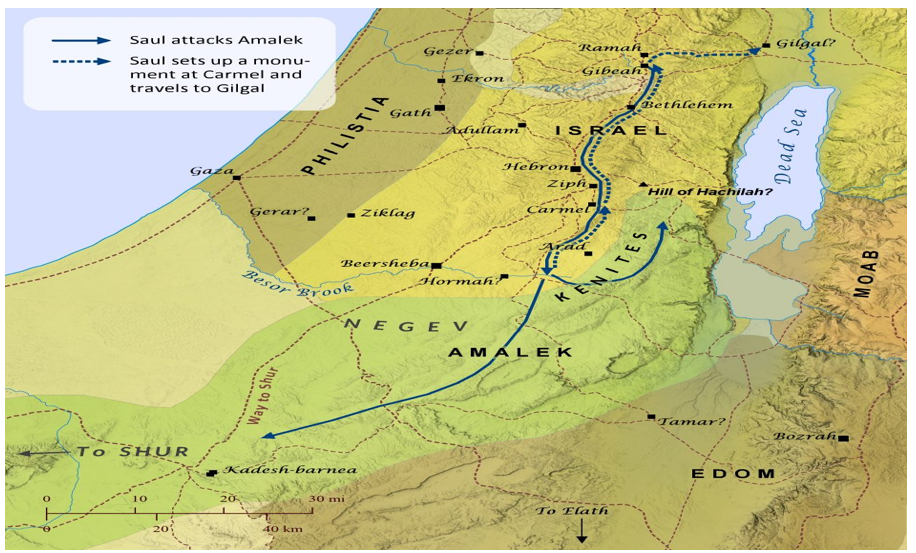
The prophet Samuel confronted Saul for his incomplete obedience. Samuel stated that obeying God is better than making sacrifices to Him and he faulted Saul for blaming the people rather than showing remorse, which demonstrated a proud and rebellious heart. Samuel killed King Agag himself by cutting him to pieces at Gilgal. Samuel told Saul that God removed him from being king over Israel which Saul fought against God’s command till his last days.
God told Samuel to stop grieving for King Saul. He instructed him to fill his horn with oil and go to Jesse’s house in Bethlehem. Samuel was afraid that King Saul would kill him if he found out where he was going and what he was going to do. God instructed Samuel to use a religious sacrifice as a cover story for his trip.
Samuel went to Bethlehem and purified Jesse and his sons and invited them to the sacrifice. Jesse paraded his oldest son, Eliab, before Samuel. Samuel thought Eliab must be God’s choice because he was tall and handsome. God told Samuel not to look at the outward appearance. God noted that man looks at the outward things, but the LORD looks at the heart.
Eliab was not accepted by God to be chosen to be king. Six other older sons of Jesse passed before Samuel, but God chose none of them. Samuel asked Jesse if he had any other boys left. Jesse said his youngest son, David, was out watching the sheep. Jesse sent for David and brought him in from the fields. David was young, a teenager, good-looking, and bright-eyed. God told Samuel to get up and anoint David because he was the chosen one. Samuel took his horn of oil and poured it on David right in front of his brothers.
The Spirit of the LORD rushed powerfully upon David from that day forward. Samuel finished the task and went back home to Ramah.
Shortly after David was anointed as the future King of Israel, he was sent by his father to go to his three oldest brothers, who were in the army of Israel. He was to give them some food from their farm. While there, David heard this Philistine giant defy their God with his loud rebukes. The giant asked for forty days to fight the champion of Israel in a duel. The winner takes all.
Well, I think everyone here knows what happened. David takes the challenge. He began to ask questions of the Israel soldiers: What was the reward for killing Goliath?
He was told that King Saul promised three main rewards to the man who killed Goliath:
- Great wealth (much money),
- Marriage to the king’s oldest daughter Merab (Saul did not give Merab to David, but instead, gave her in marriage to a man named Adriel. Saul later gave his youngest daughter, Michal, to David, who saved his life), and
- Making his father’s household completely free from taxes in Israel.
In addition, David received very harsh, false statements by his oldest brother, Eliab. Eliab became very angry and asked David why he had come down to the camp near the battle. Eliab snapped at him about the sheep left behind in the desert with no one to watch them (untrue charge). And he also falsely accused David of being prideful and full of wickedness, claiming that he only came to watch the fight. Would you want Eliab to be king with his quick temper?
David does not answer his oldest brother. The soldiers had to be fed by their friends or families. David was one who went “to and fro” with food for his three brothers who were in the army at this time. There were many men and young boys, who traveled from home to the battlefield with food and supplies for their fathers and brothers who were in the army.
David goes to King Saul and asks if he could fight the giant. The King offers to suit David up with armor and weapons. David puts them on but decides that it is not for him. He will fight Goliath with his own clothes and with his own particular weapon; a sling shot. And David kills Goliath with one shot and he becomes the hero of Israel.
Saul becomes jealous of David after the Israelite army returned home following David’s victory over Goliath. Women sang that David killed more enemy soldiers than Saul did. Saul feared David would take the kingdom, and he grew angry, suspicious and tried to kill David the next day. So, Saul is not only determined to remain king but is also insanely determined to kill David so he would not become the king of Israel. So, David is a fugitive for about twelve to fifteen years until Saul dies.
We are in this period when David is a fugitive. David has lost almost everything. The city (Bethlehem) where he was born and reared, his freedom to go about safely in Israel, his need to flee from death by the king, his every word being a possibility of harm to those who hear him and help him.
We will speed ahead many years to look at what the last words that David said. It is found in 2 Samuel, chapter 23. The first verse tells us that David was not only the anointed by the God of Jacob but was also the sweet psalmist of Israel. David was a unique person. He was a mighty warrior of God, he was one of the most loyal of subjects to King Saul, he was a writer of Psalms, both lyrics and music. He lived an amazing life, full of both victories and a few defeats. But each defeat was met with a quick repentance, and with much sorrow. And David persevered.
David says that the Spirit of the LORD spake by him, and His word was in his tongue. He later, in verse five, said that God made with him an everlasting covenant that his offspring would always be king until the King of Kings returns. And then in verse six, he mentions the sons of Belial which shall be as thorns, all thrust away. They shall be utterly burned with fire in the same place (verse 7).
Then David mentions the names of the mighty men whom David had. I don’t think that the average Christian can name them. David mentions three of his mighty men. And when he says they were mighty he meant very mighty.
When David was at the cave of Adullam there were about four hundred men that were sent unto him. It doesn’t tell us how they came. It is like the animals in Noah’s ark. How did they come to the ark? God sent them is the only answer we can give.
The four hundred men later grew to six hundred men. They included his brethren and all his father’s house, plus those that were distressed, those that were in debt, and those that were disconnected gathered up to David. And he became their captain.
Would you think that that was the men that David wanted to be captain over? Those that were distressed. How could that be of any help. Those that were in debt and faced prison or execution. How could they be of any help. And those who felt disconnected to the society that King Saul permitted. He allowed the Philistines to control most of Israel without much a fight. When David became king after Saul’s death, he had to conquer the Philistines who controlled much of Israel.
But from these men there arose thirty-seven mighty men. And David gives us the names of three of them and tells of what they accomplished.
The first one is found in 2 Samuel, chapter 23, verse 8. His name was Adino the Eznite. What did he do?
2 Samuel 23:8:
“He lift[ed] up his spear against eight hundred, whom he slew at one time.”
Was he one of the ones who were distressed? Or was he one who was in debt? Or did he feel that he was disconnected from what was happening in the lives of Israelites that had been conquered by the Philistines?
Adino killed eight hundred enemy soldiers in one battle. How did he do that? Look at the previous page: 800 against one. Was this an even greater accomplishment than David’s killing the giant Goliath?
How was this great feat accomplished? You would think that three or four enemy soldiers would gang up on Adino and kill him. The Bible does not give us any details. Can you imagine how long this took. How tired would you be if you slayed eight hundred soldiers in one battle with your spear? Adino had to have the help of the LORD God of Israel.
Verse nine gives us the name of the second mighty man of David’s army. His name was Eleazar, the son of Dodo. It was when he fought against the Philistines with two other mighty men that they defied the Philistines. But then the men of Israel fled. But Eleazar arose and smote the Philistines until his hand was weary and clave unto the sword (verse 10). How did he do this? The LORD won a great victory that day (verse 10).
Have you ever experienced something like what Eleazar did? Has your hand ever clave unto something that had to be pulled off it?
But did you notice what it says in the last part of verse 10:
“…and the people returned after him only to spoil.”
The people came; they didn’t fight against the Philistines, they fled, but they returned and took the spoils off of the dead soldiers. What was Eleazar’s reaction? Nothing is said about what he did, so we must assume that he did not hinder his people from taking the spoils.
Has that ever happened, in a smaller sense, in your life? Have you ever fought against the enemy until you were weary, and won the battle, and then your people went and gathered the spoils? Or were you part of the people that went and gathered the spoils?
Dodo is the name of an extinct bird, but in Hebrew it can mean David. So, Eleazar was the “son of David.” Who else was known as the Son of David? —Jesus Christ. Was Eleazar a type of Jesus who fought against sin and death and the rest of His people gather the spoils? It certainly could be.
The name of the third mighty man in David’s army was Shammah. That is the name of this sermon. What he did was similar to what the other two mighty men had done. The Philistines had gathered before a field full of lentils. Shammah defended the battleground alone after all Israel had fled, and God gave a great victory (verses 11 and 12). These two verses don’t tell how many Philistines he killed or how long he defended the field of beans, but just that God gave a great victory.
The field of lentils would not be a huge battle ground to fight over. Does that tell us that we don’t have to fight over just the large issues. Even small community issues are important.
And then there is what the three of them (Adino, Eleazar, and Shammah) did together (verses 13-17). David and his three mighty men where at the cave of Adullam while the troop of the Philistines were had a garrison in Bethlehem.
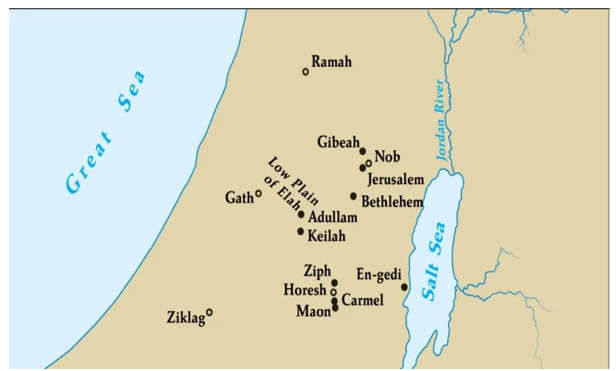
David was born and raised in Bethlehem. It was now in the hands of the Philistines. Adullam sat on a hill, and its water had to be gotten by a well that was connected to a cistern. David longed for the waters of Bethlehem that he knew in his younger days. It had the taste of great sweetness.
So, he just made the comment out loud that he longed for the waters of Bethlehem from the well that is by the gate. He knew that he wouldn’t drink of it until the Philistines were cast out and Israel could once again own it. David did not think that anyone would think that his wish was his command and that they were to go and get the water for him.
It was about 13 miles one way from Adullam to Bethlehem. So, it would take a walk of at least 26 miles to make a round-trip from Adullam to Bethlehem and back. And then you had to count on the fighting against the Philistines that were near the gate and at the well. But nevertheless, the three mighty men of David (Adino, Eleazar, and Shammah) loved David very much to endanger their lives in such a way.
The three mighty men marched twenty-six miles round trip; fought the Philistines who guarded the gate of Bethlehem; fought the Philistines and killed them who were at the water well; filled up a knapsack full of water; took the water back to Adullam and gave it to their leader. That is true loyalty.
David was so moved by the devotion of these men that “he would not drink it, but poured it out to the Lord” (v.16). David felt that it would be sacrilege before the Lord to drink water purchased at the risk of his men’s lives. He felt that it was essentially the blood of his men since they had hazarded their lives to get him the water. The only thing he could do with the water that would be worthy of the price paid for it was to give it to the LORD, so he poured it out as a solemn drink offering to God.
The rest of the chapter tells of the exploits of two men who were more courageous than most of his men but were not equal to the three mighty men’s accomplishments. One was Abishai who slew three hundred enemy soldiers at one time. But he was not as mighty as Adino, Eleazar, and Shammah.
Another man of honor was Benaiah who had done many acts. For example, he slew two “lionlike men of Moab” or two mighty men of Moab. He also killed an Egyptian, a man of great stature, five cubits high (10 ft., 5 in. tall) who had a spear in his hand. He went to him with a staff, plucked the spear out of his hand, and slew the man with his own spear (see also 1 Chronicles 11:22-25). The remainder of the chapter gives the names of the all the mighty men (32 names).
1 Samuel 22:6-8:
6) “When Saul heard that David was discovered, and the men that were with him, (now Saul abode in Gibeah under a tree in Ramah, having his spear in his hand, and all his servants were standing about him;)
It had been a while since David and Saul had seen each other. Saul didn’t know where David even was until now. He began to plead with his servants (who were from the same tribe as he was—Benjamin) to help him kill David.
Saul was at the city where he grew up—Gibeah, which was the capital city of Israel. It was only about four miles to the north of Jerusalem and was one of the wickedest cities in all of Israel. It was destroyed eventually because of its sexual perversions.
7) Then Saul said unto his servants that stood about him, Hear now, ye Benjaminites: will the son of Jesse give every one of you fields and vineyards, and make you all captains of thousands, and captains of hundreds;
Saul was obsessed with David so much that we would say he had a huge case of “David derangement syndrome.” Saul was speaking to Benjaminites, men of his own tribe, and asked them would David, who was from the tribe of Judah, give them as much as a king from their own tribe? He was saying that David would be unfair to them and the other tribes.
Saul’s syndrome was so compelling to him, that it caused him to commit major sins against his faithful servant, the anointed next king: jealousy, hatred, the desire to murder, insults, lying, etc. Saul knew, that when he died, David would be king. So, Saul thought that he could kill David, he would remain king. Saul was so confused in his mind, that he thought that he could “un-anoint” David as king, even though the God of Israel had already said that David would be king.
Saul asks a question of his men, which begins in verse seven and concludes in verse eight. It is one of the longest questions in scripture: eight-eight words.
7b) “…will the son of Jesse [David] give every one of you [Saul’s Benjaminite servants] fields and vineyards, and make you [Saul’s Benjamite servants] all captains of thousands, and captains of hundreds;
8) That all of you [Saul’s Benjaminite servants] have conspired against me [King Saul], and there is none that sheweth me[King Saul] that my[King Saul’s] son[Jonathan] hath made a league with the son of Jesse [David], and there is none of you[Saul’s Benjaminite servants] that is sorry for me [King Saul], or shewth unto me[King Saul] that my[King Saul’s] son[Jonathan] hath stirred up my [King Saul’s] servants against me [King Saul], to lie in wait, as at this day?”
Saul kept the idea of David becoming king fresh in the minds of his subjects. He played politics. He argued what benefits would they receive from him when compared to what they would receive from David as king?
But Saul presented a real problem for the Benjaminites. How could sane men go along with a seemingly insane king who was out of God’s will and determined to destroy the best man and the anointed future king of Israel? Men did not want to offend their king for fear of death, but neither did they want to commit sin against an innocent man who had saved their nation from military defeat thus sparing many of their lives as well as the lives of their women and children.
They knew that King Saul was whining like a spoiled child, seeking sympathy for his cause. He made three false accusations against his men.
- He complained that none of them had told him about the covenant with David and his own son, Jonathan.
- He complained that none of them were sorry for him.
- He complained that none of them had told him that Jonathan had stirred up David against him, to lie in wait to kill him.
CONCLUSION
We will stop right here and continue this story in my next sermon. So far, there were no Kenites, no Canaanites, and just one group of Edomites, the Amalekites, mentioned. There were no Jews at this time as there were no Christians either. There were the descendants of Esau and Ham and the descendants of Jacob.
Today’s story was mainly about the difficulties among the descendants of Jacob. There can be jealousy, envy, insane hatred toward each other, murder against each other, lying talked about each other, stealing from each other, etc. But didn’t our God tell us to “love one another?” David showed his love for his king and would not kill him, even when he had the opportunity. (Pastor Ramsey and his wife showed this same kind of love to one of our own.)
The last third of 1 Samuel is all about David being a fugitive. David is on the run from King Saul who wants to kill him simply because he sees him as a threat to his power. David hasn’t done anything wrong. He never threatened Saul’s authority or power; David has been nothing but a loyal servant in Saul’s court. He did everything from leading Saul’s army to playing soothing music for him. And despite all of that, Saul still wanted David dead.
David didn’t do anything wrong, and he is the number one person on the “hit” list to be killed by his own government. Think about that for a while. Have any of you suffered from something you didn’t do? How did you react?
David flees, goes to the city of Nob where he is helped by the priests. Then he goes to the city of Gath. Gath! That is the city that Goliath was from. It was in Phillistine territory. He goes to the King and asks if he would protect him. As the king thinks about this, a lot of his servants came to him with concerns about David. David was the most famous man in Israel. Achish’s servants were skeptical of David to say the least, which would explain why David became afraid. He was afraid the Philistines were going to kill him.
How did he get out of that situation. He pretended to be crazy. He scratched the door and let spit run down his beard. David escaped by the skin of his teeth and he goes to the cave in Adullam.
David is by himself. He is all alone. He is in a cave. And Saul is still trying to find where he is to kill him.
But then his family finds out his location and they join him there. The word spreads and more people gather to David in the cave of Adullam. The people who were in distress, in debt, and bitter in soul, gathered to him. And he became commander over these four hundred men. But they were all the people who could relate on some level to what David was going through. The place that you would expect to be the place of loneliness and spiritual depression for David became the place of fellowship and spiritual renewal.
Isn’t that exactly what the church is supposed to be? A place of spiritual renewal and fellowship? The thing that unites us together isn’t our brokenness; it’s our shared faith and hope in the King who can fix it!
All these broken people gathered around David because he gave them hope for a brighter future in the same way Jesus offers each of us refuge, strength, and hope for a brighter future.
David takes his parents to Moab for protection from King Saul. The Word of the LORD came to David through the prophet Gad and told David to go back to Israel. He told David to go back to where Saul could easily find him.
God in his mercy will often lead us out of hiding and into the places of hard obedience. At some point, your Christian faith will challenge some deeply held aspect of your life. At some point your faith will call you to do something hard. And the question is always, “will you obey?”
To be continued.
Blessed be the LORD God of Israel.