What Gospel Is Important? - Part 2
Copied from the sermon notes of Pastor Don Elmore
December 7, 2025
Scripture Reading: Revelation 12:7-9
7) “And there was war in heaven: Michael and his angels fought against thedragon; and thedragon fought and his angels.
8) And prevailed not; neither was their place found any more in heaven.
9) And the great dragon was cast out, that old serpent, called the Devil, and Satan, which deceiveth the whole world: he was cast out into the earth, and his angels were cast out with him.”
There was “war” in heaven? When I was young, I thought that heaven was a place of eternal peaceful bliss. I was shocked when I read that there was a war in this peaceful abode because I thought that was impossible. Who fought who? The angels: Michael and his angels fought against the dragon and his angels. Michael won, and his opponents, led by the old Serpent, or the Devil or Satan, were driven out of heaven and cast down onto the earth.
And what did the dragon and his defeated fallen angels do when they got on the earth? The Bible informs us when it says that their leader, the dragon, “deceiveth the whole world.”
Christian Identity is now split into a lot of different subsets. There are some churches in Christian Identity that deny the deity of Jesus Christ, some deny the Trinity, some believe in a world-wide flood of Noah with only eight survivors, some believe in a flat earth. Some believe that there are no angels, giants, demons, or Satan, some believe that Christians are required to sacrifice a lamb each Passover, some believe that the Sabbath is on Saturday, some on Sunday, some celebrate the Catholic holiday of the Mass of Christ (Christmas). Some believe that Adam was the father of Cain, others believe it was the Serpent, some believe that the Apostle Paul was a heretic, some eat the food that God said not to eat, many take out usury bank and credit card loans, many disagree on whether the United States was or is a Christian nation, some believe that Jesus has already come back. Some teach that the Jews are descended from Judah, when it was only his third half-Canaanite son, Shelah, who eventually became Jews, a few are violent agitators against the government, some ignore as best as they can all the other races, some preach the Calvinistic or Arminian gospel, many believe that all races can be saved, some believe that the “sons of God” were the sons of Seth, etc. Should some of these preachers be called “accursed”? (Galatians 1:8).
The Jews have been successful in nullifying the influence of the Christian Identity movement so that it has as small an influence as possible. Therefore, I am in favor of not being called a Christian Identity believer anymore, as there are so many different beliefs within Christian Identity, but just call me an Israelite-Christian believer.
And in Christendom there are many more denominations and/or religions now than there have ever been. Some say it is over one thousand. It is almost unanimous that each church preaches one of the two major gospels, Calvinism or Arminianism, which are both wrong. How did it get this way? In my opinion, one must understand history to learn what has taken place. The devil, in my opinion, is no longer in the bottomless pit! What strategy would the Devil use to deceive the entire world?
THE DRAGON LET LOOSE AFTER A THOUSAND YEARS
Revelation 20:1-3:
1) “And I saw an angel coming down from heaven, having the key of the bottomless pit and a great chain in his hand.
2) And he laid hold on the dragon, that old serpent, who is the Devil and Satan, and bound him a thousand years.
3) And cast him into the bottomless pit, and shut him up, and set a seal upon him, that he should deceive the nations no more, till the thousand years should be fulfilled: and after that he must be loosed a little season.”
It is my opinion that this prophecy is being fulfilled today. The story of when the old serpent was released a little before 1517, but in order to understand how it affected America we need to understand more about the history of the state of affairs in the royalties of Scotland and England in the 16th and 17th centuries. I will elaborate more on them later in the sermon.
- One young infant became the Queen of Scotland when she was only six days old and later also became the Queen of France.
- One baby boy became the King of Scotland when he was one year old.
- One child became the King of England when he was nine years old.
- One teenager was made the Queen of England when she had no desire to be royalty.
- One Queen of England was also the Queen of Spain.
- Several royalties were executed by having their heads chopped off.
- One Queen of Scotland was ordered to abdicate her throne.
- One King of England married his older brother’s widow.
- One King of England was charged with vacating his throne and was replaced.
- One Queen of Scotland’s marriage was torn apart by a jury that found both her and her husband guilty and exiled her husband to Europe, to never see his wife again, while the queen was put in prison on a very small island.
- One sister of two Kings of England was married when she was nine years old and became the mother of another King of England.
- Several of the Kings and Queens endured imprisonment, attempted assassinations, arranged marriages to foreign kings/queens, trials for murder and treason, and some were Catholic and some were Protestant.
A BRIEF HISTORY OF THE 16th AND 17th CENTURIES
As I said previously, in my opinion, the millennium (one thousand years) has already happened in history. It was in the Middle Ages, from around 500 A.D. till around 1500 A.D.
England kicked the Jews out of their nation in 1290 AD for about 370 years (the United States will celebrate only its 250-year anniversary next year) as a point of reference.
About fifty years before this, in 1242, France put on trial, in their own courts, the Jewish Talmud, with the chief rabbis defending their filthy “holy” book. The Jews’ book was found guilty on all charges. The trial found that the Talmud contained certain blasphemies against Jesus Christ, His family, including His mother, the Christian religion, attacks on Christians themselves and obscene folklore. As a result, the Frenchmen rounded up all the Talmuds (which were handwritten, as this was before the printing press was invented) in the entire nation (it took one year) and then burned them in a great fire. Several decades later (in 1306), the French kicked all the Jews out of their nation.
In the 1650s, this changed from expulsions only to some re-admittance when one of the Jewish rabbis, Menasseh Ben Israel, convinced Oliver Cromwell (a Calvinist). He had taken over the government of England from the beheaded king (Charles I in 1649). The monarchy had ended, and the Republic had begun. The rabbi informed Cromwell that Jesus could not return to the earth until the Jews were in all the nations of the world. Rabbi Ben Israel based it on one verse:
Deuteronomy 28:64
28) “And the LORD shall scatter thee [the rabbi explained that ‘thee,’ and ‘thou’ meant the Jews] among all people, from the one end of the earth even unto the other; and there thou [Jews] shall serve other gods, which neither thou [Jews] nor thy fathers have known, even wood and stone.”
If Jews were not allowed to settle in all corners of the world, in particular in England, Rabbi Ben Israel asserted, the coming of the Messiah would be delayed. It was the perfect timing for such a doctrine, since according to an old Christian belief (heresy), in 1666 (ten years later) the dooms day was due. Rabbi Ben Israel knew how to take advantage of the opportunity offered by history – to change history.
Since the Jews were not in England at this time, the child-prodigy rabbi convinced Oliver that his scattered Jewish people needed to be permitted back in the British Isles so Jesus could return shortly. This view convinced Oliver, and the Jews were let back into England.
The Jews made their usury loans to the British people and government, and they soon took control of the banking system, the currency, and the stock market in England from that time forth. Too bad Oliver did not know that Deuteronomy 28 is about the blessings and curses that Israel (not the Jews) would receive based on whether they kept God’s laws.
A little over one hundred years later, in the new world, after a few decades of moral stability under the State Constitutions and the Articles of Confederation, the new nation’s leaders produced a constitution that reflected little if any discernable Christian influence. All the Christian denominational references in the state constitutions were gone by 1833.
America, when it became a nation, was made up of almost all White people who were 98% Protestants. It is now different. America is the melting pot of the world.
When America won the Revolutionary War, the Articles of Confederation of Perpetual Union of the States left it up to each State and they set the usury cap at 6%. Eight years later, when the nation supposedly adopted the new Constitution, the state and nation adopted usury laws, setting the interest cap at 8%. They did not impose the Biblical teaching that Israelites were not to be under usury of any kind. Big mistake!
Right after the British colonies became a new nation, the French Revolution started. I believe that the period when the “souls” were “beheaded,” who did not “worship the beast” was during this major Revolution (Revelation 20:4). The guillotine was used for most of the executions. It is a well-known fact that the French Revolution was financed by Jews and Masonry and was the beginning of Communism.
With the Jews in control of the British usury banking system, they began their accumulation of money to give them the power to rule the world.
BACKGROUND OF CHURCH HISTORY IN ENGLAND
To refresh our memories, between 1532 and 1540, King Henry VIII took control of the English Church from Rome, the start of many decades of religious tensions in England and Scotland. The King made a treaty with Scotland to say that his young son, Edward VI, would be betrothed to young Mary Stuart, Queen of Scotland, to be married when they got of age. England wanted to unite the crowns of England and Scotland.
When the Scottish Parliament rejected the marriage treaty, Henry VIII retaliated with force. The War was known as the Rough Wooing. It lasted from 1543 to 1551 (over eight years). The English efforts failed to achieve their goal. The conflict ended in 1551, but the violence continued until the crowns were finally united in 1603.
For the young Queen’s own safety, she was betrothed to the future King of France. So, when she was five years old, she went to France to live and received a very good upbringing. She lived in France for thirteen happy years until she married Francis II when she was fifteen years old. They both were the king and queen of Scotland and France and were very happy. Two years later, she was a widow. Her days of happiness were over. She was more of a French woman, than a Scottish when she returned to Scotland.
A lot had happened in Scotland in the nineteen years that she had been in France. The nation was in religious turmoil. The Catholic nation was in the middle of the Scottish Protestant Reformation.
Many of the new converts to Protestantism considered their queen as a foreigner, with a religion that most of Scotland now hated--Catholicism. But the royalty of Scotland was still Catholic, while the populace was becoming more anti-Catholic or Protestant. This was mainly because of the preaching of George Wishart and John Knox. More on what happened in Scotland in the battle between the two contrasting “Christian” religions later in the sermon.
But back to Queen Mary Stuart, who was only eighteen years old when she returned to Scotland. Shortly after she became a widow, she returned to her native nation of Scotland, where she had been queen since the age of only six days old.
Queen Mary soon married a close friend, Henry Stuart or Lord Danley. They had a son together, the future King of Scotland, King James VI. But Mary Stuart suffered a traumatic event while she was still pregnant. She witnessed the murder of her close personal secretary, Rizzio, by her jealous husband and his rebellious friends.
The murderous men crept into her house and stabbed Rizzio to death, as Mary watched. All Mary could do was scream, but there was no one nearby who could help.
But the story doesn’t end here. After this tragic event happened, her husband, the King of Scotland, lived in another city and became distant from her. The Queen knew that her husband was guilty of murder but didn’t say anything to the authorities. Her marriage was unofficially over.
But the King was killed when his home exploded. Who did it? James Hepburn was a prime candidate. He was a pursuer of Queen Mary and was a soldier and ambitious leader. He told the queen that he would protect and love her. James was accused of murder and was put on trial but was found innocent.
But the story continues in a very strange way. Twelve days after he was found innocent, he divorced his wife and then a couple of weeks later, kidnapped and allegedly raped the queen (it was unclear whether this was mutually planned). For they became married shortly after this strange episode had happened.
What were the people of Scotland to make of all this? Even her own supporters were disgusted with the queen’s behavior. A military force was raised that fought against the queen’s army, and the rebel forces defeated her smaller army very quickly. They put them both, King and Queen, in a new trial.
This time they were both found guilty. Her husband was exiled to Europe, where he never saw his wife again. The queen was made to abdicate the throne and grant it to her one-year-old son, James VI of Scotland. She was also put in prison that was located on a very small island.
The former Queen of France and the former Queen of Scotland was in prison, with her husband exiled, her crowns taken away, and she was alone in a prison. Her one-year-old son was now King of Scotland, while his mother was locked in prison and his father was in exile. The king would never see either of his biological parents for as long as he lived.
Then what happened to the former queen of two nations: France and Scotland? Did she stay imprisoned for the rest of her life? She was only twenty-four years old when she was forced to abdicate the throne of Scotland. No, she didn’t stay imprisoned, but she only had a couple of weeks of freedom.
She eventually escaped, with the help of her Catholic supporters, by disguising herself as a servant girl and being taken by a rowboat across the waters to the mainland. Once free, she rounded up an army to fight and if they won, she would once again be Queen of Scotland. But the battle lasted less than one hour, and she had to flee to England for safety.
Her cousin, Elizabeth I, was on the throne. But Elizabeth I was a Protestant, while Mary, queen of Scots, was Catholic. Queen Elizabeth never met her cousin for the twenty years she was in England.
Queen Elizabeth I put the former queen in house arrest, where she became a prisoner. But Mary had a comfortable arrangement. She wrote letters, lived in basic comfort, ate good food, but she still was a prisoner. There were attempts made, mostly by the Catholics to have Mary on the throne of England, because many believed she was more in line to be queen that the reigning Queen, Elizabeth I. This would have been her third country in which she would have been Queen; (1) Scotland, (2) France and (3) England. But Mary was never queen of England.
There were four major assassination plots that were planned by the Catholics to put Mary on the throne. But Mary was never found to be involved until the fourth one. After almost twenty years in prison, Mary was tried and found guilty and was executed on February 1, 1587, for treason.
THE TUDOR LINE
But we have gotten ahead of ourselves in the story. Henry VIII died in 1547. Henry VIII had made a line of succession. It would go to Henry VIII’s son, Edward VI, and if he did not have any children, it would then go to his oldest daughter, Mary I, and if she were childless, then it would go to his youngest daughter, Elizabeth I.
But his son, Edward VI, died when he was just fifteen years old. He had been the King of England for just six years. While he was on his deathbed, he changed his father’s rule of succession. Edward VI was a devout Protestant, while his half-sister, Mary I was a devout Catholic. So, he declared, right before he died, that the next Queen of England would be his cousin, Lady Jane Grey, who was Protestant. He was afraid to give it to his half-sister because she would try to revert the nation back to being Catholic.
Lady Jane Grey was the granddaughter of Mary Tudor, who was the daughter of Henry VII and sister of Henry VIII. There are a lot of Mary’s in the royalty line in these two centuries in these two nations. So, let’s go over them.
- (1496-1533) Mary Tudor, daughter of Henry VII, grandmother of Lady Jane Grey, was Catholic, whose daughter and granddaughter were Protestant. Mary was the Queen of France for two years until her husband died. Her granddaughter was childless.
- (1516-1588) Mary Tudor, daughter of Henry VIII, was Catholic and Queen of England for five years, and was childless.
- (1542-1587) Mary Stuart, Queen of Scots, daughter of James V of Scotland, mother of James I of England was Catholic. She was Queen of Scotland and France.
- (1631-1660) Mary Stuart, daughter of Charles I, mother of William III of Orange, was Protestant.
- (1689-1694) Mary Stuart, daughter of James II, was Protestant and joint monarch of England was childless.
Lady Jane’s grandmother, Mary Tudor, who was the Queen of France, lived an interesting life. She was an exceptionally beautiful woman. She was part of an arranged marriage with the King of France, Louis XII, who was 34 years older than she was. She was just eighteen. He died three months later.
Mary Tudor then decided to marry the man that she loved, Charles, Duke of Suffolk. The king, Henry VIII, her brother, was against it, but she secretly married him anyway. They could have been executed, but it was decided to give them a huge fine instead. She died when she was thirty-seven years old.
Lady Jane, her granddaughter, was Protestant who was very well educated. She spoke eight different languages. She had no desire to be queen. But two months before she became Queen of England, she was forced to marry John Dudley’s son, Guilford. John Dudley had been the head regent while Edward VI was on the throne.
After they got married, her husband asked Lady Jane to let him be king, which she refused. She offered to make him a Duke, instead. This was considered an insult to her husband’s family. Guilford’s family retaliated by saying that their son would withhold his conjugal duties, thereby denying her an heir.
Mary Tudor I (daughter of Henry VIII) would not let the crown of England be given to anyone else besides her. She wanted that crown and she believed that she was next in line to inherit it. She was a devout Catholic who wanted to restore the head of the Church of England back to the Pope.
She marched into London with a small army and demanded that she be queen. Lady Jane’s supporters quickly fled, and Queen Lady Jane was deposed off the throne and put into prison.
A couple of months later, there was a rebellion led by Thomas Wyatt over the announcement of Queen Mary I’s future husband, who was Catholic and the King of Spain. Lady Jane’s father, Henry Grey, joined in the rebellion. Queen Mary 1 mother was from Spain (Catherine of Aragon) and Catholic.
The fact that Lady Jane’s father participated in the plot to assassinate Queen Mary I, plus the fact the Lady Jane was a staunch Protestant, made Queen Mary I, a Catholic, determined to execute her. Lady Jane was executed, along with her husband, when she was just seventeen years old.
Queen Mary Stuart executed about three hundred Protestants in her five-year reign and became known as “Bloody Mary.” In addition, Queen Mary I married Philip II of Spain. Philip II was the son of Charles V of Spain of the Holy Roman Empire and was a very devout Catholic. The union between Mary I and Philip II, which lasted for three-and-half years, was unpopular in England, leading to tensions and conflicts. Queen Mary I died in 1558, and Philip II returned to Spain. Philip II’s reign in Spain lasted from 1556 to 1598, during which he sought to expand Spanish power. They were childless.
But there is more to the story. Well, this was too much for King Philip II of Spain. Spain was the most powerful nation in Europe, and he wanted England to be a Catholic nation once more. After his marriage with Queen Mary Tudor I failed, thirty years later, after the execution of the other Mary (who was also Catholic), queen of the Scots, was the final straw. King Philip II decided to invade England and make them Catholic once again.
He sent his mighty Spanish Armada, 130 ships with over 30,000 soldiers from Spain to England. It looked unbelievably bad for England, but through a series of incidents, including a God-sent terrific storm, the Armada limped home with over half their boats sunk. Spain would never again be the most powerful nation in Europe.
Let us give a brief review:
Henry VIII, after being refused an annulment from his marriage by the Pope with Catherine of Aragon, he decided that he would be the head of the Church of England. Catherine, who was from Spain, had been married to Henry VIII’s brother, Arthur Tudor first, but he died shortly after they were married. Henry VIII then married his brother’s widow.
Catherine of Aragon and Henry VIII had six children between 1510 and 1518, but only one, Mary I, survived past infancy. The other five were either stillborn or died in early childhood. The annulment with Catherine, for the first time, made England, a Protestant nation.
King Henry VIII wanted to have a son to be his heir. He had six wives who were either divorced (annulled), beheaded, died by natural causes, or survived. His son, (2) Edward VI, a Protestant, ruled from age nine to fifteen. He, on his death bed, decided that Protestant Lady Jane Grey would be the next in line to be Queen of England, instead of his Catholic half-sister, Mary I.
(3) Queen Lady Jane ruled for nine days until (4) Mary I, half-sister to the former King of England, drove her off the throne and executed her and she became queen. “Bloody Mary” as she was known a stanch Catholic married Philip II of Spain, a Catholic, but remained childless. She was followed by (5) Queen Elizabeth I, her half-sister, who was Protestant. She died childless.
It then went to (6) James VI of Scotland and James I of England, whose mother was Mary, Queen of Scots (Catholic). King James VI of Scotland became Protestant, through the preaching of John Knox, when his mother spent thirteen years in France. King James VI of Scotland and King James I of England united the kingdoms of England and Scotland.
Are you confused? This ended the Tudor dynasty of British rule.
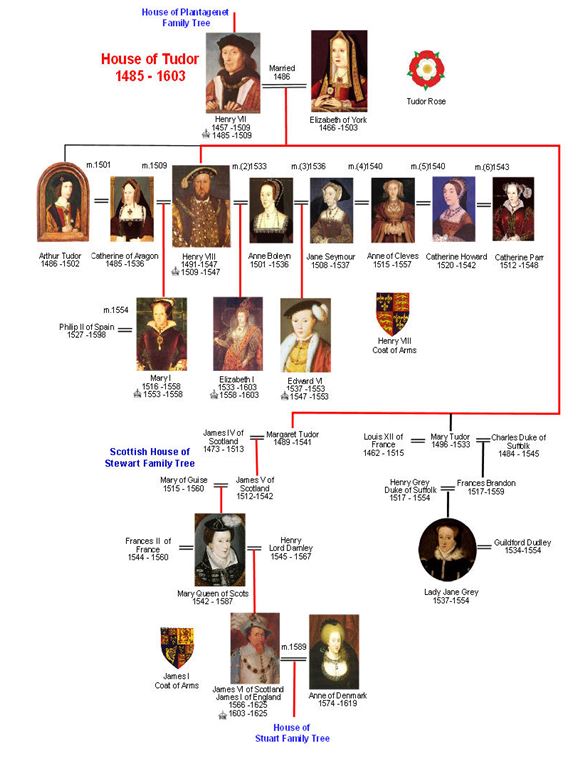
Queen Elizabeth I, unmarried and childless, steadfastly refused to name an heir. The English Secretary of State, Robert Cecil, negotiated secretly with Mary’s (Queen of Scots) son and successor, King James VI of Scotland. His wife, Anne of Denmark, and the king had three children: two sons and a daughter.
During King James I of England’s reign (1603-1625) the European wars of religion were intensifying. Protestants and Catholics were engaged in violent persecution of each other across Europe following the Protestant Reformation. There were all kinds of assassination and murderous plots between the two so-called Christian religions.
The Kings and Queens of the House of Tudor and the House of Stuart included spouses from
(1) Spain,
(2) France,
(3) Scotland,
(4) Denmark,
(5) Portugal,
(6) Holland,
(7) Italy, and
(8) Germany, besides
(9) England.
OTHER TROUBLES
This was just part of the troubles in 17th-century England. During Protestant James I reign, Catholics were disappointed in his non-tolerance of their religion. They tried to blow-up Parliament in 1605, which was known as the Gunpowder Plot or the Jesuit (Catholic Jews) Treason. The explosion, which was discovered shortly before it would have happened, would have assassinated King James I, his wife, Anne, and the heir at the time, Henry Frederick (he died of typhoid fever in 1612 and was never king).
After King James I died, the next king was his son, Charles I. The conflict between the monarchy and Parliament, which led to the English Civil War (1642-1651) and the execution of King Charles I in 1649. This beheading of the king caused the termination of the monarchy. In its place, the establishment of the new government of the English Commonwealth, was headed by Oliver Cromwell. This was fueled by deep divisions over religion, with fear of Catholicism and a struggle between the Church of England and the Puritans.
Besides these major problems, was the devastating epidemic (bubonic plague) that struck London and other parts of England in 1665, killing a sizable portion of the population. Then there was the Great Fire of London in 1666 (four-day fire) that destroyed most of the city. Then there were the rising bread prices that made it harder for many families to survive, as well as the enclosure movement made it difficult for the poor to access land for grazing. Religious and political conflicts drove some of the Protestants to leave England for North America, where they established settlements like Jamestown and Massachusetts. In my opinion, these were God’s judgments against His people for not following His commandments.
After the brief stint with England being the Commonwealth (eleven years), the monarchy was restored to Charles II (son of Charles I). He had been residing in exile in France, the Dutch Republic, and the Spanish Netherlands.
But politics in England remained chaotic. There was the Rye House Plot to murder both Charles II and his brother, James II, in 1683. Things got so bad that Charles II dissolved the English Parliament in 1681 and ruled alone until his death in 1685.
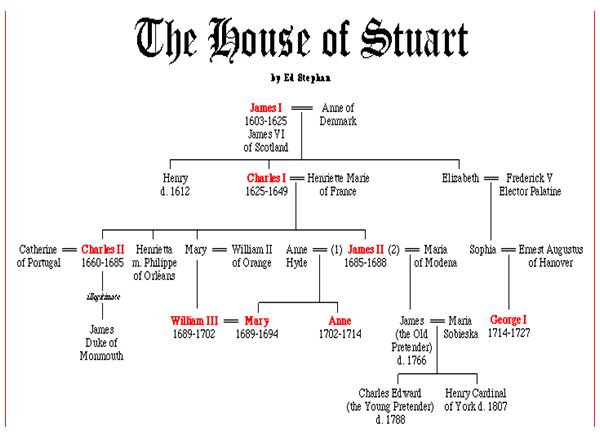
After Charles II’s death, his brother, James II, took the throne. James II was the last Catholic monarch of England, Scotland, and Ireland and his reign is remembered primarily for conflicts over religion. James II wanted to promote Catholicism in Britain, even though it was a more of a Protestant nation. This made many Protestants in the nation very angry.
In the first year of his reign, King James II faced a rebellion led by the Duke of Monmouth, an illegitimate son of Charles II, which was quickly defeated. The duke was executed at the Tower of London, and the rebel recruits were found guilty of treason and sentenced to death or servitude in the West Indies. King James II also put down a rebellion led by Archibald Campbell of Scotland.
King James II then turned his attention to religious policies issuing a Declaration of Indulgence in 1687, which granted religious freedom to Catholics and non-Anglican Protestants. The king’s Declaration of Indulgence was met with opposition from many in England, including the Anglican Church and Parliament. They saw it as an attempt by the king to undermine the Church of England and establish Catholicism as the dominant religion in England. James also had placed many Catholics to positions in the government.
To make matters worse, it was assumed that James’ second wife, Maria Molena of Italy, would never produce an heir. The nation was prepared to wait until the King died, when he would be succeeded by His Protestant daughter (another Mary). But then the King and Queen had a son born on June 10, 1688, and was baptized into the Catholic faith. It was suspected by some that a live infant child had been substituted for a stillborn one, or that the queen even faked her pregnancy.
Nevertheless, within a few weeks, some of the king’s most determined political opponents finally decided enough was enough. They were tired of the fighting between a Catholic royalty or a Protestant royalty that had been going on since 1534. It had been a century and a half, and they decided that Parliament would be the main ruler, and they would appoint a king or queen who would no longer be Catholic. The monarchy would be a figurehead.
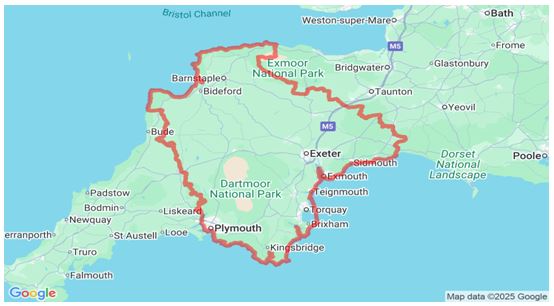
They formally invited William of Orange (Holland) who was married to the former King’s Protestant daughter, Mary, who was 15 years old, to invade Britain and take the throne. Accompanied by a large army, William III landed at Brixham on the Devon coast in November of 1688. Realizing that nearly all his supporters had joined his son-in-law, the king fled for France, thus bringing the Glorious Revolution to an end. James II was captured and brought back to London, but William III let him escape so he would not become a martyr to the Catholic cause.
For a few weeks, there was no sovereign of England. In January 1689, it was agreed that the married couple should be joint sovereigns, with William remaining as sole monarch should his wife die first. It was declared that James II had left the throne “vacant” by fleeing abroad and abdicating the realm’s government. In 1689 Parliament issued the Bill of Rights that: No Roman Catholic shall ever take the throne of England.
Although, in 1690, James II returned to Ireland with an army to regain his throne. He was defeated at the battle of the Boyne and spent the rest of his life in France where he died in 1701.
The crowning of William and Mary marked a significant shift towards a constitutional monarchy, where Parliament’s authority over the monarch was established and the monarch’s power was limited. Parliament gained control over:
- Taxation,
- The Army and Navy,
- Legislation, and
- Laying the foundation for the modern British parliamentary system.
In 1696 the Jacobites, a faction loyal to the deposed James II, plotted to assassinate William III and restore the former Catholic king to the throne. But it failed. The Revolution created the principle of a contract between monarch and people, which if violated meant the monarch could be removed. A key tenet of Jacobitism was that kings were appointed by God, making the post-1688 regime illegitimate.
Queen Mary, died first, followed by King William III a few years later. They were succeeded on the English throne, by Anne, who was a Protestant, and sister to Queen Mary.
But King James II’s son and grandson, James Edward Stuart, the Old Pretender, and Charles Edward Stuart, the Young Pretender, after they grew-up, attempted to supplant King George I and King George II, off the throne with the aid of the French. They both failed miserably in their attempts.
The Old Pretender retired in France, while the Young Pretender eventually died a drunk in Rome the year before George Washington became President of the United States.
Queen Anne died childless. Thus ended the Stuart dream of sitting once more upon the British throne.
It is understandable why most of the founding fathers did not want a monarchy in the United States! The next king would come from the Hanovers of Germany. The first Hanover couldn’t speak English and was very seldom in England while the second king did do much better.
THE GLORIOUS REVOLUTION AND THE MINISTRY OF JOHN KNOX
John Knox received a very high education (master’s degree), and after he graduated, he eventually met iterant preacher George Wishart who was a reformer. But Scotland had not embraced this new form of Christianity and remained strongly Catholic. John Knox provided security for George Wishart as he traveled around Scotland.
But Catholic Cardinal Beaton captured Wishart and charged him with heresy and had him burnt at the stake. Many in Scotland were outraged because they knew that Wishart had done nothing worthy of being burnt to death and Cardinal Beaton was guilty of having many open cases of affairs.
A couple of months later, five men snuck into the house of Beaton and killed him. They then, with their families, took refuge together and asked John Knox to be their preacher.
In his first sermon, he preached from Daniel, chapter seven, that the Pope was the antichrist. His teachings combined his theological learning, Wishart’s reformation teaching, and a distrust of the Catholic leadership. He preached the rejection of the Pope, Mass, purgatory, and stressed the importance of the Bible over church tradition.
But soon, the mother of the Queen of Scotland, Mary Guise, had ordered John Knox to be arrested and put on a galley ship. Her daughter, the young Queen of Scotland, was in France awaiting the day when she would marry the King of France when they were both older. John Knox was a galley slave on a French boat for 19 months and became very ill.
Knox was rescued by the teenage English King, Edward VI, who was once offered to be betrothed to the five-year-old Catholic Queen of Scotland and soon to be Queen of France, but Scotland refused. The young King of England rescued Knox because he thought that he would be the one to make England Protestant better than anyone else.
Knox became the preacher of the English court as they tried to solidify the Reformation in England. But King Edward VI died after two years after he rescued Knox (1553), and then after a nine-day rule by his cousin, the crown was taken over by his half-sister, Mary Tudor, a Roman Catholic. She was called “Bloody Mary” for her execution of close to three hundred Protestants. It was her desire to drive out all the Reformation achievements that had occurred in England.
John Knox fled to Geneva, Switzerland where he met John Calvin. They spent a lot of time together. But was Calvin Jewish?
Eustace Mullins wrote the following:
“We [the Jews] are the Fathers of all Revolutions, even of those which sometimes happen to turn against us [Jews]. We [Jews] are the supreme Masters of Peace and War. We [Jews] can boast of being the Creators of the Reformation! Calvin was one of our [Jews’] children; he was of Jewish descent and was entrusted by Jewish authority and encouraged with Jewish finance to draft his scheme in the reformation (which was to convince Christians it was alright to charge usury and other damnable heresies which are in violation of God’s Laws.”
Geneva had been transformed into a Reformation city and John Knox was interested in repeating this in his nation of Scotland. Knox returned for two years and preached in Scotland but returned to Geneva after the political realm became too dangerous to stay.
Then he wrote his famous booklet, “The First Blast of the Trumpet Against the Monstrous Regimen of Women.” This told that Knox thought that women were not created by God to be leaders of nations. That was against the mother of the Queen of Scotland, Mary Guise, her daughter Queen Mary of Scots and Queen Mary I of England.
But Knox received his best support from one of the other queens. This time it was after Queen Mary I died and the Protestant Queen Elizabeth I of England supported Knox’s role.
Knox gained the support of the lower class of people, while the mother of the Queen of Scotland, Mary Guise, gained the support of the nobles. But Guise died in 1580. And Knox wrote the Confession of Faith of the Kirk [church] of Scotland. But Queen Guise’s daughter, Mary Queen of Scots, returned from France and took the Catholic eucharist with the nobles.
This set the stage for the battle: Catholic or Protestant; Queen Mary or John Knox. They battled for six years, with both trying to convert Scotland. One to get the people to join the Protestant Reformation, the other to remain Catholic. But with Mary’s problems with her marriage and the murder charges against her most recent husband, she eventually fled to England where she was imprisoned by Protestant Elizabeth I.
John Knox was married twice and had children from both marriages. He married first when he was in his twenties (the dates are not sure) and he married a 17-year-old when he was 51 years old. He died six years later when he was 57 years old and had three daughters with her.
King James I was only one year old when he took the throne of Scotland. Knox had the opportunity to teach him to believe the Protestant Reformation, and he led him to help make Scotland a Protestant nation—the Presbyterian Church.
Yikes! What history took place in these two countries right before the formation of the United States of America. The old dragon began his attack on the monarchies and disrupted the nations of Europe into many wars (brother killing brother), with the enlightenment changing the gospel and the politics of the Protestants.
To be continued.
Blessed be the LORD God of Israel.