The Life of David - Part 9
“Uzzah and Ahio”
Copied from the Sermon notes of Pastor Don Elmore
November 22, 2026
Scripture Reading: 2 Samuel 6:1
“Again, David gathered together all the chosen men of Israel, thirty thousand.”
Christians United for Israel, a very pro-Zionist ministry said this in their email on October 22, 2026:
“Hello Friend of Israel[i],
Israel[i] is a nation created by a sovereign act of God. It is:
- A beacon of democracy.
- A light to the nations.
- A global leader in innovation.
- A testament of resilience.
These truths remind us why Israel[i] is so extraordinary—and why it is vital for Christians to understand its significance and stand boldly in its defense….”
There is a lot wrong with this statement from Christians United for Israel under the leadership of Pastor John Hagee. I will give one example: “Israel is a nation created by a sovereign act of God. It is a beacon of democracy.”
This statement is as idiotic as the name of the organization that says it. Their name should be Christians United for Antichrists not Christians United for Israel[i]. For Israel[i] or the Jews are the antichrists. They hate Jesus Christ and say that He is now in Hell. Was today’s Israel[i] or was ancient Israel created to be a beacon of democracy?
Our study of the Life of David showed us that Israel in the Bible was not created by God to be a beacon of democracy. It wasn’t anything close to a democracy. Democracy is a framework of governance built on the principle that power resides with the people. In a democracy, citizens exercise authority either directly or indirectly through elected representatives, ensuring that government decisions reflect the collective will of the people while protecting their individual rights.
Israel was created to be a kingdom. For example, the king ordered certain individuals to be executed, and they were executed right away. There was no Grand Jury, no trial, no waiting around for forty or so years with appeals. Who were their elected representatives ensuring that their individual rights would be protected? The population didn’t have an election on anything.
If the king made a mistake, like king Saul refusing God’s command to kill every one of the Amalekites including king Agag; the priest, Samuel, took over and obeyed what God had said and killed the king (Agag). In another example, when the 12 spies were sent to the Promise Land and gave their verdict: the democratic vote was ten against any invasion to two for an invasion. Democracy lost.
Israel was created with God being their King. It was the people of Israel who requested that He step down and give the kingdom to one of the men of Israel. This He did. God first chose Saul from the tribe of Benjamin and then He chose David. The rest of the kings were to be from the descendants of David.
Back to our study on David:
This was the fourth time David had gathered the men chosen to be in the army of Israel since he became king. First, it was to fight the Jebusites and capture Jerusalem and then it was in two consecutive battles against the Philistines. The size of David’s army had increased 50 times; from 600 to 30,000. But they were not going to fight an enemy of Israel on this call up; they were going to make the capital city also the religious center of the nation.
2 Samuel 6:2-5:
2) “And David arose, and went with all the people that were with him from Baale of Judah, to bring up from thence the ark of God, whose name is called by the name of the LORD of hosts that dwelleth between the cherubims.
3) And they set the ark of God upon a new cart, and brought it out of the house of Abinadab that was in Gibeah: and Uzzah and Ahio, the sons of Abinadab, drave the new cart.
4) And they brought it out of the house of Abinadab which was at Gibeah, accompanying the ark of God: and Ahio went before the ark.
5) And David and all the house of Israel played before the LORD on all manner of instruments made of fit wood, even on harps, and on psalteries, and on timbrels, and on cornets, and on cymbals.
So, King David had 30,000 of his soldiers plus the priests, plus some of the people of the city to go out and fetch the Ark of the Covenant that had been missing from its rightful place for over 40 years. Thirty thousand soldiers plus a host of singers, dancers, and musicians were accompanying the King on bringing back the Ark.
Have you ever thought what the life of the Israelites was like when the tabernacle and the Ark of the covenant were separated? How could they keep the Day of Atonement once a year on the tenth day of the seventh month in the Hebrew calendar, when the mercy seat on the Ark of the Covenant was not in the Holy of Holies? In fact, it was not even in the tabernacle. In addition, what was the spirituality of the Israelites when all but one of their priests were killed by order of their king (Saul)? The Bible doesn’t inform us, but it must have been horrific.
But there was, at least one Israelite who was deeply disturbed over the dishonor of the LORD’s throne, His worship system, and His nation. David, from the days of his youth, was dedicated to making Jerusalem the place where the LORD God would dwell.
Psalm 132:1-5, 13:
1) “LORD, remember David, and all his afflictions:
2) How he sware unto the LORD, and vowed unto the mighty God of Jacob;
3) Surely I will not come into the tabernacle of my house, nor go up into my bed;
4) I will not give sleep to mine eyes, or slumber to mine eyelids,
5) Until I find out a place for the LORD, an habitation for the mighty God of Jacob.
13) For the LORD hath chosen Zion; He hath desired it for His habitation.”
David would do this by either moving the old tabernacle to Jerusalem or building a new tabernacle or a new Temple in Jerusalem. He then would set the Ark of the Covenant in the Holy of Holies, where it should have been, but hadn’t for over a half-century.
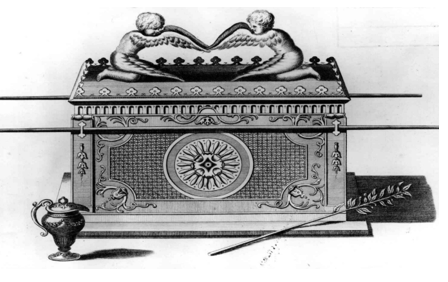
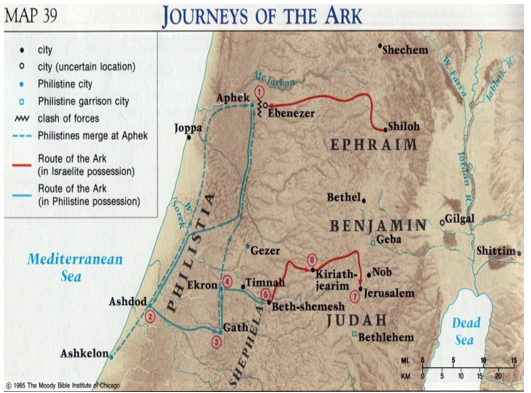
But first, we should review the short history of where the Ark was located after the Israelites entered the Promised Land and where it went from there. The Ark has been lost for many centuries, but was estimated to weigh between 300 to 600 pounds with the mercy seat, the throne of God, on top of it. Inside the Ark were the stone tablets with the Ten Commandments written on them, Arron’s rod that budded, and a jar of manna.
When the Israelites entered the Promised Land, the Ark and the Tabernacle were located at the town of Bethel.
During the time of the Judges, the Arkand tabernacle were moved to Shiloh.
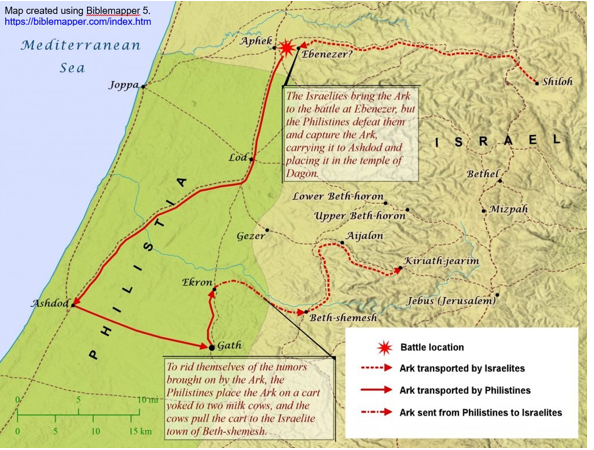
Just prior to Samuel’s ministry, the Ark was carried into battle near Aphek (Ebenezer), but was captured by the Philistines, who took it to Ashdod and placed it in the temple of Dagon. When the Ark was there, the false god Dagon fell two times and broke some of his features. Besides the destruction of their god’s statue, tumors were brought on to the Philistine citizens by the Ark.
As a result, the Philistines sent the Ark to Gath and Ekron before they attempted to reduce their suffering of tumors by placing the Ark on a cart. The cart was pulled by two nursing milk cows, and these two bovines pulled the cart to the Israelite town of Beth-shemesh. While the Ark was at Beth-shemesh, seventy priests were killed when they looked into the Ark (not 50,070; a mistranslation of 1 Samuel 6:19). The Ark remained here for several weeks.
The Israelite priests then brought the Ark to Kiriah-jearim where it was placed in the house of Abinadab, a Kohath Levite.
King Saul begins to reign.
Nob, the city of priests, is destroyed by Saul, and the tabernacle and altar are moved from Nob to Gibeon.
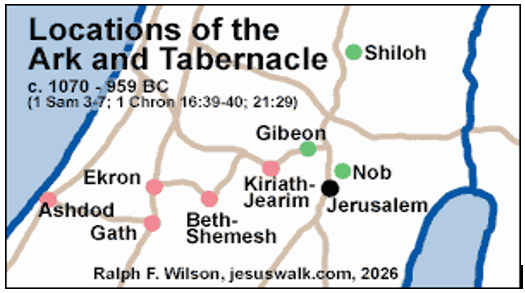
The Ark was then moved by Kohath Levites after twenty years, to Gibeah.
David reigned over Judah for 7 1/2 years and then over all Israel for 32 ½ years. He takes Jerusalem from the Jebusites and makes it his capital city.
About a year later, David went to bring the Ark to Jerusalem from Gibeah. Uzzah, the son of Abinadab is killed when he touches the Ark.
David then has the Kohath Levites carry the Ark to the house of Obededom for three months (the Bible does not give us the exact location of his house, but it was near the route between Kiriath-jearim and Jerusalem).
After the house of Obededom is blessed, David successfully uses the Kohath Levites to carry on their shoulders the Ark of the Covenant to the tent of the tabernacle in Jerusalem. David, along with many of the priests, play instruments, sing, dance and celebrate the return of the Ark to the city of Jerusalem.
Who was Abinadab? He was a resident of Kiriath-jearim whose home sheltered the Ark of the Covenant for 20 years. He was a Kohath Levite who had three sons: Eleazar, Uzzah, and Ahio. But there is a controversy among Bible scholars about whether Abinadab and his three sons, were Levites or not. Josephus, in his ancient history book, Antiquities of the Jews, says that they were Levites. The Bible is silent on this question but gives clues that they were Levites.
Some of these clues are that his eldest son Eleazar was consecrated to guard the Ark, and his other sons Uzzah and Ahio, drove the cart when King David tried to move the Ark to Jerusalem. Uzzah was struck dead for touching the Ark, which violated God’s command.
When they brought the Ark out of the house of Abinadab, I believe that the Kohath Levites carried it on poles, like they should have and then placed it on a new cart, which was wrong. Uzzah and Ahio drove the cart with the Ark on the backside of the cart. This was wrong. It was like what the Philistines had done when they got rid of the Ark—they put it on a cart but with no drivers on it—it was driven by two nursing cows.
David led an instrumental band which played before the LORD. It was a grandiose occasion. Can you imagine all the people; over 30,000? But something happened that brought fear to David.
2 Samuel 6:6, 7:
6) “And when they came to Nachon’s threshing floor, Uzzah put forth his hand to the ark of God, and took hold of it; for the oxen shook it.
7) And the anger of the LORD was kindled against Uzzah; and God smote him there for his error; and there he died by the ark of God.”
David made a BIG mistake that would cost the life of young Uzzah. David did not ask God what he should do. He asked his military leaders and advisers. His actions were brash and impulsive and it had consequences.
Numbers 4:15a:
15) “And when Aaron and his sons have made an end of covering the sanctuary, and all the vessels of the sanctuary, as the camp is to set forward; after that, the sons of Kohath shall come to bear it: but they shall not touch any holy thing, lest they die…” I believe that Uzzah was a Kohath Levite, a son of Kohath who should have known better than to touch the holy Ark of the Covenant at any time. The Levites were divided into three companies: (1) Kohathites, (2) Gershonites, and (3) Merarites.
I believe that Uzzah was a Kohath Levite, a son of Kohath who should have known better than to touch the holy Ark of the Covenant at any time. The Levites were divided into three companies: (1) Kohathites, (2) Gershonites, and (3) Merarites.
The Kohathites were responsible for caring for the most sacred sanctuary objects: The Ark of the Covenant, the table of showbread, the lampstand, and the altars. They were not to use any wagons or carts. The other two companies of Levites were to use wagon or carts, as they were responsible for the heavy structural framework like boards, crossbars, pillars, bases, pegs, cords, fabrics, curtains, hangings, coverings and ropes of the sanctuary (Numbers 7:8-9).
God had given strict instructions for moving the Ark. It was to be carried by the priests (Kohath) by putting poles through the rings on the sides of the ark. David probably reasoned that the mileage to Jerusalem was too far to carry the Ark, so he had the Ark put on a new cart. The oxen stumbled and young Uzzah reached out to stabilize it, but the LORD’s anger burned against Uzzah and he died.
2 Samuel 6:8-11:
8) “And David was displeased, because the LORD had made a breach upon Uzzah: and he called the name of the place Perezuzzah [breach of Uzzah] to this day.
9) And David was afraid of the LORD that day, and said, How shall the ark of the LORD come to me?
10) So David would not remove the ark of the LORD unto him into the city of David, but David carried it aside into the house of Obededom the Gittite.
11) And the ark of the LORD continued in the house of Obededom the Gittite three months: and the LORD blessed Obededom and all his household.”
With the sudden death of Uzzah, the Ark was, I believe, carried with poles by the Kohath Levites to the house of Obededom the Gittite. David would wait and see what happened when the Ark was in Obededom’s house. Would he be blessed?
Now who was Obededom the Gittite?
His name suggests that he was an Edomite, but was he? I don’t think so, for the following reasons.
Obededom is called a “Gittite” meaning he was either from the Philistine city of Gath or from Gath-Rimmon (a Levitical city), city in the tribe of Dan on the coastal plain near Joppa. I believe he was from the latter.
Why would David put the Ark in the home of an uncircumcised enemy of God? The Ark was Israel’s and not any other nations. We saw what happened when the Ark was captured by the Philistines. They voluntarily shipped it back to Israel.
I believe that he was a Kohath Levite and a temple musician or gatekeeper. Later, Obededom and his many sons and descendants (62 in total) served as doorkeepers, gatekeepers, and musicians for the Temple in Jerusalem. Obededom and his sons could not do these jobs in the tabernacle or Temple unless they were Levites.
Psalm 84:10b:
10b) “I had rather be a doorkeeper in the house of my God, than to dwell in the tents of wickedness.”
But after three months, David heard that Obededom was getting blessed and he wanted that for Jerusalem. It is obvious in the three months of reflection that David had repented and done some research, because this time, as we read in 1 Chronicles 15:4-10, he gathers 862 priests and Levites who have been consecrated before the Lord, rather than his army and he instructs them to carry the ark. They were also musicians, singers and gatekeepers.
2 Samuel 6:12-15:
12) “And it was told king David, saying, The LORD hath blessed the house of Obededom, and all that pertaineth unto him, because of the ark of God. So David went and brought up the ark of God from the house of Obededom into the city of David with gladness.
13) And it was so, that when they that bare the ark of the LORD had gone six paces, he sacrificed oxen and fatlings.
14) And David danced before the LORD with all his might: and David was girded with a linen ephod.
15) So David and all the house of Israel brought up the ark of the LORD with shouting, and with the sound of the trumpet.”
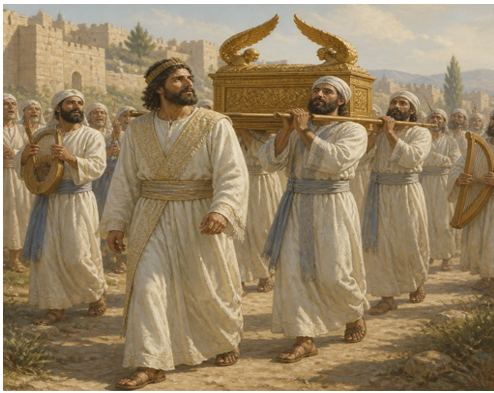
Notice their caution; they took just six steps and stopped, and when everything seemed okay, David sacrificed a bull and a fattened calf. But was this just six steps in the beginning or was it every six steps of the journey?
What a minute. If you strictly interpret this scenario as stopping to sacrifice an ox every six steps for the entire journey, it would take over several months to complete the 5-mile march.
Notice what the diamondtree.wordpress.com and many other commentators say:
“The journey of the Ark’s return is fascinating but the part I [Gareth Lowe, the author of the website] want to focus on is that David sacrificed a bull and fattened calf every 6 steps of the way! When those who were carrying the ark of the LORD had taken SIX STEPS, he SACRIFICED a BULL and a FATTENED CALF.”
If Israel physically built an altar and sacrificed an ox every single time they progressed six steps, the logistics quickly multiply and show that this is a misinterpretation:
- Total Steps: An average human step is about 2.5 feet. A 5-mile journey is 26,400 feet, which equals roughly 10,560 steps.
- Total Sacrifices: Stopping every 6 steps means stopping 1,760 times to perform a ritual sacrifice.
- The Time Breakdown:
- Walking Time: Just walking 5 miles takes about 1.75 hours.
- Sacrifice Time: Even if a highly efficient team could build an altar, process and sacrifice an ox in an impossibly fast 30 minutes per stop, 1,760 stops would require 880 extra hours.
- Total Duration: If the team slept 8 hours a night, the 5-mile journey would stretch well over a couple of months, which it didn’t. It only took a part of one day.
Most modern theologians and ancient historians agree that this literal calculation is a misinterpretation of the text. Instead, it is my opinion and others that the bearers walked the initial six paces safely to verify that they would not be struck down by God (following a previous failed attempt where Uzzah died from touching the Ark).
Once they successfully cleared the first six paces without incident, they stopped to sacrifice a single ox and fattened calf as a thank-you ritual and then marched the rest of the five miles normally. Under this interpretation, it would take only about 3 to 4 hours for the entire journey.
Once the Ark made the trip to Jerusalem without incident, the party began. David took off his royal robe as king and put on a priestly garment. David danced before the LORD with all his might. He probably spun and stumbled, laughed and continued. He danced with total abandon, he was not concerned with public opinion, he was worshipping the Lord the holy God of Israel.
2 Samuel 6:16:
16) “And as the ark of the LORD came into the city of David, Michal Saul’s daughter looked through a window, and saw king David leaping and dancing before the LORD, and she despised him in her heart.”
Instead of leading the women to meet the men as they returned, Michal despised David in her heart as she sat in her room and looked out the window.
2 Samuel 6:17-19:
17) “And they brought in the ark of the LORD, and set it in his place. In the midst of the tabernacle that David had pitched for it: and David offered burnt offerings and peace offerings before the LORD.
18) And as soon as David had made an end of offering burnt offerings and peace offerings, he blessed the people in the name of the LORD of hosts.
19) And he dealt among all the people, even among the whole multitude of Israel, as well to the women as men, to every one a cake of bread, and a good piece of flesh, and a flagon of wine. So all the people departed every one to his house.”
David brought the Ark into the midst of the new tabernacle that he had made in Jerusalem and offered burnt and peace offerings. In addition, David remembered all the host of Israel, and he gave to them (both men and women) the flesh of the burnt sacrifices plus bread and wine.
2 Samuel 6:20-23:
20) “Then David returned to bless his household. And Michal the daughter of Saul came out to meet David, and said, How glorious was the king of Israel to day, who uncovered himself to day in the eyes of his handmaids of his servants, as one of the vain fellows shamelessly uncovereth himself!
21) And David said unto Michal, It was before the LORD, which chose me before thy father, and before all his house, to appoint me ruler over the people of the LORD, over Israel: therefore will I play before the LORD.
22) And I will yet be more vile than thus, and will be base in mine own sight: and of the maidservants which thou hast spoken of, of them shall I be had in honour.
23) Therefore Michal the daughter of Saul had no child unto the day of her death.”
It happened once again. David was joyous. He had finally had the Ark of the Covenant in the new tabernacle in his city. The people were with him, and he fed all his people with the sacrifices that were made. He blessed the people and their homes. And then he returns home and is met with harsh criticism from his first and eighth(?) wife. Verse twenty-three tells us of whose side the LORD God of Israel was on.
But the Bible is silent on what his other wives said. What did they say? I would assume that they gave complimentary replies to David and not criticisms. Was Michal the only person who criticized David? It seems like that was true.
Jerusalem was now both the political and religious city of Israel. The Ark was now in the same city as the king. Things were starting to come together as Israel became a United Kingdom after many years of being divided.
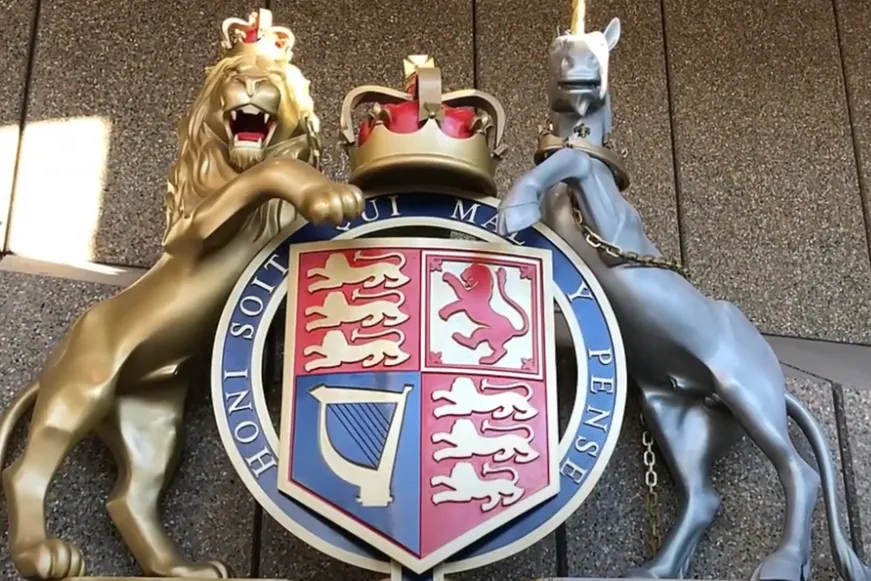
Most commentators who say that the throne of David does not exist, now also deny the “stone of Scone” or Jacob’s pillow, carried from the Holy Land through Egypt, Spain, Ireland, Scotland, and England. The stone is on permanent display at the Perth Museum in Perth, Scotland, having moved there from Edinburg Castle. It will temporarily be returned to Westminster Abbey in London only for future British monarch coronations. Why is that?
The commentators also will deny that Jeremiah took two daughters of King Zedekiah (Scota and Tea Tephi); one to Spain and other the other to Ireland. Tea Tephi married an Irish king (Eochaidh) which united the royal lines of Judah, and Scota married a Spanish king.
The marriage of Tephi and Eochaidh not only established a new dynasty over Israelite Ireland, but it also resolved an ancient breach or division in the tribal family of Judah. This breach, which took place shortly before Jacob relocated his family to Egypt, resulted from the unusual circumstance surrounding the birth of Judah’s and Tamar’s twins, Zarah and Pharez.
When the time came for Tamar to give birth, her midwife discovered she was carrying twins. Surprisingly, one of the infants put forth its hand, to which the midwife promptly tied a red string, saying, “This one came out first.” Assuming that it would be born first, the midwife was simply trying to keep track of which baby was the firstborn. But the child withdrew his hand, and the other baby was born first.
To this unexpected turn of events, the midwife declared, “What a breach you have made for yourself!” Fittingly, this male child was named Pharez, meaning breach. His twin brother who had put forth his hand was named Zarah. One must wonder why this story is included in Scripture, for this breach is never again mentioned. What purpose could there be to these remarkable events?
The unusual circumstances surrounding the twins’ birth no doubt caused some controversy as to which child was truly the firstborn. At stake were the rights of the firstborn, a prominent aspect of Hebrew culture. In my opinion, Shelah, the living first born of Judah, is not considered, because he was illegitimate.
Tea Tephi was the daughter of King Zedekiah of Judah. She is traced through the line of Pharez (the elder twin), which connects directly to King David and the royal house of Judah. King Eochaidh is associated with the line of Zerah (the younger twin), whose descendants also go back to King David, and they migrated westward to Ireland. This marriage solved the breach of the twins; they were now one.
2 Samuel 7:1-3:
1) “And it came to pass, when the king sat in his house, and the LORD had given him rest round about from all his enemies;
2) That the king said unto Nathan the prophet, See now, I dwell in an house of cedar; but the ark of God dwelleth within curtains.
3) And Nathan said to the king, Go, do all that is in thine heart; for the LORD is with thee.”
David lived in a house of cedar. Does anyone here remember who built David his mansion to live in? It came from the king of Tyre. King Hiram built it for David. He supplied the materials, carpenters, masons, cedars, stones, etc. to build him this house shortly after he became king of Israel. David lived in a marvelous cedar mansion!
The Ark of the Covenant, with the mercy seat located on top of it, was housed in a tent. David lived in a cedar mansion; God lived in a tent. David thought it should be reversed. David thought that the Ark should be housed in a place that was better than what he lived in. He wanted to build a magnificent Temple and put the Ark in there. What would God say about this plan of David’s?
2 Samuel 7:4-12:
4) “And it came to pass that night, that the word of the LORD came unto Nathan, saying,
5) Go and tell my servant David, Thus saith the LORD, Shalt thou build Me an house for Me to dwell in [Thou shalt not build Me a house for Me to dwell in, Septuagint]?
6) Whereas I have not dwelt in any house since the time that I brought up the children of Israel out of Egypt, even to this day, but have walked in a tent and in a tabernacle.
7) In all the places wherein I have walked with all the children of Israel spake I a word with any of the tribes of Israel, whom I commanded to feed my people Israel, saying, Why build ye not Me and house of cedar?
8) Now therefore so shalt thou say unto my servant David, Thus saith the LORD of hosts, I took thee from the sheepcote, from following the sheep, to be ruler over my people, over Israel.
9) And I was with thee whithersoever thou wentest, and have cut off all thine enemies out of thy sight, and have made thee a great name, like unto the name of the great men that are in the earth.
10) Moreover I will appoint a place for my people Israel, and will plant them, that they may dwell in a place of their own, and move no more: neither shall the children of wickedness afflict them any more, as beforetime.
11) And as since the time that I commanded judges to be over my people Israel, and have caused thee to rest from all thine enemies, Also the LORD telleth thee that He will make thee an house[that thou shalt build a house to Him, Septuagint].
12) And when thy days be fulfilled, and thou shalt sleep with thy fathers, I will set up thy seed after thee, which shall proceed out of thy bowels, and I [the LORD God of Israel] will establish his kingdom.”
We are getting to the place where they is a lot of disagreement among Biblical scholars over what the LORD God said to David regarding his request to build Him a house.
Here is what I believe:
2 Samuel 7:13-15:
13) “He [Solomon, David’s son] shall build an house for My name [Temple], and I will stablish the throne of his[Solomon’s] kingdom for ever.
14) I will be his [Solomon’s] father, and he[Solomon] shall be My son. If he [Solomon] commit iniquity, I will chasten him with the rod of men, and with the stripes of the children of men:
15) But My [the LORD God of Israel] mercy [lovingkindness] shall not depart away from him [Solomon], as I took it from Saul, whom I put away before thee.”
There is that word again. In the Hebrew the word is chesed and it appears over 250 times with different interpretations of the word. In verse fifteen it connects with the covenant made with David.
God told David that one of his sons [Solomon] would have the “lovingkindness” because of the covenant made between Himself and David. David would always have a descendant who was ruling over the House of Israel.
Jeremiah 33:17:
17) “For thus saith the LORD; David shall never want a man to sit upon the throne of the house of Israel:”
In about a half a century, the House of Israel separated from the House of Judah once again. For a little more than 200 years, the house of Israel existed. They had nineteen kings and none of them were of the house of David. Jeremiah makes a prediction that the house of Israel will have descendants of the house of David sitting on their thrones! It would be a complete reversal.
2 Samuel 7:16, 17:
16) “And thine [David’s] house and thy[David’s] kingdom shall be established for ever before thee: thy [David’s] throne shall be established for ever.
17) According to all these words and according to all this vision, so did Nathan speak unto David.”
All three things are eternal:
- David's House,
- David's Kingdom, and
- David's Throne.
Almost all Christian commentaries say that all three were done away when Jerusalem was taken by Nebuchanezzar and not one of them has ever been restored. They say that the throne and crown were to be removed from Zedekiah and remain removed until Jesus Christ returns to take the throne of David again. But I disagree with this interpretation. I will give my view in the next sermon, part 10 of this series.
How is Israel doing now? The political scene is a little bit better, but the religious situation is starting to make a comeback. Israel couldn’t hold many of their special holy days with the Ark not in the right place; for example, the Day of Atonement. But David wants to bring the Ark back into the tabernacle and he even has plans for the Ark to go into the Temple of God.
We will find out what happens in Lesson number ten..
Blessed be the LORD God of Israel.